answer.
Ask question
Login Signup
Ask question
All categories
  • English
  • Mathematics
  • Social Studies
  • Business
  • History
  • Health
  • Geography
  • Biology
  • Physics
  • Chemistry
  • Computers and Technology
  • Arts
  • World Languages
  • Spanish
  • French
  • German
  • Advanced Placement (AP)
  • SAT
  • Medicine
  • Law
  • Engineering
andrew11 [14]
2 years ago
12

Determine the identity of each element based upon the following data.

Chemistry
1 answer:
svet-max [94.6K]2 years ago
3 0

Ionization energy is defined as the energy required to remove the electron requiring the least amount of energy in the atom.

When valence electrons are being removed, the ionization energy will be quite low. However, once there is a spike in the number (In this case, IE6 starts at 8496 and jumps to 27110 in IE7), that indicates that a core electron is being removed.

Since there are 6 ionization energies that are relatively low before the spike in energy in IE(7), it can be inferred that this period 3 element has 6 valence electrons.

Because of this, we simply have to go from left to right in period 3 six times. (Make sure to skip over the transition metals if you're counting past period 3, since their valence electrons vary)

Sulfur is the mystery element

Good luck! If you have any questions, just ask! :))

You might be interested in
Arkeisha and Rodney are having a discussion about the correct use of the term "battery acid." Arkeisha insists that an alkaline
mote1985 [20]
Arkeisha is correct because the fluid in an alkaline battery has a ph between 7.1 and 14.0
8 0
2 years ago
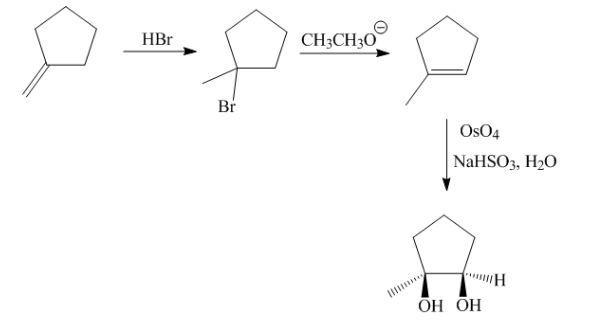
The target diol is synthesized in one step from 1-methylcyclopentene, but your lab partner exhausted the supply of that alkene.
andrezito [222]

Answer:

The reagents are CH_{3}CH_{3}O^{-},OsO_{4},NaHSO_{3}and H_{2}O.

Explanation:

1-Methylenecyclopentene is treated with HBr form 1-bromo-1-methylcyclopentane, which is treated with strong base ethoxide ion and forms 1-methylcyclopent-1-ene.

This alkene is treated with osmium tetraoxide in the presence of sodium bisulfite to form target product.

The chemical reaction is as follows.

4 0
2 years ago
while your finger is still pushing the coin, there are four forces acting on the coin: what are they?
Viefleur [7K]
Is there some kind of diagram? how is your finger pushing the coin, and where? It may be:
1)friction against a surface
2)push from the finger
3)gravity
4)air resistance behind the coin
8 0
2 years ago
Read 2 more answers
Insoluble sulfide compounds are generally black in color. Which of the following combinations could yield a black precipitate? C
Lubov Fominskaja [6]

Answer:

Li₂S(aq) + Pb(NO₃)₂(aq)

2 K₂S(aq) + Sn(NO₃)₄(aq)

Explanation:

For these reactions, the products are:

1. Na₂S(aq) + 2 KCl(aq) → K₂S + 2 NaCl

2. Li₂S(aq) + Pb(NO₃)₂(aq) →  PbS + 2 Li(NO₃)

3. Pb(ClO₃)₂(aq) + 2 NaNO₃(aq) → Pb(NO₃)₂ + 2 Na(ClO₃)

4. AgNO₃(aq) + KCl(aq) → AgCl + KNO₃

5. 2 K₂S(aq) + Sn(NO₃)₄(aq) → SnS₂ + 4 KNO₃

K₂S is a soluble sulfide that, in solid state, is white. As K has a low electronegativity, the relative polar bond K-S allows its dissolution in water.

PbS is a black and insoluble compound. As Pb electronegativity is higher than K electronegativity, The bond is less-polar and its dissolution will not be allowed.

For the third reaction, all nitrates are soluble and Na(ClO₃) is also a very soluble compound.

AgCl is an insoluble white compound.

As Sn electronegativity is high, the solubility of this compound is very low. Also, this compound is black!

Thus, combinations could yield a black precipitate are:

Li₂S(aq) + Pb(NO₃)₂(aq)

2 K₂S(aq) + Sn(NO₃)₄(aq)

I hope it helps!

6 0
2 years ago
How much heat is lost when changing 65 g of water vapor (H2O) at 421 K to ice at 139 K?
poizon [28]

The heat change will be

Moles of water = mass / Molar mass = 65/ 18 = 3.61 mol

specific heat of ice =2.09J /g C

specific heat of water = 4.184 J/g C

Specific heat of vapour= 2.01 /g C

Heat of fusion = 3.33X10⁵ J /kg = 333 J /g

Heat of vaporization = 2.26 X10⁶J/kg = 2260J/g

Q1 = heat change when vapours get cooled to 373.15 K

Q2 = heat change when vapours get converted to liquid water

Q3 = heat change when liquid water cools to 273.15 K

Q4= heat change when liquid water freezes to ice

Q5= heat change when ice cools from 273.15K to 139 K

Q1= mass of water X specific heat of vapours X change in temperature

Q1 = 65 X 2.01 /g C X (421-373.15) = 6251.60 J = 6.252 kJ

Q2 = heat of vaporization X mass = 2260 X 65 = 146900 = 146.9 kJ

Q3 = mass X specific heat of water X change in temperature =

Q3 = 65 X 4.184 X (373.15-273.15) = 65 X 4.184 X 100 = 27196 J = 27.196kJ

Q4 = heat of fusion X mass =333X65 = 21645 J = 21.645 kJ

Q5 =  mass X specific heat of ice X change in temperature

Q5 = 65 X 2.09 X (273.15-139) = 18224.3 J = 18.224 kJ

Total energy = 6.252 +146.9+27.196+ 21.645+ 18.224 = 220.217

As this is energy released so it will be expressed in negative

-220.217

from the given options the correct answer will be -219.4 kJ

The answer is little different as the reference values of specific heats or enthalpy may vary.

3 0
2 years ago
Other questions:
  • What is the predicted order of first ionization energies from highest to lowest for beryllium, calcium, magnesium, and strontium
    5·2 answers
  • What volume (ml) of a 0.2450 m koh(aq) solution is required to completely neutralize 55.25 ml of a 0.5440 m h3po4(aq) solution?
    9·1 answer
  • If 35.50 cm3 of a NaOH solution are required for the complete neutralization of a 25.00cm3 sample of 0.200mol dm-3 H2SO4, what i
    5·1 answer
  • ben helps his dad make chicken soup. their recipe makes 15 cups of soup. if they each eat 2 cups and freeze the rest will the le
    5·1 answer
  • What is the number of moles in 15.0 g AsH3?
    12·1 answer
  • The electron in a ground-state H atom absorbs a photon of wavelength 97.20 nm. To what energy level does it move?
    13·1 answer
  • Choose the nonmetallic elements from the list. Check all that apply yttrium: oxygen: boron: polonium: argon: gallium: carbon:
    11·2 answers
  • How do genetic factors influence the formation of "dead zones” around creosote bushes?
    8·2 answers
  • PLEASE HELP! WILL DO BRAINLIEST! What do scientists call all of the compounds that contain carbon and are found in living things
    7·2 answers
  • NaOH+HCL=NaCL+H2O
    12·1 answer
Add answer
Login
Not registered? Fast signup
Signup
Login Signup
Ask question!