answer.
Ask question
Login Signup
Ask question
All categories
  • English
  • Mathematics
  • Social Studies
  • Business
  • History
  • Health
  • Geography
  • Biology
  • Physics
  • Chemistry
  • Computers and Technology
  • Arts
  • World Languages
  • Spanish
  • French
  • German
  • Advanced Placement (AP)
  • SAT
  • Medicine
  • Law
  • Engineering
vodka [1.7K]
2 years ago
9

The target diol is synthesized in one step from 1-methylcyclopentene, but your lab partner exhausted the supply of that alkene.

Fortunately, you have plenty of isomers (C6H10) on hand from which to synthesize 1-methylcyclopentene and, ultimately, the diol. Provide the missing reagents and organic structures needed to most efficiently produce the target product.

Chemistry
1 answer:
andrezito [222]2 years ago
4 0

Answer:

The reagents are CH_{3}CH_{3}O^{-},OsO_{4},NaHSO_{3}and H_{2}O.

Explanation:

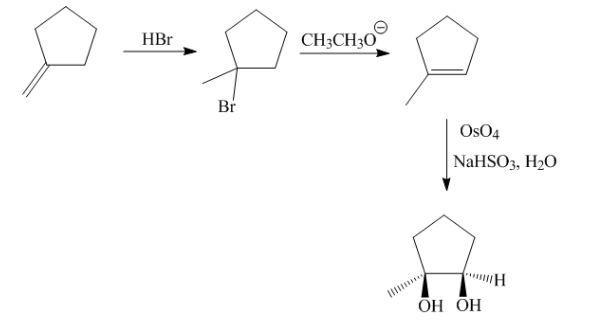
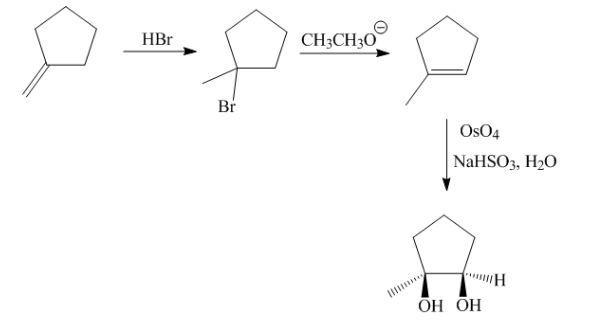
1-Methylenecyclopentene is treated with HBr form 1-bromo-1-methylcyclopentane, which is treated with strong base ethoxide ion and forms 1-methylcyclopent-1-ene.

This alkene is treated with osmium tetraoxide in the presence of sodium bisulfite to form target product.

The chemical reaction is as follows.

You might be interested in
Chloe wants to lighten the color of her dark hair, which will require the use of both haircolor and hydrogen peroxide. hydrogen
bearhunter [10]

The answer is developer .

Chloe wants to lighten the color of her dark hair, which will require the use of both hair color and hydrogen peroxide.

Hydrogen peroxide (H₂O₂) is an example of a most commonly used developer in hair color.

Hydrogen peroxide lighten hair color, as it can dissolve darker pigment. According to the  natural hair color and the length of time a person will leave hydrogen peroxide on  hair,  hair can turn somewhere on the color spectrum between caramel, orange and yellow.


7 0
2 years ago
What is the net cell reaction for the iron-silver voltaic cell?
RSB [31]
The net cell reaction for the iron-silver voltaic cell would be:

<span>3Ag+ + Fe --------> 3Ag + Fe3+
</span>
wherein it comes from the reaction of the cathode and the anode:

<span>Ag+ + e- -------> Ag, for the cathode and;
</span>
<span>Fe -------> Fe3+ + 3e-, for the anode
</span>
When both equations would be multiplied, the it would now yield the balanced net reaction as stated above.
4 0
2 years ago
How many sulfur atoms would be present in 41.8 moles of sulfur?
Montano1993 [528]

Answer:

2.51 x 10*25 atoms

6 0
2 years ago
The vapor pressure of diethyl ether (ether) is 463.57 mm Hg at 25 °C. A nonvolatile, nonelectrolyte that dissolves in diethyl et
Molodets [167]

Answer:

Explanation:

The vapor pressure of diethyl ether (ether) is 463.57 mm Hg at 25 °C. A nonvolatile, nonelectrolyte that dissolves in diethyl ether is aspirin. Calculate the vapor pressure of the solution at 25 °C when 14.88 grams of aspirin, C9H8O4 (180.1 g/mol), are dissolved in 269.2 grams of diethyl ether. diethyl ether = CH3CH2OCH2CH3 = 74.12 g/mol.

mol of C4H10O = mass of C4H10O / molar mass of C4H10O

= 242.1 g / 74.12 g/mol

= 3.266 mol

mol of C9H8O4 = mass of C9H8O4 / molar mass of C9H8O4

= 10.33 g / 180.1 g/mol

= 0.05736 mol

mole fraction of C4H10O,

X = mole of CHH1O0 / total mol

= (3.266)/(3.266 + 0.05736)

= 0.9827

now use:

P = Po*X

P = 463.57 * 0.9827

= 455.6 mm Hg

3 0
2 years ago
Which response includes all of the following processes that are accompanied by an increase in entropy?
dlinn [17]

Answer:

1 and 3.

Explanation:

The entropy measures the randomness of the system, as higher is it, as higher is the entropy. The randomness is associated with the movement and the arrangement of the molecules. Thus, if the molecules are moving faster and are more disorganized, the randomness is greater.

So, the entropy (S) of the phases increases by:

S solid < S liquid < S gases.

1. The substance is going from solid to gas, thus the entropy is increasing.

2. The substance is going from a disorganized way (the molecules of I are disorganized) to an organized way (the molecules join together to form I2), thus the entropy is decreasing.

3. The molecules go from an organized way (the atom are joined together) to a disorganized way, thus the entropy increases.

4. The ions are disorganized and react to form a more organized molecule, thus the entropy decreases.
7 0
2 years ago
Other questions:
  • At 1 atm, how many moles of co2 are released by raising the temperature of 1 liter of water from 20∘c to 25∘c? express your answ
    11·2 answers
  • If you perform the experiment described in investigation #15 by mixing 10 g of glue with 13 g of water and 8 g of sodium borate
    7·1 answer
  • How can we increase the rate of collisions between the reactants in this reaction?
    10·2 answers
  • 5. Given the cell notation Cu(s)|Cu2+(aq)||Ag+(aq)|Ag(s), what is the half-reaction that occurs at the anode?
    5·2 answers
  • Liquid X is known to have a higher surface tension and higher viscosity than Liquid Y Use these facts to predict the result of b
    12·1 answer
  • A 0.944 M solution of glucose, C6H12O6, in water has a density of 1.0624 g/mL at 20∘C. What is the concentration of this solutio
    10·1 answer
  • Which of these was not proposed by john dalton in 1805?
    13·1 answer
  • Which procedure cannot be performed on a hot plate, requiring a Bunsen burner instead
    6·1 answer
  • When the following equation is balanced, the coefficients are __________. Al(NO3)3 + Na2S → Al2S3 + Na(NO3)
    11·1 answer
  • In a laboratory setting, concentrations for solutions are measured in molarity, which is the number of moles per liter (mol/L).
    15·2 answers
Add answer
Login
Not registered? Fast signup
Signup
Login Signup
Ask question!
