answer.
Ask question
Login Signup
Ask question
All categories
  • English
  • Mathematics
  • Social Studies
  • Business
  • History
  • Health
  • Geography
  • Biology
  • Physics
  • Chemistry
  • Computers and Technology
  • Arts
  • World Languages
  • Spanish
  • French
  • German
  • Advanced Placement (AP)
  • SAT
  • Medicine
  • Law
  • Engineering
Lady bird [3.3K]
2 years ago
5

A student dissolved 4.00 g of Co(NO3)2 in enough water to make 100. mL of stock solution. He took 4.00 mL of the stock solution

and then diluted it with water to give 275. mL of a final solution. How many grams of NO3- ion are there in the final solution?
Chemistry
1 answer:
mihalych1998 [28]2 years ago
4 0

Answer:

0.08097 grams of nitrate ions are there in the final solution.

Explanation:

Moles of cobalt(II) nitrate ,n= \frac{4.00 g}{245 g/mol}=0.01633 mol

Volume of the cobalt(II) nitrate solution, V = 100.0 mL = 0.1 L

Molarity=\frac{n}{V(L)}

Let the molarity of the solution be M_1

M_1=\frac{0.01633 mol}{0.1 L}=0.1633 M

A students then takes 4 .00 mL of M_1 solution and dilute it to 275 ml.

M_1=0.1633 M

V_1=4.00 mL

M_2=? (molarity after dilution)

V_2=275 mL (after dilution)

M_1V1=M-2V_2

M_2=\frac{M_1V_1}{V_2}=\frac{0.1633 M\times 4.00 mL}{275 mL}=0.002375 M

Molarity of the of solution after dilution is 0.002375 M.

Co(NO_3)_2(aq)\rightarrow Co^{2+}(aq)+2NO_3^{-}(aq)

1 mol of cobalt(II) nitrate gives 2 moles of nitrate ions. Then 0.002375 M solution of cobalt (II) nitrate will give:

[NO_3^{-}]=\frac{2}{1}\times 0.002375 M=0.004750 M

Moles of nitrate ions = n

Volume of the solution = 275 mL = 0.275 L

Molarity of the nitrate ions = [NO_3^{-}]=0.004750 M

[NO_3^{-}]=\frac{n}{0.275 L}

n = 0.001306 mol

Mass of 0.001306 moles of nitrate ions:

0.001306 mol × 62 g/mol= 0.08097 g

0.08097  grams of nitrate ions are there in the final solution.

You might be interested in
Hydroxyapatite, Ca 10 ( PO 4 ) 6 ( OH ) 2 Ca10(PO4)6(OH)2 , has a solubility constant of Ksp = 2.34 × 10 − 59 2.34×10−59 , and d
Margarita [4]

Answer:

1.315x10⁻³M = [Ca²⁺]

Explanation:

Based in the reaction:

Ca₁₀(PO₄)₆(OH)₂(s) ⇄ 10Ca²⁺(aq) + 6PO₄³⁻(aq) + 2OH⁻(aq)

Solubility product, ksp, is defined as:

ksp = [Ca²⁺]¹⁰ [PO₄³⁻]⁶ [OH⁻]²

From 1 mole of hydroxyapatite are produced  10 moles of Ca²⁺ and 6 moles of PO₄³⁻. That means moles of PO₄³⁻ are:

6/10 Ca²⁺ = PO₄³⁻

Replacing in ksp formula:

ksp = [Ca²⁺]¹⁰ [0.6Ca²⁺]⁶ [OH⁻]²

As [OH⁻] is 2.50x10⁻⁶M and ksp is 2.34x10⁻⁵⁹:

2.34x10⁻⁵⁹ =  [Ca²⁺]¹⁰ [0.6Ca²⁺]⁶ [2.50x10⁻⁶]²

3.744x10⁻⁴⁸ = 0.046656[Ca²⁺]¹⁶

<em />

<em>1.315x10⁻³M = [Ca²⁺]</em>

<em />

I hope it helps!

5 0
2 years ago
How much maleic anhydride would you need to react 178 mg of anthracene? Assume 1:1 ratio from maleic anhydride to anthracene.
Licemer1 [7]

Answer:

(1) 0.10      (2) 17.8 g

Explanation:

Since the reaction ratio is 1:1 what we need is to convert the given masses to moles and you will have the answer:

MW anthracene = 178.23 g/mol

MW maleic anhydride = 98.06 g/mol

a) mass anthracene = 178 mg x 1 g/ 1000 mg = 0.178 g anthracene

Moles anthracene = 0.178 g anthracene/ 178.23 g/mol

= 0.001 mol anthracene

0.001 mol anthracene x 1 mol maleic acid/mol anthracene

= 0.001 mol maleic anhydride

mass maleic anhydride  = 0.001 mol x 98.06 g/mol =  0.10 g

b) moles maleic anhydride = 9.8 g/ 98.06 g/mol = 0.099 moles

0.099 moles maleic anhydride x 1 mol anthracene/mol  maleic anhydride =

0.099 mol anthracene

g anthracene = 0.10mol x 178 g/mol = 17.8 g

8 0
2 years ago
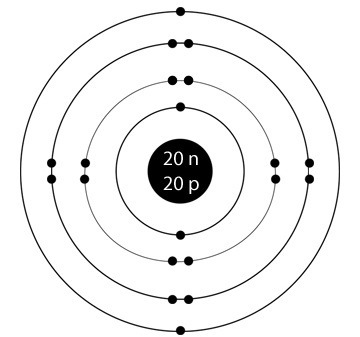
Illustrate a model of a calcium atom including the number and position of protons neutrons and electrons in the atom
andrey2020 [161]

The model would look something like the image below.

There would be a <em>central nucleus</em> containing <em>20 protons</em> and <em>20 neutrons</em>.

Surrounding the nucleus would be four concentric rings (energy levels) containing <em>20 electron</em>s.

Going out from the nucleus, the number of electrons in each ring would

be <em>2, 8, 8, 2</em>.

8 0
2 years ago
A gas occupies 22.4 l at stp and 14.5 l at 100c and 2.00 atm pressure. how many moles of gas did the system gain or lose?
azamat
<span>At standard temperature and pressure 22.4 l of an ideal gas would contain 1 mole. in order to find the change in moles we must look at the ideal gas law PV=nRT where P=Pressure V=volume n=Moles R= Gas constant T= Temperature. To simplify this equation we will be using the gas constant at .08206 L-atm/mol-K. We must first convert 100c to k which is 373.15. Then we can plug the values into our equation which gives us (2atm)(14.5 l)=(n)(.08206 L-atm/mol-K)(373.15). After some basic algebra we get the moles to equal roughly .95 which is .05 moles less than our original system.</span>
6 0
2 years ago
Why are the concentrations of [H3O+] and [OH−] equal in pure water?
kotegsom [21]

Answer : The correct option is, (A) [H_3O^+]=[OH^-] because one of each is produced every time an [H^+] transfers from one water molecule to another.

Explanation :

As we know that, when the two water molecule combine to produced hydronium ion and hydroxide ion.

The balanced reaction will be:

HOH+HOH\rightarrow H_3O^++OH^-

Acid : It is a substance that donates hydrogen ion when dissolved in water.

Base : It is a substance that accepts hydrogen ion when dissolved in water.

From this we conclude that, the hydrogen ion are transferred from one water molecule to the another water molecule to form hydronium ion and hydroxide ion. In this reaction, one water molecule will act as a base and another water molecule will act as an acid.

Hence, the correct option is, (A)

3 0
2 years ago
Other questions:
  • Do you think that solids can undergo convection? explain
    8·1 answer
  • Impure benzoic acid was dissolved in hot water. the container of solution was placed in an ice-water bath instead of being allow
    14·1 answer
  • The relative atomic mass of aluminium is 27 and of oxygen is 16. The aluminium ore shown below contains 5.4kg of aluminium and 4
    7·1 answer
  • A sample of gas has a volume of 215 cm3 at 23.5 degrees Celsius and 84.6kPa what volume will the gas occupy at stp
    13·2 answers
  • Janet observes that the shape of a dented table tennis ball is restored by heating the ball gently in warm water. Which of the f
    13·1 answer
  • Which statement about the spectrophotometric analysis of Red 40 dye is TRUE?
    8·1 answer
  • For heat transfer purposes, a standing man can be modeled as a 30-cm-diameter, 175-cm-long vertical cylinder with both the top a
    13·1 answer
  • onsider the reversible dissolution of lead(II) chloride. P b C l 2 ( s ) − ⇀ ↽ − P b 2 + ( a q ) + 2 C l − ( a q ) PbClX2(s)↽−−⇀
    9·1 answer
  • If the atmospheric pressure in the laboratory is 1.2 atm, how many moles of gas were in each syringe? (Hint: Choose one volume a
    10·1 answer
  • Two students are working together to build two models. Both models will represent the molecular structure of sodium bicarbonate,
    10·1 answer
Add answer
Login
Not registered? Fast signup
Signup
Login Signup
Ask question!