answer.
Ask question
Login Signup
Ask question
All categories
  • English
  • Mathematics
  • Social Studies
  • Business
  • History
  • Health
  • Geography
  • Biology
  • Physics
  • Chemistry
  • Computers and Technology
  • Arts
  • World Languages
  • Spanish
  • French
  • German
  • Advanced Placement (AP)
  • SAT
  • Medicine
  • Law
  • Engineering
Nostrana [21]
2 years ago
10

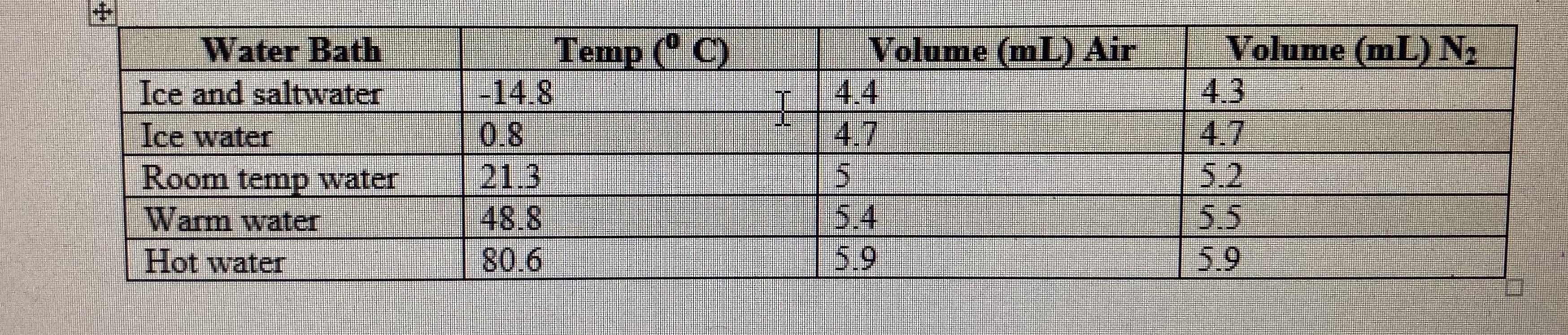
If the atmospheric pressure in the laboratory is 1.2 atm, how many moles of gas were in each syringe? (Hint: Choose one volume a

nd temperature pair from your data table to use in your ideal gas law calculation.)

Chemistry
1 answer:
Naily [24]2 years ago
8 0

Answer:

A: 2.525 x 10⁻⁴ mol

B: 2.583 x 10⁻⁴ mol

Explanation:

Part A:

Data Given:

. Temperature of water (H2O) = 21.3°C

Convert Temperature to Kelvin

T = °C + 273

T = 21.3 + 273 = 294.3 K

volume of (H2O) gaseous state = 5.1 mL

Convert mL to liter

1000 mL = 1L

5.1 ml = 5.1/1000 = 0.0051 L

Pressure = 1.2 atm

. no. of moles = ?

Solution

no. of moles can be calculated by using ideal gas formula

PV = nRT

Rearrange the equation for no. of moles

n=PV/RT......... (1)

where

P = pressure

V = Volume

T= Temperature

n = Number of moles

R = ideal gas constant

where

R = 0.08206 L.atm/ mol. K

Now put the value in formula (1) to calculate no. of moles of

n = 1.2 atm x 0.0051 L / 0.08206 L.atm.mol-1. K-1 x 294.3 K

n = 0.0061 atm.L / 24.162 L.atm.mol-1

n = 2.525 x 10⁻⁴ mol

no. of moles of gas (H2O) = 2.525 x 10⁻⁴ mol

Part B:

Data Given:

Temperature of water (H2) = 21.3°C

Convert Temperature to Kelvin

T = "C + 273

T= 21.3 + 273 = 294.3 K

volume of (H2) gas = 5.2 mL

Convert mL to liter

1000 mL = 1 L

5.2 ml = 5.2/1000 = 0.0052 L

Pressure = 1.2 atm

. no. of moles = ?

Solution

no. of moles can be calculated by using ideal gas formula

PV = nRT

Rearrange the equation for no. of moles

n= PV / RT......... (1)

where

P = pressure

V = Volume

T= Temperature

n = Number of moles

R = ideal gas constant

where

R = 0.08206 L.atm/mol. K

Now put the value in formula (1) to calculate no. of moles of

n = 1.2 atm x 0.0052 L/0.08206 L.atm.mol-1. K-1 x 294.3 K

n = 0.0062 atm.L/ 24.162 L.atm.mol-1

n = 2.583 x 10⁻⁴ mol

I

no. of moles of gas (H2) = 2.583 x 10⁻⁴ mol
You might be interested in
Which of the following statements correctly illustrates the difference between weather and climate? A Tonight’s cool, breezy wea
Ratling [72]

i actually dont know what is it?

Explanation:

5 0
2 years ago
Rahul and Manav each were given a mixture of iron filings and sulphur powder. Rahul heated the mixture strongly and a new substa
AlexFokin [52]

Answer:

sure

Explanation:

The substance formed after heating the mixture of that of Rahul is caleed a compound. Whereas, Manav's mixture still remains in its current stae that is a heterogeneous mixture.

The compound formed is in black in color whereas the mixture is a mix of brownish-red and yellow.

The compound is a homogeneous mixture whereas the mixture is a heterogenous mixture because of its uneven distribution.

3 0
2 years ago
Combined gas law problem: a balloon is filled with 500.0 mL of helium at a temperature of 27 degrees Celsius and 755 mmHg. As th
Papessa [141]
The statement of the combined gas law for a fixed amount of gas is,
PV/T = constant
Here, the units of pressure and volume must be consistent and the temperature must be the absolute temperature (Kelvin or Rankine).
0.65 atm is equivalent to 494 mmHg
Using the equation:
(755 x 500) / (27 + 273) = (494 x V) / (-33 + 273)
V = 3396 ml = 3.4 liters
8 0
2 years ago
Hydrochloric acid (75.0 mL of 0.250 M) is added to 225.0 mL of 0.0550 M Ba(OH)2 solution. What is the concentration of the exces
Shalnov [3]

Answer:  The concentration of excess [OH^-] in solution is 0.017 M.

Explanation:

1. Molarity=\frac{moles}{\text {Volume in L}}

moles of HCl=Molarity\times {\text {Volume in L}}=0.250\times 0.075=0.019moles

1 mole of HCl give = 1 mole of H^+

Thus 0.019 moles of HCl give = 0.019 mole of H^+

2. moles of Ba(OH)_2=Molarity\times {\text {Volume in L}}=0.0550\times 0.225=0.012moles

According to stoichiometry:

1 mole of Ba(OH)_2 gives = 2 moles of OH^-

Thus 0.012 moles of Ba(OH)_2 give = 2 \times 0.012=0.024 moles of OH^-

H^++OH^-\rightarrow H_2O

As 1 mole of H^+ neutralize 1 mole of OH^-

0.019 mole of H^+ will neutralize 0.019 mole of OH^-

Thus (0.024-0.019)= 0.005 moles of OH^- will be left.

[OH^-]=\frac{\text {moles left}}{\text {Total volume in L}}=\frac{0.005}{0.3L}=0.017M

Thus molarity of [OH^-] in solution is 0.017 M.

4 0
2 years ago
Read 2 more answers
The table lists the chemical formulas or symbols of a few common substances. Which two substances are compounds? A) aluminum and
katrin [286]
D is the correct answer

every other option contains an element
7 0
2 years ago
Read 2 more answers
Other questions:
  • The average kinetic energy of water molecules is greatest in which of these samples?(1) 10 g of water at 35°C(2) 10 g of water a
    14·2 answers
  • 7. Two teams are competing in a tug-of-war contest. Team A is pulling at 4000N and Team B is pulling at 4900N is the opposite di
    8·2 answers
  • A solid is 5 cm tall 3 cm wide and 2 cm thick it has a mass of 129 g what is the density
    7·2 answers
  • Compare and contrast the outer core and the inner core.
    8·2 answers
  • Draw the alcohol needed to form isobutyl benzoate
    9·2 answers
  • A certain microwave has a wavelength of 0.032 meters. Calculate the frequency of this microwave
    7·1 answer
  • If Co(NH3)63+ has a λmax at 440 nm, calculate ΔE for the complex. A) 2.72 x 10⁻⁴ kJ/mol B) 4.52 x 10⁻² kJ/mol C) 2.72 x 10 2 kJ/
    5·1 answer
  • Which reaction does not occur?
    11·1 answer
  • Suppose you have 200.0 mL of a 0.750 M sodium hydroxide solution. How many
    9·1 answer
  • 1. Given the image below, which calculation will NOT give you the correct average atomic mass?
    10·1 answer
Add answer
Login
Not registered? Fast signup
Signup
Login Signup
Ask question!
