answer.
Ask question
Login Signup
Ask question
All categories
  • English
  • Mathematics
  • Social Studies
  • Business
  • History
  • Health
  • Geography
  • Biology
  • Physics
  • Chemistry
  • Computers and Technology
  • Arts
  • World Languages
  • Spanish
  • French
  • German
  • Advanced Placement (AP)
  • SAT
  • Medicine
  • Law
  • Engineering
Shkiper50 [21]
2 years ago
12

Rusting of iron is a very common chemical reaction. It results in one form from Fe reacting with oxygen gas to produce iron (III

) oxide. Your sample of iron is 12.0 moles of iron. So which if these is a true statement? NOTE: All numbers located immediately after elemental symbols below should be considered subscripts. A. 4.5 moles of O2 and produce 3.0 moles of Fe2O3. B. 12.0 moles of O2 and produce 24.0 moles of Fe2O3. C. 9.0 moles of O2 and produce 3.0 moles of Fe2O3. D. 9.0 moles of O2 and produce 6.0 moles of Fe2O3 E. none of the above
Chemistry
1 answer:
Vlada [557]2 years ago
5 0

<u>Answer:</u> The given amount of iron reacts with 9.0 moles of O_2 and produce 6.0 moles of Fe_2O_3

<u>Explanation:</u>

We are given:

Moles of iron = 12.0 moles

The chemical equation for the rusting of iron follows:

4Fe+3O_2\rightarrow 2Fe_2O_3

  • <u>For oxygen gas:</u>

By Stoichiometry of the reaction:

4 moles of iron reacts with 3 moles of oxygen gas

So, 12.0 moles of iron will react with = \frac{3}{4}\times 12.0=9.0mol of oxygen gas

  • <u>For iron (III) oxide:</u>

By Stoichiometry of the reaction:

4 moles of iron produces 2 moles of iron (III) oxide

So, 12.0 moles of iron will produce = \frac{2}{4}\times 12.0=6.0mol of iron (III) oxide

Hence, the given amount of iron reacts with 9.0 moles of O_2 and produce 6.0 moles of Fe_2O_3

You might be interested in
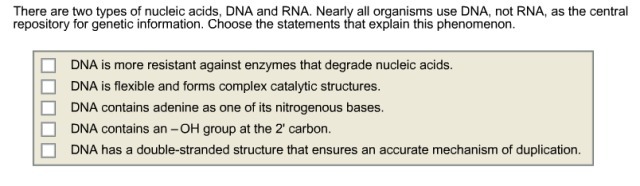
There are two types of nucleic acids, dna and rna. nearly all organisms use dna, not rna, as the central repository for genetic
Leya [2.2K]
Found the choices. Pls see attachment. 

The statements that explains this phenomenon are:
1) DNA contains adenine as one of its nitrogenous bases.
2) DNA has a double-stranded structure that ensures an accurate mechanism of duplication.

6 0
2 years ago
Phosphorous acid, H3PO3(aq), is a diprotic oxyacid that is an important compound in industry and agriculture. K pKa1 K pKa2 1.30
FrozenT [24]

Answer:

* Before addition of any KOH:

pH = 0,0301

*After addition of 25.0 mL KOH:

pH = 1,30

*After addition of 50.0 mL KOH:

pH = 2,87

*After addition of 75.0 mL KOH:

pH = 6,70

*After addition of 100.0 mL KOH:

pH = 10,7

Explanation:

H₃PO₃ has the following equilibriums:

H₃PO₃ ⇄ H₂PO₃⁻ H⁺

k = [H₂PO₃⁻] [H⁺] / [H₃PO₃] k = 10^-(1,30) <em>(1)</em>

H₂PO₃⁻ ⇄ HPO₃²⁻ + H⁺

k = [HPO₃²⁻] [H⁺] / [H₂PO₃⁻] k = 10^-(6,70) <em>(2)</em>

Moles of H₃PO₃ are:

0,0500L×(1,8mol/L) = 0,09 moles of H₃PO₃

* Before addition of any KOH:

Using (1), moles in equilibrium are:

H₃PO₃: 0,09-x

H₂PO₃⁻: x

H⁺: x

Replacing:

10^{-1.30} = \frac{x^2}{0.09-x}

4.51x10⁻³ - 0.050x -x² = 0

The right solution of x is:

x = 0.0466589

As volume is 0,050L

[H⁺] = 0.0466589moles / 0,050L = 0,933M

As pH = -log [H⁺]

<em>pH = 0,0301</em>

*After addition of 25.0 mL KOH:

0,025L×1,8M = 0,045 moles of KOH that reacts with H₃PO₃ thus:

KOH + H₃PO₃ → H₂PO₃⁻ + H₂O

That means moles of KOH will be the same of H₂PO₃⁻ and moles of H₃PO₃ are 0,09moles - 0,045moles = 0,045moles

Henderson-Hasselbalch formula is:

pH = pka + log₁₀ [A⁻] /[HA]

Where A⁻ is H₂PO₃⁻ and HA is H₃PO₃.

Replacing:

pH = 1,30 + log₁₀ [0,045mol] / [0,045mol]

<em>pH = 1,30</em>

*After addition of 50.0 mL KOH:

The addition of 50.0 mL KOH consume all H₃PO₃. Thus, in the solution you will have just H₂PO₃⁻. Thus, moles in solution for the equilibrium will be:

H₂PO₃⁻: 0,09-x

HPO₃²⁻: x

H⁺: x

Replacing:

10^{-6.70} = \frac{x^2}{0.09-x}

1.8x10⁻⁸ - 2x10⁻⁷x - x² = 0

The right solution of x is:

x = 0.000134064

As volume is 50,0mL + 50,0mL = 100,0mL

[H⁺] = 0.000134064moles / 0,100L = 1.34x10⁻³M

As pH = -log [H⁺]

<em>pH = 2,87</em>

*After addition of 75.0 mL KOH:

Applying Henderson-Hasselbalch formula you will have 0,045 moles of both H₂PO₃⁻ HPO₃²⁻ and pka: 6,70:

pH = 6,70 + log₁₀ [0,045mol] / [0,045mol]

<em>pH = 6,70</em>

*After addition of 100.0 mL KOH:

You will have just 0,09moles of HPO₃²⁻, the equilibrium will be:

HPO₃²⁻ + H₂O ⇄ H₂PO₃⁻ + OH⁻ with kb = kw/ka = 1x10⁻¹⁴/10^-(6,70) = 5,01x10⁻⁸

kb = [H₂PO₃⁻] [OH⁻] / [HPO₃²⁻]

Moles are:

H₂PO₃⁻: x

OH⁻: x

HPO₃²⁻: 0,09-x

Replacing:

5.01x10^{-8} = \frac{x^2}{0.09-x}

4.5x10⁻⁹ - 5.01x10⁻⁸x - x² = 0

The right solution of x is:

x = 0.000067057

As volume is 50,0mL + 100,0mL = 150,0mL

[OH⁻] = 0.000067057moles / 0,150L = 4.47x10⁻⁴M

As pH = 14-pOH; pOH = -log [OH⁻]

<em>pH = 10,7</em>

<em></em>

I hope it helps!

6 0
2 years ago
What are the coefficients that will balance this skeleton equation? AlCl3 + NaOH → Al(OH)3 + NaCl
almond37 [142]

Answer:

The coefficients are 1, 3, 1, 3

Explanation:

The equation;

AlCl3 + NaOH → Al(OH)3 + NaCl

can be balanced by using the coefficients  1, 3, 1, 3, such that the balanced equation will be;

AlCl3 + 3NaOH → Al(OH)3 + 3NaCl

Chemical equations needs to be balanced so as to follow the law of conservation of mass. This occurs when the number of the different atoms of elements in the reactants side is equal to that of the products side.

3 0
2 years ago
How many moles are equal to 5.82 x 10^23 atoms of tungsten (w)
fiasKO [112]

Answer:

0.97 mole

Explanation:

1 mole will give 6.02×10^23 atoms

Xmole of tungsten will give 5.82×10^23 atom of tungsten

X= 5.82×10^23/ 6.02×10^23

X = 0.97 moles of tungsten

6 0
2 years ago
Read 2 more answers
Using the van der Waals equation, find the pressure exerted by 1 mole of Ar gas stored in a 1.42-liter container at 300 K. Given
worty [1.4K]
I’m writing this equation by memory, so I hope I’m correct. It’s been about four months since we used in in my chem class:

(P-(n^2•a)/V^2)(V-nb)=nRT

Plugging in values given:

(P-(1•1.35)/(1.42^2))(1.42-(1•0.0322))=(1)(0.0821)(300)
(P-(1.35/2.016))(1.42-0.0322)=24.63
(P-(1.35/2.016))=17.75
P=18.42 atm

The pressure exerted by the Argon would be 18.42 atmospheres.
7 0
2 years ago
Read 2 more answers
Other questions:
  • Identify the reaction type for each generic chemical equation
    15·2 answers
  • If a solution at pH 5 undergoes a 1000-fold increase in [OH-], what is the resulting pH?
    9·1 answer
  • Question 3 options: how many moles of argon atoms are present in 11.2 l of argon gas at stp?
    13·1 answer
  • Carbon monoxide (CO) gas reacts with oxygen (O2) gas to produce carbon dioxide (CO2) gas. If 1.00 L of carbon monoxide reacts wi
    10·2 answers
  • Thiamine (vitamin B1) deficiency diseases have a lower prevalence now than in the past. However, they are seen as beriberi in so
    12·1 answer
  • Calculate the grams of so2 gas present at stp in a 5.9 l container. (r = 0.0821 l·atm/k·mol)
    15·1 answer
  • A divalent metal ion dissolved in dilute hydrochloric acid forms a precipitate when H2S is bubbled through the solution. Which i
    13·1 answer
  • How does heat conduction work in the metal brownie pan?
    8·1 answer
  • How many elements are in H2CrO4
    15·2 answers
  • A hydrogen filled balloon has a bolume of 8.3 L at 36 C and 751 torr. How many moles of hydrogen are inside the balloon?
    13·1 answer
Add answer
Login
Not registered? Fast signup
Signup
Login Signup
Ask question!