answer.
Ask question
Login Signup
Ask question
All categories
  • English
  • Mathematics
  • Social Studies
  • Business
  • History
  • Health
  • Geography
  • Biology
  • Physics
  • Chemistry
  • Computers and Technology
  • Arts
  • World Languages
  • Spanish
  • French
  • German
  • Advanced Placement (AP)
  • SAT
  • Medicine
  • Law
  • Engineering
Natali5045456 [20]
2 years ago
13

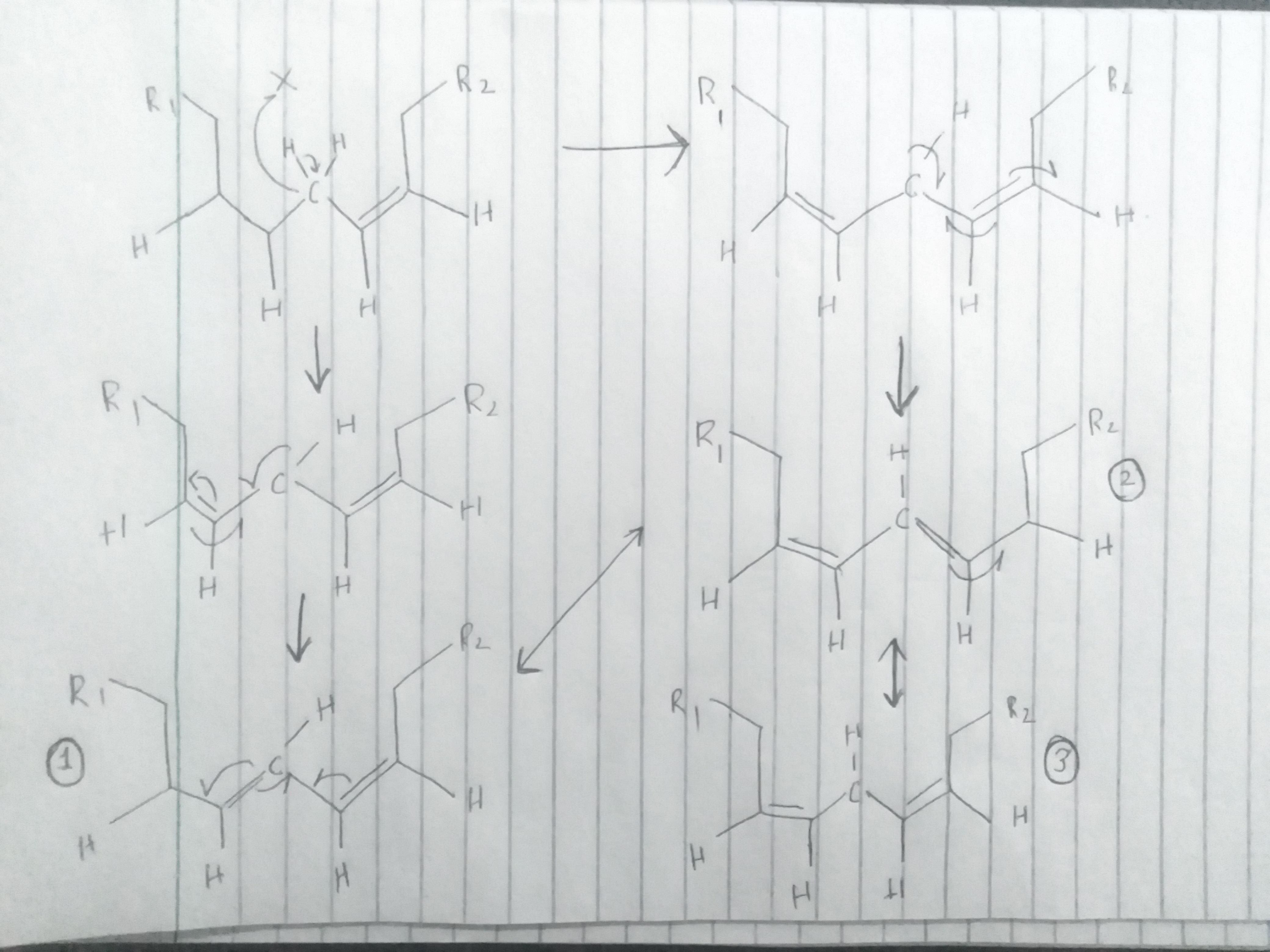
Linoleic acid is a polyunsaturated fatty acid found, in ester form, in many fats and oils. Its doubly allylic hydrogens are part

icularly susceptible to abstraction by radicals, a process that can lead to the oxidative degradation of the fat or oil. The radical formed by abstraction of one of the doubly allylic hydrogens is an allylic radical that has three resonance structures. Complete one of these resonance structures by dragging bonds and electrons to their appropriate positions.

Chemistry
1 answer:
Ganezh [65]2 years ago
8 0

Answer:

Explanation:

Linoleic acid, which is polyunsaturated fatty acid, found

the three resonance structures are given as,

You might be interested in
In the adjoining figure, the circles with the + sign represent protons and the empty circles represent neutrons. Determine which
Natali [406]

Answer: option C. 2 and 3.

Explanation:

1) Isotopes are atoms of a same element with different number of neutrons. That means that the isotopes of a same element have the same number of protons, since the number of protons is what identify an element.

2) For example, all the atoms of oxygen have 8 protons. But isotope oxygen-16 has 8 neutrons, while oxygen-18 has 10 neutrons.

3) In the figure there are 3 different atoms:

i) atom # 1 has 5 protons and 7 neutrons

ii) atom # 2 has 6 protons and 7 neutrons

iii) atom # 3 has 6 protons and 8 neutrons.

4) Hence the atoms with the same number of protons and different number of neutrons are the #2 and the # 3. So, they are the isotopes of the same element.

4 0
2 years ago
Read 2 more answers
Trichloromethane consists of 10.05% carbon. 0.83% hydrogen and 89.12% chlorine. if uts relative molecular mass is 119.5g . find
Delicious77 [7]

Answer:

C24H2CL213

Explanation:

C

(10.05/100)x119.5

=12x2=24

H

(0.083/100)x119.5

=1x2=2

Cl

(89.12/100)x119.5

=106.5x2=213

4 0
2 years ago
Hydrochloric acid (75.0 mL of 0.250 M) is added to 225.0 mL of 0.0550 M Ba(OH)2 solution. What is the concentration of the exces
Shalnov [3]

Answer:  The concentration of excess [OH^-] in solution is 0.017 M.

Explanation:

1. Molarity=\frac{moles}{\text {Volume in L}}

moles of HCl=Molarity\times {\text {Volume in L}}=0.250\times 0.075=0.019moles

1 mole of HCl give = 1 mole of H^+

Thus 0.019 moles of HCl give = 0.019 mole of H^+

2. moles of Ba(OH)_2=Molarity\times {\text {Volume in L}}=0.0550\times 0.225=0.012moles

According to stoichiometry:

1 mole of Ba(OH)_2 gives = 2 moles of OH^-

Thus 0.012 moles of Ba(OH)_2 give = 2 \times 0.012=0.024 moles of OH^-

H^++OH^-\rightarrow H_2O

As 1 mole of H^+ neutralize 1 mole of OH^-

0.019 mole of H^+ will neutralize 0.019 mole of OH^-

Thus (0.024-0.019)= 0.005 moles of OH^- will be left.

[OH^-]=\frac{\text {moles left}}{\text {Total volume in L}}=\frac{0.005}{0.3L}=0.017M

Thus molarity of [OH^-] in solution is 0.017 M.

4 0
2 years ago
Read 2 more answers
A student heats a sample of Copper (II) sulfate in a crucible and records the data shown in the table. What is the complete form
liberstina [14]

Explanation:

Copper (II) sulfate is usually present as a hydrous state, which is of the form CuSO4 * nH2O, where n is a whole number.

Mass of sample (CuSO4 * nH2O)

= 152.00g - 128.10g = 23.90g.

Mass of water loss during heating

= 152.00g - 147.60g = 4.40g.

Molar mass of H2O = 18g/mol

Moles of H2O in sample

= 4.40g / (18g/mol) = 0.244mol.

Mass of anhydrous sample (CuSO4)

= 23.90g - 4.40g = 19.50g

Molar mass of CuSO4 = 159.61g/mol

Moles of CuSO4 in sample

= 19.50g / (159.61g/mol) = 0.122mol.

Since mole ratio of CuSO4 to H2O

= 0.122mol : 0.244mol = 1:2, n = 2.

Hence we have CuSO4 * 2H2O.
6 0
2 years ago
Read 2 more answers
Oxides of virtually every element are known. bromine, for example, forms several oxides when treated with ozone. suppose you all
FromTheMoon [43]
Answer is: empirical formula of the product is Br₂O₅.
Chemical reaction: x/2Br₂ + y/3O₃ → BrₓOy.
m(Br₂) = 1,250 g.
m(BrₓOy) = 1,876 g.
n(Br₂) = m(Br₂) ÷ M(Br₂).
n(Br₂) = 1,25 g ÷ 159,81 g/mol.
n(Br₂) = 0,0078 mol.
n(Br) = 2 · 0,0078 mol = 0,0156 mol.
m(O₃) = 1,876 g - 1,25 g = 0,626 g.
n(O₃) = 0,626 g ÷ 48 g/mol = 0,013 mol.
n(O) = 0,039 · 3 = 0,039 mol
n(Br) : n(O) = 0,0156 mol : 0,039 mol.
n(Br) : n(O) = 1 : 2,5.
5 0
2 years ago
Read 2 more answers
Other questions:
  • A hydrate of CoCl2 with a mass of 6.00 g is heated strongly. after cooling the mass the anhydrate is 3.27g
    14·2 answers
  • Draw the electron dot structures for each molecule. Identify polar covalent bonds by assigning slightly positive and slightly ne
    13·1 answer
  • A compound contains 69.94 percent iron and 30.06 percent oxygen. What is its molecular formula if the molar mass of the compound
    15·2 answers
  • Which of the following statements concerning the process of spontaneous folding of proteins is false?
    10·2 answers
  • A solution is prepared by dissolving 91.7 g fructose in 545 g of water. Determine the mole fraction of fructose if the final vol
    12·1 answer
  • Which equation represents a reduction half-reaction?
    12·1 answer
  • HELP! Ethanol has a density of 0.8 g/cm3. a. What is the mass of 225 cm3 of ethanol? b. What is the volume of 75.0 g of ethanol?
    12·1 answer
  • A laser with a wavelength of 225 nm is shown on an isolated gas-phase sodium atom. Calculate the velocity of the ejected electro
    10·1 answer
  • From the following list of elements, select the elements that are likely to form a cation. Choose one or more: A. oxygen B. chlo
    12·1 answer
  • Which statements describe lattice energy?
    7·1 answer
Add answer
Login
Not registered? Fast signup
Signup
Login Signup
Ask question!