answer.
Ask question
Login Signup
Ask question
All categories
  • English
  • Mathematics
  • Social Studies
  • Business
  • History
  • Health
  • Geography
  • Biology
  • Physics
  • Chemistry
  • Computers and Technology
  • Arts
  • World Languages
  • Spanish
  • French
  • German
  • Advanced Placement (AP)
  • SAT
  • Medicine
  • Law
  • Engineering
Kobotan [32]
2 years ago
3

A 7.5 kg stone moves up frictionless hill that slopes upward at 41 above the horizontal. If the stone has a initial velocity of

8.5 m/s at the bottom, how far (as measured along the surface of the hill) will it go before stopping?

Physics
1 answer:
cluponka [151]2 years ago
8 0

Answer:

The stone will reach <u>3.2 m</u> along the surface of the hill before stopping.

Explanation:

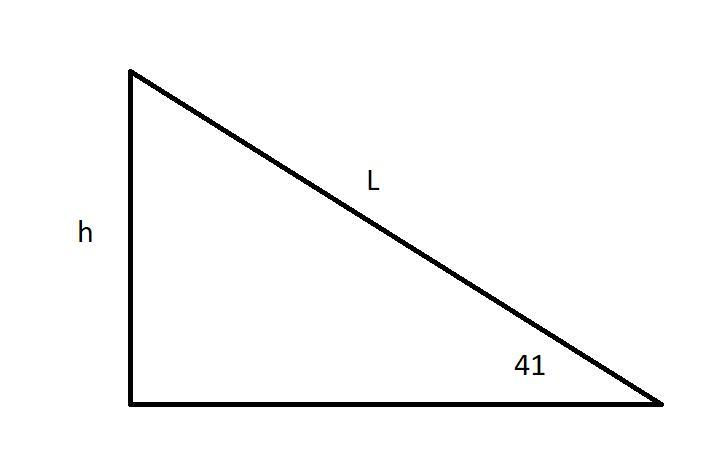
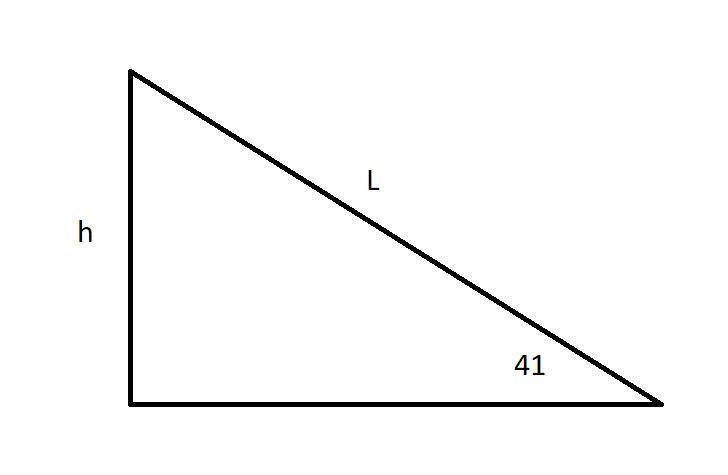
Let the height reached by the stone be 'h' m

Given:

Mass of the stone is 7.5 kg.

Angle of inclination is, \theta = 41\°

Initial velocity of the stone at the bottom is, v=8.5\ m/s

Final velocity of the stone at the top is 0 m/s.

Now, as per conservation of energy principle, sum of total energy is always conserved. Therefore, decrease in kinetic energy is equal to the increase in its potential energy.

Increase in Potential Energy = Decrease in Kinetic Energy

⇒ mgh = \frac{1}{2}mv^2

⇒ gh=  \frac{1}{2}v^2

⇒ h=\frac{v^2}{2g}

Plug in the given values and solve for 'h'. This gives,

h=\frac{8.5^2}{2\times 9.8}=3.686\ m

Now, slant height is given using the trigonometric ratio. The slant length 'L' is the hypotenuse and 'h' is the opposite side. Therefore,

\tan \theta=\frac{L}{h}\\\\L=h\times \tan\theta\\\\L=3.686\times \tan(41)\\\\L=3.2\ m

Therefore, the stone will reach 3.2 m along the surface of the hill before stopping.

You might be interested in
A block of mass m1 = 3.5 kg moves with velocity v1 = 6.3 m/s on a frictionless surface. it collides with block of mass m2 = 1.7
maxonik [38]
First, let's find the speed v_i of the two blocks m1 and m2 sticked together after the collision.
We can use the conservation of momentum to solve this part. Initially, block 2 is stationary, so only block 1 has momentum different from zero, and it is:
p_i = m_1 v_1
After the collision, the two blocks stick together and so now they have mass m_1 +m_2 and they are moving with speed v_i:
p_f = (m_1 + m_2)v_i
For conservation of momentum
p_i=p_f
So we can write
m_1 v_1 = (m_1 +m_2)v_i
From which we find
v_i =  \frac{m_1 v_1}{m_1+m_2}= \frac{(3.5 kg)(6.3 m/s)}{3.5 kg+1.7 kg}=4.2 m/s

The two blocks enter the rough path with this velocity, then they are decelerated because of the frictional force \mu (m_1+m_2)g. The work done by the frictional force to stop the two blocks is
\mu (m_1+m_2)g  d
where d is the distance covered by the two blocks before stopping.
The initial kinetic energy of the two blocks together, just before entering the rough path, is
\frac{1}{2} (m_1+m_2)v_i^2
When the two blocks stop, all this kinetic energy is lost, because their velocity becomes zero; for the work-energy theorem, the loss in kinetic energy must be equal to the work done by the frictional force:
\frac{1}{2} (m_1+m_2)v_i^2 =\mu (m_1+m_2)g  d
From which we can find the value of the coefficient of kinetic friction:
\mu =  \frac{v_i^2}{2gd}= \frac{(4.2 m/s)^2}{2(9.81 m/s^2)(1.85 m)}=0.49
3 0
2 years ago
A horizontal spring with spring constant 85 n/m extends outward from a wall just above floor level. a 3.5 kg box sliding across
Rina8888 [55]

k = spring constant of the spring = 85 N/m

m = mass of the box sliding towards the spring = 3.5 kg

v = speed of box just before colliding with the spring = ?

x = compression the spring = 6.5 cm = 6.5 cm (1 m /100 cm) = 0.065 m

the kinetic energy of box just before colliding with the spring converts into the spring energy of the spring when it is fully compressed.

Using conservation of energy

Kinetic energy of spring before collision = spring energy of spring after compression

(0.5) m v² = (0.5) k x²

m v² = k x²

inserting the values

(3.5 kg) v² = (85 N/m) (0.065 m)²

v = 0.32 m/s

8 0
2 years ago
Evaporation of sweat requires energy and thus take excess heat away from the body. Some of the water that you drink may eventual
kotegsom [21]

Answer:

The amount of heat required is H_t =  1.37 *10^{6} \ J

Explanation:

From the question we are told that

The mass of water is m_w  =  20 \ ounce = 20 * 28.3495 = 5.7 *10^2 g

The temperature of the water before drinking is T_w  =  3.8 ^oC

The temperature of the body is T_b  =  36.6^oC

Generally the amount of heat required to move the water from its former temperature to the body temperature is

H=  m_w  *  c_w * \Delta T

Here c_w is the specific heat of water with value c_w = 4.18 J/g^oC

So

H=   5.7 *10^2 * 4.18 * (36.6 - 3.8)

=> H= 7.8 *10^{4} \  J

Generally the no of mole of sweat present mass of water is

n = \frac{m_w}{Z_s}

Here Z_w is the molar mass of sweat with value

Z_w =  18.015 g/mol

=> n = \frac{5.7 *10^2}{18.015}

=> n = 31.6 \  moles

Generally the heat required to vaporize the number of moles of the sweat is mathematically represented as

H_v  =  n  *  L_v

Here L_v is the latent heat of vaporization with value L_v  = 7 *10^{3} J/mol

=> H_v  =  31.6 * 7 *10^{3}

=> H_v  = 1.29 *10^{6} \  J

Generally the overall amount of heat energy required is

H_t =  H +  H_v

=> H_t =  7.8 *10^{4} +  1.29 *10^{6}

=> H_t =  1.37 *10^{6} \ J

4 0
2 years ago
A ball of mass m and radius R is both sliding and spinning on a horizontal surface so that its rotational kinetic energy equals
spin [16.1K]

Answer:

\frac{v_{cm}}{\omega} = 1.122\cdot R

Explanation:

According to the statement of the problems, the following identity exists:

K_{t} = K_{r}

\frac{1}{2}\cdot m \cdot v_{cm}^{2} = 0.63\cdot m \cdot R^{2} \cdot \omega^{2}

After some algebraic handling, the ratio is obtained:

\frac{v_{cm}^{2}}{\omega^{2}}=1.26\cdot R^{2}

\frac{v_{cm}}{\omega} = 1.122\cdot R

4 0
2 years ago
29. 2072 Set C Q.No. 10c
Annette [7]

Answer:

90.2^{\circ}C

Explanation:

Considering the thermal conductivity of aluminium and brass as k_{al}=205 W/mK and k_{br}=109 W/mk respectively  

The temperature at the end of aluminium and brass are given as T_{al}=150^{\circ}C and T_{br}=20^{\circ}C respectively with length of rod L=1.3 m , Length of aluminium L_{al}=0.8 m, length of brass L_{br}=0.5 m and letting temperature at steady state be T

At steady state, thermal conductivity of both aluminium and brass are same hence

H_{br}=H_{al}

k_{al}A\frac {T_H-T}{L_{al}}= k_{br}A\frac {T-T_H}{L_{br}}

Upon re-arranging

T=\frac {k_{al}L_{al}T_{br}+k_{al}L_{br}T_{al}}{k_{br}L_{al}+k_{al}L_{br}}

(205)\frac {150-T}{0.8}=109\frac {T-20}{0.5}

T=\frac {(109*0.8*20)+(205*0.5*150)}{(109*0.8)+(205*0.5)}

T=90.2^{\circ}C

Therefore, the temperatures at which the metals are joined is 90.2^{\circ}C

6 0
2 years ago
Other questions:
  • After watching a video about submarines, Jamil wants to learn more about the ocean. which question could be answered through sci
    9·1 answer
  • A granite monument has a volume of 25,365.4 cm3. The density of granite is 2.7 g/cm3. Use this information to calculate the mass
    10·1 answer
  • A car travels 30 miles in 1 hour on a winding mountain road. Which of the following is a true statement?
    9·2 answers
  • Question 8 (4 points)
    10·2 answers
  • A truck of mass mT = 2000 kg is going north on Guadalupe with a speed of 4 m/s. The truck is struck by an eastbound car (mass of
    14·1 answer
  • A vertical spring of constant k = 400 N/m hangs at rest. When a 2 kg mass is attached to it, and it is released, the spring exte
    6·1 answer
  • Consider a simple ideal Rankine cycle with fixed turbine inlet conditions. What is the effect of lowering the condenser pressure
    8·1 answer
  • A girl is shown at position A on a swing when the seat is directly below the support bar. The seat is then at height A as shown
    7·2 answers
  • A champion athlete can produce one horsepower (746 W) for a short period of time. The number of 16-cm-high steps a 70-kg athlete
    13·1 answer
  • In the year 2090, and Burt is still alive! Well, he’s really just a brain connected to a “life machine.” Since Burt has no body,
    7·1 answer
Add answer
Login
Not registered? Fast signup
Signup
Login Signup
Ask question!