answer.
Ask question
Login Signup
Ask question
All categories
  • English
  • Mathematics
  • Social Studies
  • Business
  • History
  • Health
  • Geography
  • Biology
  • Physics
  • Chemistry
  • Computers and Technology
  • Arts
  • World Languages
  • Spanish
  • French
  • German
  • Advanced Placement (AP)
  • SAT
  • Medicine
  • Law
  • Engineering
stealth61 [152]
2 years ago
8

4. Convert the following: a. 4g mol of MgCl2 to g b. 2 lb mol of C3H8 to g c. 16 g of N2 to lb mol d. 3 lb of C2H6O to g mol

Chemistry
1 answer:
Nuetrik [128]2 years ago
6 0

Answer:

a) 381.2 g

b) 39916 g

c) 0.0013 lb mol

d) 29.6 g mol

Explanation:

The molecular weight (mw) of a compound is the mass of it per mole, so it's the ratio of the mass (m) per mole (n).

a) The molecular weight of one mol is found at the periodic table. So, for Mg, mw = 24.3 g/mol, for Cl = 35.5 g/mol, so for MgCl2, mw = 24.3 + 2*35.5 = 95.3 g/mol. The g mol is the mass divided by the molecular weight:

g mol = m/mw

4 = m/95.3

m = 381.2 g

b) The pound (lb) is a unity of mass, and the lb mol is a unity of the mass divided by the molecular weight. So, by the periodic table, the molecular weight of C3H8 is 3*12 (of C) + 8*1 (of H) = 44 lb/mol.

lb mol = m/mw

2 = m/44

m = 88 lb

1 lb = 453.592 g

So, m = 88*453.592 = 39916 g

c) The molecular weight of N2 is 2*14 (of N) = 28 lb/mol.

m = 16/453.592 = 0.0353 lb

lb mol = m/mw

lb mol = 0.0353/28

lb mol = 0.0013 lb mol

d) The molecular weight is 2*12 (of C) + 6*1(of H) + 1*16(of O) = 46 g/mol

3 lb = 1360.78 g

g mol = m/mw

g mol = 1360.78/46

g mol = 29.6 g mol

You might be interested in
According to the lab guide, which changes below will you look for in order to test the hypothesis? check all that apply. changes
viktelen [127]

Answer:

All of them are.

Explanation:

8 0
2 years ago
Read 2 more answers
14) The central iodine atom in the ICl4- ion has __________ nonbonded electron pairs and __________ bonded electron pairs in its
masha68 [24]

Answer:

Two non bonded electron pairs and four bonded electron pairs

Explanation:

An image of the compound as obtained from chemlibretext is attached to this answer.

The ion ICl4- ion, is an AX4E2 ion. This implies that there are four bond pairs and two lone pairs of electrons. As expected, the shape of the ion is square planar since the lone pairs are found above and below the plane of the square. This is clear from the image attached.

7 0
2 years ago
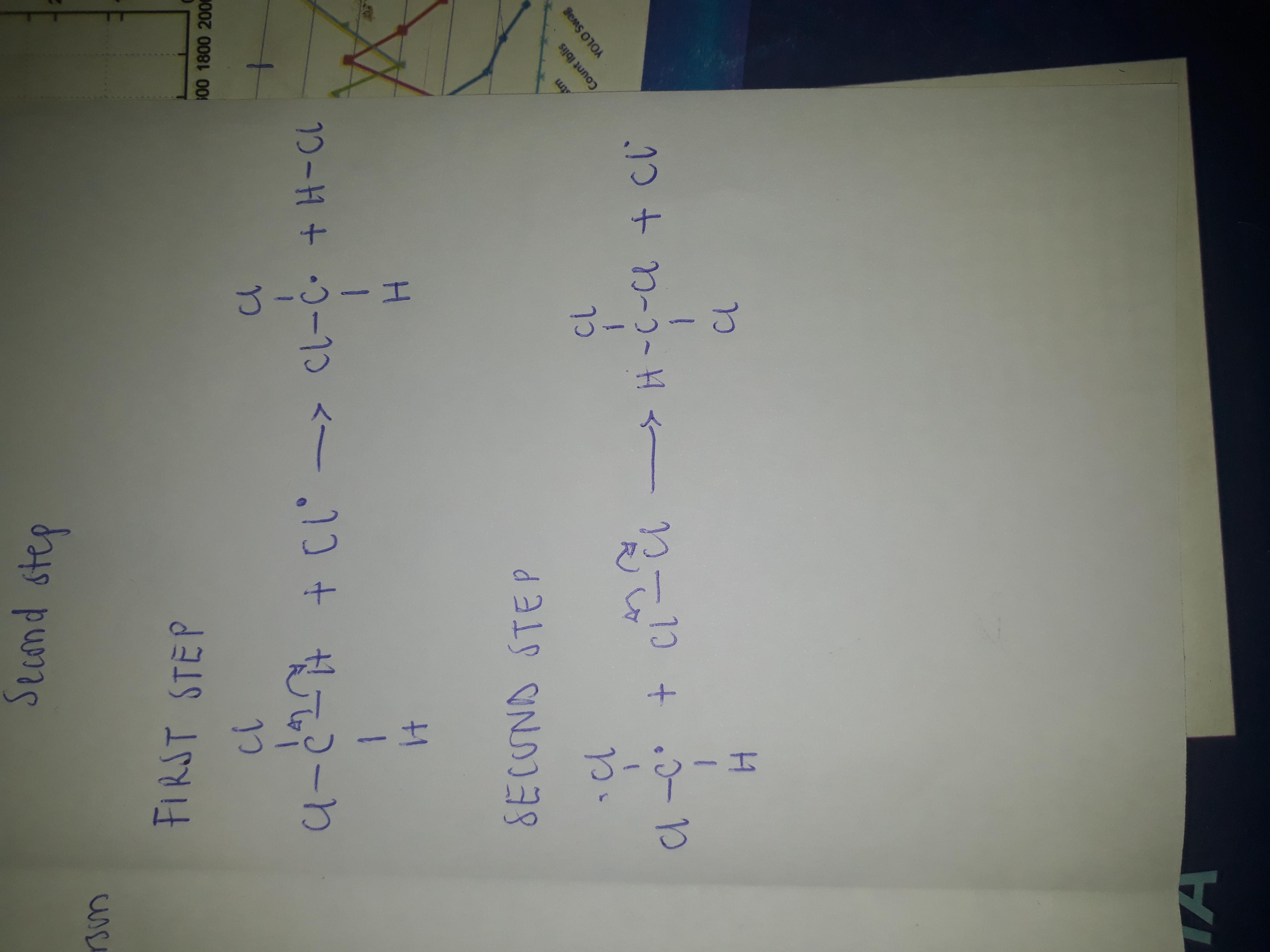
Which of the following represents a propagation step in the monochlorination of methylene chloride (CH2Cl2)?a. CHCl3 + Cl. Right
svetlana [45]

Answer:

B = CHCl2 + Cl2 --> CHCl3 + Cl

Explanation:

Free radical halogenation is a chlorination reaction on Alkane hydrocarbons. This involves the splitting of molecules into radicals/ unstable molecules in the presence of sunlight/ U.V light which ensures bonding of the molecules.

Free radical chlorination is divided into 3 steps which are:

The initiation step

The propagation step

The termination step

So in reference to the question, propagation step involves two steps.

The first step is where the molecule in this case the methylene chloride(CH2Cl2) loses a hydrogen atom and then bond with a chlorine atom radical to give a nethylwnw chloride radical and HCl.

The second step involves the reaction of this methylene chloride got in the first step with chlorine molecule to form trichloride methane and a chlorine radical.

You would find in the attachment the 2 step mechanism.

3 0
2 years ago
The combustion of propane is best described as an
GalinKa [24]
<h3><u>Answer;</u></h3>

Exothermic chemical reaction

<h3><u>Explanation;</u></h3>
  • Exothermic reactions are chemical reactions where the products have less energy that the reactants.
  • Exothermic reactions give off energy, usually in the form of heat, while endothermic reactions absorb energy.
  • The combustion of propane is definitely an exothermic reaction because it generates a lot of heat.

5 0
2 years ago
Over-the-counter hydrogen peroxide solutions are 3% (w/v). What is this concentration in moles per liter?
Marina CMI [18]
<span>1 ml of water weighs 1 gram so 1 liter (1000 ml) weighs 1000 grams. A 3% solution (3% = 0.03) of hydrogen peroxide (w/v) would contain 1000 grams x 0.03 or 30 grams. The chemical formula of hydrogen peroxide is H2O2 and a mole weighs 34.0147 grams/mole. So 30 grams of H2O2 divided by 34.0147 grams/mole equals 0.88 moles of H2O2. The concentration of a 3% (w/v) hydrogen peroxide solution therefore contains 30 grams of H202 (or 0.88 moles of H202) per in a liter of water (or 1000 grams H20) would thus be 0.88 moles H2O2 per liter (0.88 moles H2O2/l) .</span>
5 0
2 years ago
Other questions:
  • An average copper penny minted in the 1960s contained about 3.000 g of copper. how much chalcopyrite had be mined to produce 100
    6·2 answers
  • How many moles of ions are in 285 ml of 0.0150 m mgcl2?
    10·2 answers
  • A steam turbine is a device in which high-pressure steam enters the turbine and causes blades to spin. The spinning blades have
    15·2 answers
  • Match the specific enzyme to its class. A. oxidoreductase B. hydrolase C. transferase D. ligase E. lyase aminase
    8·1 answer
  • if 5.50 mol of calcium carbide (CaC 2 ) reacts with an excess of water, how many moles of acetylene (C 2 H 2 ) , a gas used in w
    12·1 answer
  • Design a synthesis of 2-ethyl-2-hexenoic acid from alcohols of four carbons or fewer.
    11·1 answer
  • How many liters of 3.0 M NaOH solution will react with 2.4 mol H2SO4? (Remember to balance the equation.)
    12·1 answer
  • A laser with a wavelength of 225 nm is shown on an isolated gas-phase sodium atom. Calculate the velocity of the ejected electro
    10·1 answer
  • create a flowchart that outlines when to use dimensional analysis and when to use scientific notation.
    11·1 answer
  • Compound X has a molar mass of 104.01·gmol−1 and the following composition: element mass % nitrogen 26.93% fluorine 73.07% Write
    6·2 answers
Add answer
Login
Not registered? Fast signup
Signup
Login Signup
Ask question!