answer.
Ask question
Login Signup
Ask question
All categories
  • English
  • Mathematics
  • Social Studies
  • Business
  • History
  • Health
  • Geography
  • Biology
  • Physics
  • Chemistry
  • Computers and Technology
  • Arts
  • World Languages
  • Spanish
  • French
  • German
  • Advanced Placement (AP)
  • SAT
  • Medicine
  • Law
  • Engineering
natali 33 [55]
2 years ago
4

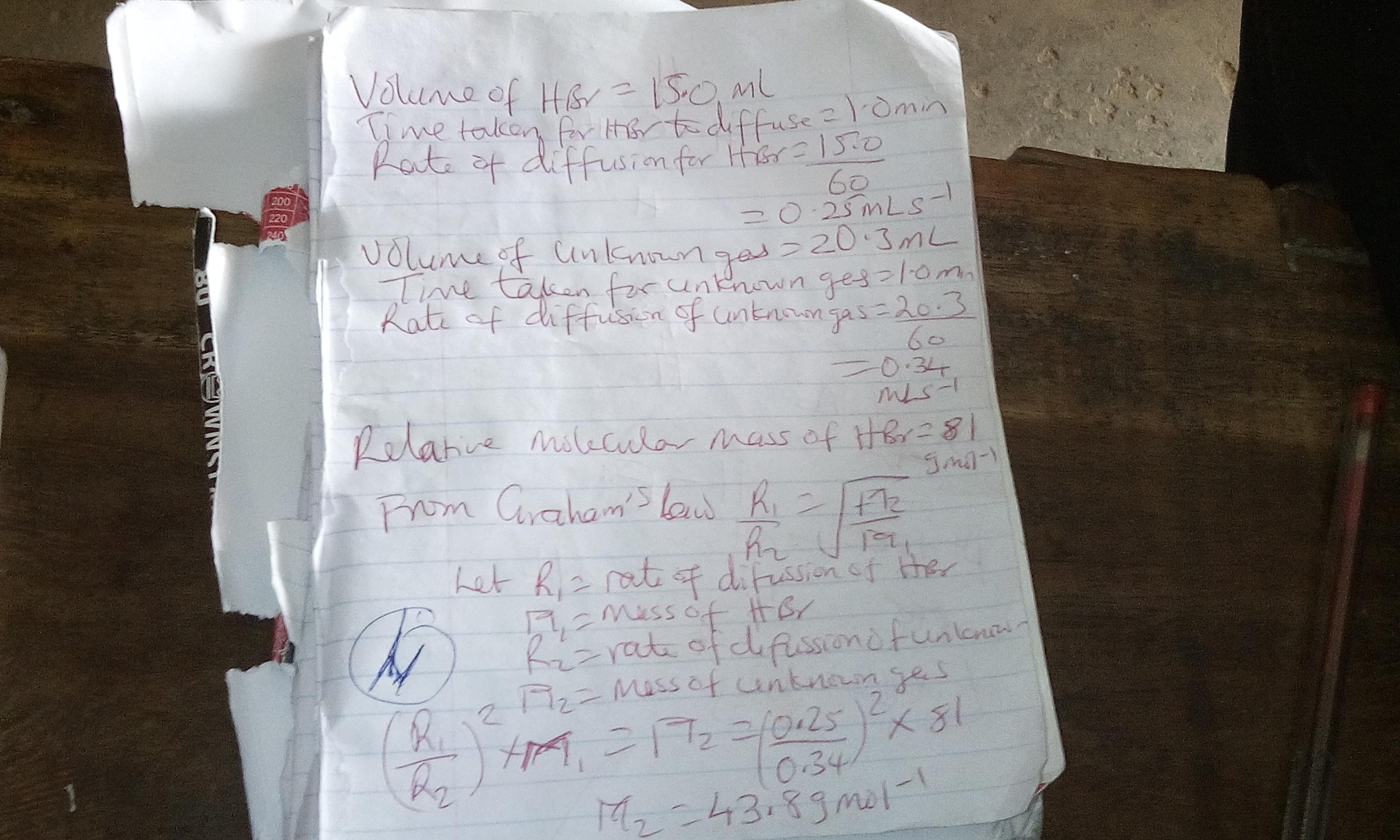
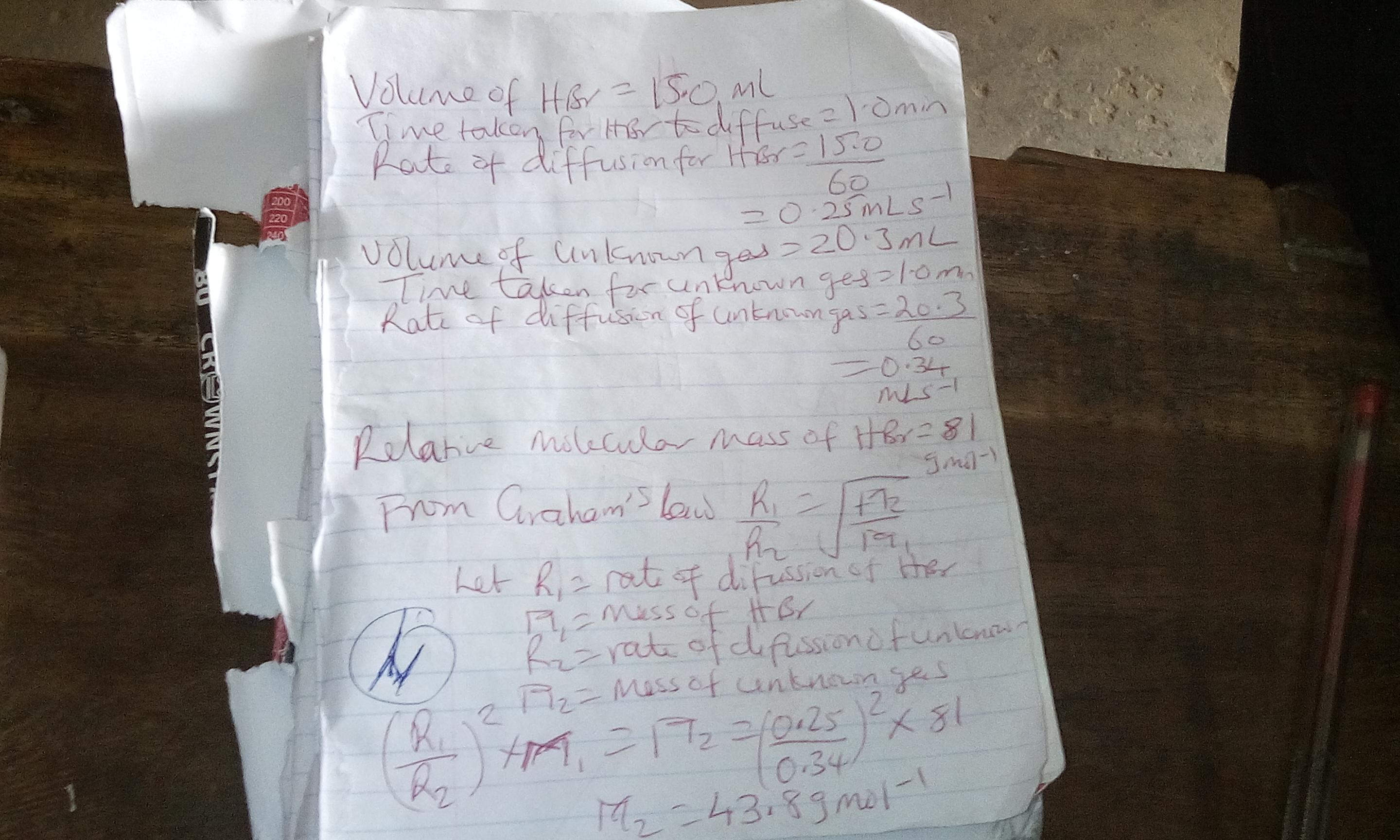
In a given diffusion apparatus, 15.0mL of HBr gas diffused in 1.0 min. In the same apparatus and under the same conditions, 20.3

mL of an unknown gas diffused in 1.0 min. The unknown gas is a hydrocarbon. Find it's molecular formula.

Chemistry
1 answer:
yanalaym [24]2 years ago
8 0

Answer: C3H3

Explanation:

We first obtain the rate of diffusion of the gases in mLs-1 which is the same as cm3s-1 since 1mL=1cm3. Then we proceed to find the relative molecular mass of the unknown gas by Graham's law of diffusion. After that we proceed to obtain its molecular formula from its molecular mass having previously been told that it is a hydrocarbon (CH). All these processes are shown in the image attached.

You might be interested in
The potential energy diagram for a reaction starts at 180 kJ and ends at 300 kJ. What type of reaction does the diagram best rep
aleksklad [387]

Answer: Endothermic reaction

Explanation:

Exothermic reactions are defined as the reactions in which energy of the product is lesser than the energy of the reactants. The total energy is released in the form of heat and \Delta H for the reaction comes out to be negative.

Endothermic reactions are defined as the reactions in which energy of the product is greater than the energy of the reactants. The total energy is absorbed in the form of heat and \Delta H for the reaction comes out to be positive.

As the energy of reactants is 180 kJ and that of products is 300 kJ, the energy of products is greater than that of reactants, which means  the energy has been absorbed and reaction is endothermic.

8 0
2 years ago
A precipitate forms when mixing solutions of sodium fluoride (NaF) and lead II nitrate (Pb(NO3)2). Complete and balance the net
Margarita [4]

Answer:

Pb^2+(aq) + 2F-(aq) → PbF2(s)

Explanation:

Step 1: Data given

sodium fluoride = NaF

lead(II)nitrate Pb(NO3)2

Step 2: The unbalanced equation

NaF(aq) + Pb(NO3)2(aq) →  PbF2(s) + NaNO3(aq)

Step 3: Balancing the equation

NaF(aq) + Pb(NO3)2(aq) →  PbF2(s) + NaNO3(aq)

On the left side we have 2x NO3 (in Pb(NO3)2), on the right side we have 1x NO3 (in NaNO3). To balance the amount of NO3 we hvae to multiply NaNO3 on the right side by 2.

NaF(aq) + Pb(NO3)2(aq) →  PbF2(s) + 2NaNO3(aq)

On the left side we have 1x Na (in NaF), on the right side we have 2x Na (in 2NaNO3). To balance the amount of Na we have to multiply NaF on the left side by 2. Now the equation is balanced.

2NaF(aq) + Pb(NO3)2(aq) →  PbF2(s) + 2NaNO3(aq)

Step 4: Calculate net ionic equation

The net ionic equation, for which spectator ions are omitted - remember that spectator ions are those ions located on both sides of the equation - will , after canceling those spectator ions in both side, look like this:

2Na+(aq) + 2F-(aq) + Pb^2+(aq) + 2NO3-(aq) → PbF2(s) + 2Na+(aq) + NO3-(aq)

Pb^2+(aq) + 2F-(aq) → PbF2(s)
4 0
2 years ago
The easiest way to determine whether a process is exothermic or endothermic is to note the change in temperature in a calorimete
Kryger [21]

Answer:

In the calorimeter, water is the <u>exothermic</u>. The salt LiCI, which will dissolve, is the <u>endothermic</u>. The final temperature of the water after the dissolution of LiCI was <u>lower</u> than the initial temperature, meaning the process is <u>exothermic</u>. In the microscopic view of the disspolution of LiCI, water molecules were seen to move <u>slowly</u> as they <u>gained </u>energy.

Explanation:

Exothermic is a process in which heat is released during the process. Endothermic reactions absorbs heat from surrounding during a chemical process. The dissolution of salt into water is an exothermic reaction. During this process heat is release and water molecules are broken down which are surrounded by salt ions.

5 0
2 years ago
Water is dissolved into n-butanol (a polar liquid). Which is the second step at the molecular level as water dissolves into n-bu
sergeinik [125]
<span>The steps of solubility of water in N-butanol is as follows:1. N-butanol molecules are attracted to the surface of the water, 2. N-butanol molecules surround water molecules, 3. Butanol mixes with water and 4. Water molecules are carried into N-butanol.</span>
7 0
2 years ago
Read 2 more answers
Which of the following is the best piece of laboratory glassware for preparing 500.0 mL of an aqueous solution of a solid?
Leni [432]

Answer:

The correct answer is option A.

Explanation:

Volumetric flask  : A glass ware with round lower body with flat bottom and with thin cylindrical neck along with mark which indicates the specific volume filled to that mark.It is used in preparation of standard solution of compound with desired concentration with fixed volume.

Erlenmeyer flask : is a flask with conical shape with flat bottom used in titration  experiments to carry out reaction with fixed volume of solution.

Test tube : Small cylindrical tube with rounded bottom used to observe reaction in between reactant taken in small amount.

Graduated beaker : Laboratory glassware used measure larger volumes of solution or to mix or stir solutions and liquids.

Graduated cylinder : Laboratory thin cylindrical glassware with accurate marking of volume used to measure an accurate volume of solutions or liquids required in an experiment.

<em><u>Volumetric flask</u></em> is the best piece of laboratory glassware for preparing 500.0 mL of an aqueous solution of a solid

8 0
2 years ago
Read 2 more answers
Other questions:
  • Na+ and Cl- are ions formed from _____.
    11·1 answer
  • A container of hydrogen gas has a volume of 1.46 liters, a pressure of 2.18 atm, and a temperature of 185 Kelvin. How many moles
    9·1 answer
  • Which of these statements describes a limitation of the Treaty on Plant Genetic Resources?
    14·2 answers
  • An equimolar mixture of N2(g) and Ar(g) is kept inside a rigid container at a constant temperature of 300 K. The initial partial
    9·1 answer
  • A flask of volume 2.0 liters, provided with a stopcock, contains oxygen at 20 oC, 1.0 ATM (1.013X10⁵ Pa). The system is heated t
    12·1 answer
  • For heat transfer purposes, a standing man can be modeled as a 30-cm-diameter, 175-cm-long vertical cylinder with both the top a
    13·1 answer
  • Anhydrous CoCl2 is blue; CoCl2•6H2O is red. When CoCl2•6H2O is heated and water is clearly being driven off, it becomes uniforml
    14·1 answer
  • What is the ph of the solution prepared by dissolving 0.927 mol hcl in enough water to make a 150 l aqueous solution?
    11·1 answer
  • 2. The model on the right looks bumpy, but when you break a large salt crystal in two, the edges of the split often look straigh
    6·2 answers
  • b) Write a few paragraphs describing the chemical reaction and explaining the energy change in the reaction. Your document shoul
    8·2 answers
Add answer
Login
Not registered? Fast signup
Signup
Login Signup
Ask question!