answer.
Ask question
Login Signup
Ask question
All categories
  • English
  • Mathematics
  • Social Studies
  • Business
  • History
  • Health
  • Geography
  • Biology
  • Physics
  • Chemistry
  • Computers and Technology
  • Arts
  • World Languages
  • Spanish
  • French
  • German
  • Advanced Placement (AP)
  • SAT
  • Medicine
  • Law
  • Engineering
Marta_Voda [28]
2 years ago
4

Imagine you are in an open field where two loudspeakers are set up and connected to the same amplifier so that they emit sound w

aves in phase at 688 Hz. Take the speed of sound in air to be 344 m/s.
Part A. If you are 3.00 m from speaker A directly to your right and 3.50 m from speaker B directly to your left, will the sound that you hear be louder than the sound you would hear if only one speaker were in use?
a. yes
b. no
Because the path difference is equal to the wavelength of the sound, the sound originating at the two speakers will interfere constructively at your location and you will perceive a louder sound.
Part B. What is the shortest distance d you need to walk forward to be at a point where you cannot hear the speakers? The forward direction is defined as being perpendicular to a line joining the two speakers and you start walking from the line that joins the two speakers.
Express your answers in meters to three significant figures.
d = m

Physics
1 answer:
riadik2000 [5.3K]2 years ago
4 0

Answer:

Distance should be 5.62m

Explanation:

We know the sound to be heard louder needs constructive interference of waves and ;no sound require destructive interference !

I should be at a distance where destructive interference could take place !

a) yes of course if only one speaker is there then there will be no wave to destruct the on coming sound wave - hence it will be heard.

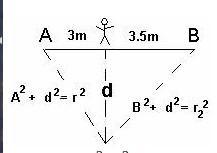
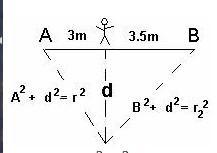
b) As clear from the figure if we don't want to hear sound then we should be at a point where destructive interference takes place.

The difference of distances 'r^{2}' and 'r2^{2}' is Δr

So, in the figure attached the Δr should be for destructive interference for no sound i-e

Δr =\frac{(2n+1)}{2}λ

or simply it should be like Δr=λ/2

We know formula for wavelength is  calculated by dividing speed with frequency i-e λ=v/f

and hence λ/2=v/2f

==> λ/2= 344/2×688

==>λ/2=1/4

but λ/2=Δr=r^{2} -r2^{2}

==> 1/4=r^{2} -r2^{2}

d= 5.26 m

You might be interested in
Imagine two people standing at placemark A and placemark E, looking at each other across the fault. Which of the following state
lord [1]

Answer:

To both observers, the land opposite them is moving to the right.

Explanation:

I have this class too. and there is also a quizlet with all the answers to the rest of the other questions. Trust me its right .

https://quizlet.com/261219090/oce-1001-chapter-2-flash-cards/

5 0
2 years ago
At t1, Car A and car B are each located at position xo moving forward at speed v. At t2, car A is located at position 2xo moving
wel

Answer:

the average velocity of car A between t1 and t2greater is greater than the average velocity of B berween t1 and t2

Explanation:

Velocity is displacement over time,

Displacement is the distance covered relative to the initial starting position

For A:

at time ti, A moved from Xo to 2Xo, displacement is 2Xo.

at time t2 a moves with speed 3V, hence, his new position will be 3Xo from 2Xo which will be at 5Xo. A's displacement is 5Xo from starting point.

For B:

at time ti, B moved from Xo to 2Xo, displacement is 2Xo.

at time t2 a moves with speed V in the opposite position so he'll be back to his starting point, hence, his new position will be at Xo. A's displacement is 0 from his starting point.

3 0
2 years ago
The equation for the change in the position of a train (measured in units of length) is given by the following expression: x = ½
mel-nik [20]

Answer:

(B) (length)/(time³)

Explanation

The equation x = ½ at² + bt³ has to be dimensionally correct. In other words the term bt³ and ½ at² must have units of change of position = length.

We solve in order to find the dimension of b:

[x]=[b]*[t]³

length=[b]*time³

[b]=length/time³

6 0
2 years ago
Read 2 more answers
Decide whether the attribute describes Earth, Venus, or both Earth and Venus.
masha68 [24]

1). both

2). Venus

3). Venus catastrophically; Earth too but much less.

4). Earth

5). Earth

6). Venus (It would be pretty hard for US to mistake Earth for a star.)


3 0
2 years ago
Read 2 more answers
(1) A typical person has a surface area of about 2m^2 and a layer of fat about 1cm thick (It can vary from 0.5 cm to 1.5 cm) . E
KATRIN_1 [288]

Answer:

1)H=714 Watts of energy is given out.

2)614.34 KCal energy is burnt in an hour in the room

3)In freezing conditions, 1337.09 KCal is spent in an hour.

Explanation:

The formula for thermal conductivity states that the rate of heat loss H is as follows:

H=\frac{KA (T_{1}-T_{2})}{x}   where,

K=Coefficient of thermal conductivity

A=Area of Cross Section

H=Rate of heat loss

x=Thickness of the material

T_{1}-T_{2}=Temperature difference between the two surfaces of the body in context

T_{1}=37°C ie. Body Temperature

T_{2}=20°C ie. Room Temperature

For first case, T_{1}-T_{2}=17°C or 17°F

K for fat= 0.21 Wm^{-1}K^{-1}

A=2m^{2}

x=0.01 m

H=\frac{0.21 * 2* 17}{0.01}

H=714 Watts of energy is given out.

2) Power×Time(in seconds) = Energy

Energy= 714 × 60 × 60=2570400 J

2570400 J=614.3403442 KCal

Therefore, 614.3403442 KCal energy is burnt in an hour.

3) Only the temperature difference becomes 37°C from 17°C , rest everything remains the same, therefore the energy will also vary due to the temperature factor and more energy will be spent as in freezing climate T_{2}=0 °C

E=\frac{614.34*37}{17}=1337.09 KCal

In freezing conditions, 1337.09 KCal is spent in an hour.
8 0
2 years ago
Other questions:
  • A space shuttle was launched from the Earth to the moon. The average, or accepted, value of the distance of the Earth to the moo
    13·1 answer
  • The position of an object that is oscillating on an ideal spring is given by the equation x=(12.3cm)cos[(1.26s−1)t]. (a) at time
    15·1 answer
  • A 1.0-c point charge is 15 m from a second point charge, and the electric force on one of them due to the other is 1.0 n. what i
    9·1 answer
  • A torque of magnitude T = 11 kN·m is applied to the end of a tank containing compressed air under a pressure of 8 MPa. Knowing t
    6·1 answer
  • A diver explores a shallow reef off the coast of Belize. She initially swims d1 = 74.8 m north, makes a turn to the east and con
    15·1 answer
  • Combine Newton's 2nd law and Hooke's law for a spring to find the acceleration of the block a(t) as a function of time. Express
    15·1 answer
  • an ice skater, standing at rest, uses her hands to push off against a wall. she exerts an average force on the wall of 120 N and
    14·1 answer
  • A ship sends out a 1200 Hz sound wave, which has a wavelength of 120 cm in the water. What would happen if that ship sent out a
    6·1 answer
  • An ac source of period T and maximum voltage V is connected to a single unknown ideal element that is either a resistor, and ind
    6·1 answer
  • A rectangular block weighs 240 N. the area of the block in contact with the floor is 20 cm2.calculate the pressure on the floor(
    11·1 answer
Add answer
Login
Not registered? Fast signup
Signup
Login Signup
Ask question!