answer.
Ask question
Login Signup
Ask question
All categories
  • English
  • Mathematics
  • Social Studies
  • Business
  • History
  • Health
  • Geography
  • Biology
  • Physics
  • Chemistry
  • Computers and Technology
  • Arts
  • World Languages
  • Spanish
  • French
  • German
  • Advanced Placement (AP)
  • SAT
  • Medicine
  • Law
  • Engineering
marysya [2.9K]
2 years ago
8

One of the emission lines of the hydrogen atom has a wavelength of 93.07 nm. Determine the initial value of n associated with th

is emission.

Chemistry
2 answers:
Softa [21]2 years ago
8 0

Answer:

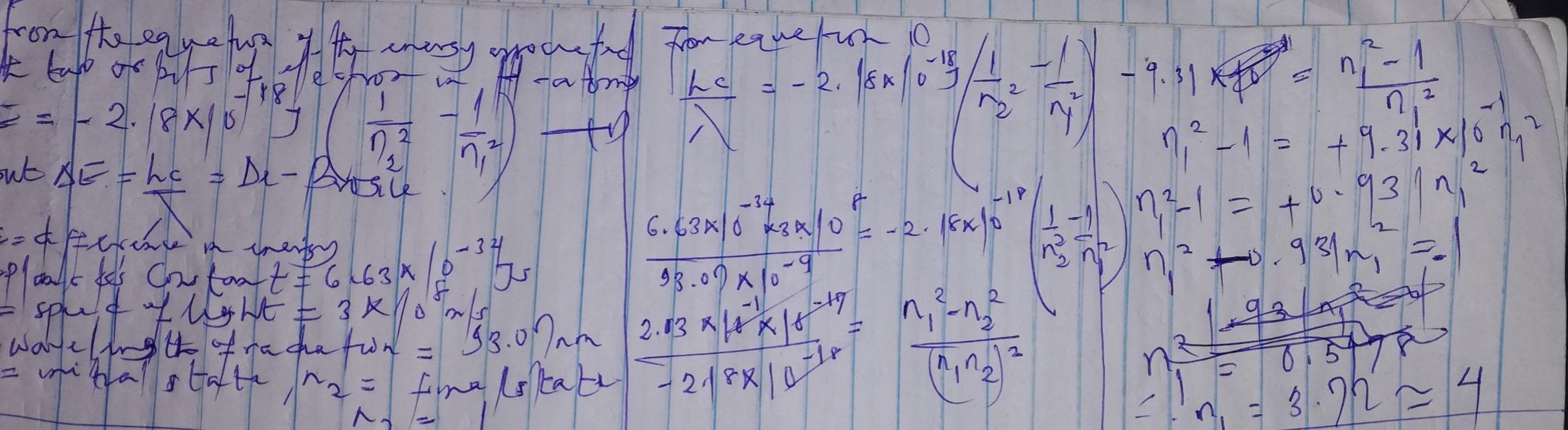
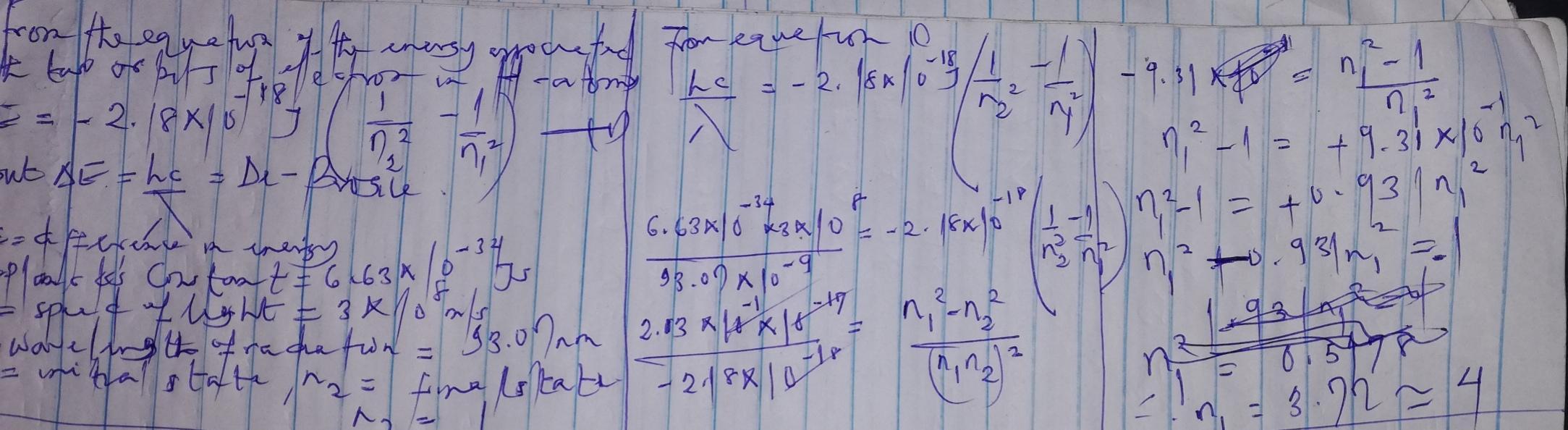
Initial value of n = 4

Explanation:

The detailed calculation and derivation was from de - brogile equation and the appropriate substitutioj were done as shown in the attachment.

Deffense [45]2 years ago
5 0

Answer:

ni, the initial value of n associated with the emission = 6

This is found by the application of the electron energy level, and the Rydberg's equation as can be seen in the following explanation

Explanation:

The known variables are

λ = 93.7 × 10⁻⁹m which is a Lyman series as it lies in the UV region

The series is in effect when the final destination of the electron is the first shell, hence

nf = final value of n =1 for ultraviolet light

The energy levels of one electron ions are given by the equation

En = -2.18×10⁻¹⁸J × Z2/n2

Z = atomic number and

n = energy level

Ef = -RH × (Z2/nf2) and Ei = -RH × (Z/ni)2

∆E = Ef - En = -RH × (Z/nf)2 – (-RH × (Z/ni)2)

Collecting like terms we have

∆E = - RH × Z × (1/nf2 – 1/ni2)

For released energy, the emitted photon energy, ∆E, is

∆E = -h×c/λ

h = Planck’s constant = 6.626×10⁻³⁴J×s

λ = wavelength of the wave = 93.7×10⁻⁹m

Z = atomic number of hydrogen = 1

n = principal quantum number

RH = Rydberg constant = 2.178×10⁻¹⁸J

c = speed of light = 299792458 m/s

ni = unknown

Thus we have ∆E = - RH × Z × (1/nf2 – 1/ni2) is the same as

-h×c/λ = - RH × Z × (1/nf2 – 1/ni2)

Inputting the known vales and constants from above we have on the left and right of the above equation

-2.12×10⁻¹⁸J = -2.178×10-18×1×(1/12 – 1/ni2)

Or (1/12 – 1/ni2) = 0.97337, or 1 – 1/ni2 = 0.97337

Which means 1/ni2 = 0.0266 or ni = 6.128 ≈ 6

ni, the initial value of n associated with the emission = 6
You might be interested in
Calculate the relative atomic mass of this sample of Germanium, giving your answer to two decimal places. ......................
Sloan [31]

Answer:

Germanium is an element in the same group with Carbon and Silicon. The atomic number is 32. The relative atomic mass is usually measured with the Sample of an isotope. In this case Germanium has a relative atomic mass of 72.63

6 0
2 years ago
Read 2 more answers
________ is the study of matter and the energy that causes matter to combine, break apart and recombine in everything living and
Kipish [7]

Answer: Emperical formula

Explanation:

8 0
2 years ago
Suppose you had a balloon containing 1 mole of helium at STP and a balloon containing 1 mole of oxygen at STP. Which statement(s
AleksAgata [21]

Answer:

The true statement  is option A.

Explanation:

Using ideal gas equation:

PV = nRT

where,

P = Pressure of gas =  1 atm

V = Volume of gas = ?

n = number of moles of gas = 1 mol

R = Gas constant = 0.0821 L.atm/mol.K

T = Temperature of gas = 273.15 K

V=\frac{nRT}{P}=\frac{1 mol\times 0.0821 atm L/mol K\times 273.15 K}{1 atm}

V = 22.42 L

This means that 1 mole of an ideal gas at STP occupies 22.42 liters of volume.

So, 1 mole of helium gas and 1 mole of oxygen gas will have same value of volume in their respective balloons at STP.

7 0
2 years ago
the melting point of scandium fluoride is 1552°c, explain why scandium fluoride has a high melting point.​
Greeley [361]

Answer:

Scandium(III) fluoride, ScF3, is an ionic compound. It is slightly soluble in water but dissolves in the presence of excess fluoride to form the ScF63− anion.

hope it will help you......

5 0
2 years ago
Read 2 more answers
The equation for the pH of a substance is pH = –log[H+], where H+ is the concentration of hydrogen ions. A basic solution has a
Rzqust [24]
For the basic solution:
11.2 = -log[H+]
[H+] = 6.31 x 10⁻¹²
For the acidic solution:
2.4 = -log[H+]
[H+] = 3.98 x 10⁻³
The difference:
3.98 x 10⁻³ - 6.31 x 10⁻¹²
≈ 4.0 x 10⁻³
The answer is B
3 0
2 years ago
Read 2 more answers
Other questions:
  • How many grams of o2 are required to produce 358.5 grams of zno??
    10·2 answers
  • Consider the equation: 2NO2(g) N2O4(g). Using ONLY the information given by the equation which of the following changes would in
    15·2 answers
  • Consider a buffer solution containing CH3COOH and CH3COO-, with an equilibrium represented by: CH3COOH(aq) + H2O (l) ←----→ H3O+
    5·1 answer
  • 100 mL of a 0.300 M solution of AgNO3 reacts with 100 mL of a 0.300 M solution of HCl in a coffee-cup calorimeter and the temper
    14·1 answer
  • What fact do scientists believe provides evidence for the big bang theory?a. all comets follow elliptical orbits.b. most extra-s
    10·2 answers
  • Identify the oxidizing and reducing agents in the following: 2H+(aq) + H2O2(aq) + 2Fe2+(aq) → 2Fe3+(aq) + 2H2O(l)
    7·1 answer
  • The reaction A  B + C is second order in A. When [A]0 = 0.100 M, the reaction is 35.0% complete in 32.3 hours. Calculate the va
    15·1 answer
  • The decantate from Question 1 that possibly contains K, Zn, or Cr, is neutralized with acetic acid and divided into the appropri
    9·1 answer
  • As the pressure of a system changes, boiling points can change in what direction?
    5·2 answers
  • (a) At what substrate concentration would an enzyme with a kcat of 30.0 s−1 and a Km of 0.0050 M operate at one-quarter of its m
    13·1 answer
Add answer
Login
Not registered? Fast signup
Signup
Login Signup
Ask question!