answer.
Ask question
Login Signup
Ask question
All categories
  • English
  • Mathematics
  • Social Studies
  • Business
  • History
  • Health
  • Geography
  • Biology
  • Physics
  • Chemistry
  • Computers and Technology
  • Arts
  • World Languages
  • Spanish
  • French
  • German
  • Advanced Placement (AP)
  • SAT
  • Medicine
  • Law
  • Engineering
Alisiya [41]
2 years ago
9

Rank the formation of the solutions A, B, and C from the most exothermic to the most endothermic. Rank the enthalpy of solution

from most exothermic to most endothermic. To rank items as equivalent, overlap them.

Chemistry
1 answer:
Elodia [21]2 years ago
4 0

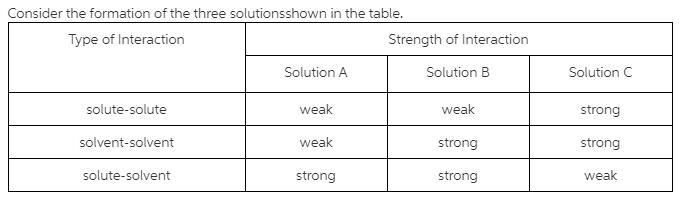
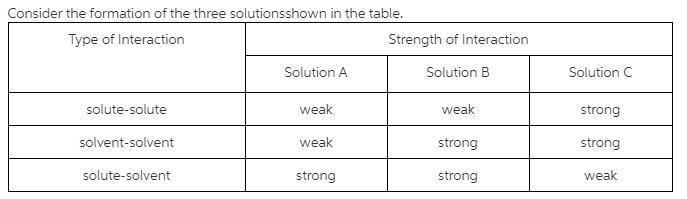
This is an incomplete question, the table is attached below.

Answer : The correct ranking of the solution from most exothermic to most endothermic will be: A, B and C.

Explanation :

As we know that the intermolecular force of attraction play an important role in the interaction of solute-solute, solute-solvent and solvent solvent solution.

In the solution A, the solute-solute and solvent-solvent interactions are weak. So, their solute-solvent interaction will be strong. That means, the solution will be more exothermic.

In the solution C, the solute-solute and solvent-solvent interactions are strong. So, their solute-solvent interaction will be weak. That means, the solution will be more endothermic.

Thus, the correct ranking of the solution from most exothermic to most endothermic will be: A, B and C.

You might be interested in
When the reaction CO2(g) + H2(g) ⇄ H2O(g) + CO(g) is at equilibrium at 1800◦C, the equilibrium concentrations are found to be [C
UNO [17]

Answer:

The new molar concentration of CO at equilibrium will be  :[CO]=1.16 M.

Explanation:

Equilibrium concentration of all reactant and product:

[CO_2] = 0.24 M, [H_2] = 0.24 M, [H_2O] = 0.48 M, [CO] = 0.48 M

Equilibrium constant of the reaction :

K=\frac{[H_2O][CO]}{[CO_2][H_2]}=\frac{0.48 M\times 0.48 M}{0.24 M\times 0.24 M}

K = 4

CO_2(g) + H_2(g) \rightleftharpoons H_2O(g) + CO(g)

Concentration at eq'm:

0.24 M          0.24 M                 0.48 M            0.48 M

After addition of 0.34 moles per liter of CO_2 and H_2 are added.

(0.24+0.34) M    (0.24+0.34) M  (0.48+x)M         (0.48+x)M

Equilibrium constant of the reaction after addition of more carbon dioxide and water:

K=4=\frac{(0.48+x)M\times (0.48+x)M}{(0.24+0.34)\times (0.24+0.34) M}

4=\frac{(0.48+x)^2}{(0.24+0.34)^2}

Solving for x: x = 0.68

The new molar concentration of CO at equilibrium will be:

[CO]= (0.48+x)M = (0.48+0.68 )M = 1.16 M

3 0
2 years ago
What mass (g) of barium iodide is contained in 188 ml of a barium iodide solution that has an iodide ion concentration of 0.532m
Katarina [22]

Answer:

What mass (g) of barium iodide is contained in 188 mL of a barium iodide solution that has an iodide ion concentration of 0.532 M?

A) 19.6

B) 39.1

C) 19,600

D) 39,100

E) 276

The correct answer to the question is

B) 39.1  grams

Explanation:

To solve the question

The molarity ratio is given by

188 ml of 0.532 M solution of iodide.

Therefore we have number of moles = 0.188 × 0.532 M = 0.100016 Moles

To find the mass, we note that the Number of moles = \frac{Mass}{Molar Mass} from which we have

Mass = Number of moles × molar mass

Where the molar mass of Barium Iodide = 391.136 g/mol

= 0.100016 moles ×391.136 g/mol = 39.12 g

8 0
2 years ago
A chunk of dry ice, solid CO2, "disappears" after sitting at room temperature for a while. There is no puddle of liquid. What ha
Vika [28.1K]
I believe the answer is A.
8 0
2 years ago
The enthalpy of formation of water is –285.8 kJ/mol. What can be inferred from this statement?
LiRa [457]
A negative formation enthalpy means that the reaction is exothermic, or that heat is released during the process.
(C,)
4 0
2 years ago
Read 2 more answers
For the reaction below, Kp 5 1.16 at 800.8C. CaCO3(s) 34 CaO(s) 1 CO2(g) If a 20.0-g sample of CaCO3 is put into a 10.0-L contai
Elena L [17]

Answer:

The mass percentage of calcium carbonated reacted is 2.5%.

Explanation:

The reaction is:

CaCO_{3}(s)--->CaO(s)+CO_{2}(g)

Thus the Kp of the equilibrium will be:

Kp = partial pressure of carbon dioxide [as the other are solid]

Moles of calcium carbonate initially present = \frac{mass}{molarmass}=\frac{20}{100}=0.2

Let us apply ICE table to the equilibrium given:

                        CaCO_{3}(s)--->CaO(s)+CO_{2}(g)

Initial                       0.2                       0          0

Change                 -x                            +x        +x

Equilibrium           0.2-x                         x          x

Kp = partial pressure of carbon dioxide

Kp = Kc(RT)ⁿ

where n = difference in the number of moles of gaseous products and reactants

for given reaction n = 1

R = gas constant = 8.314 J /mol K

T = temperature = 800 ⁰C = 1073 K

Putting values

Kc =\frac{Kp}{RT}=\frac{1.16}{8.314X1073}=1.3X10^{-4}

Kc = \frac{[CO_{2}][CaO]}{[CaCO_{3}]}= \frac{x^{2} }{(0.2-x)}=1.3X10^{-4}

1.3X10^{-4}(0.2-x)=x^{2}

x^{2} = 0.26X10^{-4}-1.3X10^{-4}x

On calculating

x =  0.005

where x = the moles of calcium carbonate dissociated or reacted.

Percentage of the moles or mass reacted = \frac{molesreacted X100}{initialmoles}=\frac{0.005X100}{0.2}=2.5%

7 0
2 years ago
Other questions:
  • Why is nonpoint source pollution potentially more harmful than point source pollution?
    7·2 answers
  • Determine the y component of reaction at a using scalar notation. express your answer to three significant figures and include t
    10·1 answer
  • Consider the structure of the amino acid alanine. indicate the hybridization about each interior atom.
    6·2 answers
  • A student checks the air in her bicycle tires early in the morning when it is cool outside. If she measures it again later in th
    12·1 answer
  • A 0.1873 g sample of a pure, solid acid, H2X (a diprotic acid) was dissolved in water and titrated with 0.1052 M NaOH solution.
    9·1 answer
  • An amount of solid barium chloride, 20.8 g, is dissolved in 100 g water in a coffee-cup calorimeter by the reaction: BaCl2 (s) 
    14·1 answer
  • What is the theoretical yield of aluminum that can be produced by the reaction of 60.0 g of aluminum oxide with 30.0 g of carbon
    12·1 answer
  • A 1-L soda bottle contains dissolved carbon dioxide gas. Which bottle would have the highest concentration of dissolved gas? a b
    7·2 answers
  • Two mixtures were prepared from three very narrow molar mass distribution polystyrene samples with molar masses of 10,000, 30,00
    5·1 answer
  • A laboratory utilizes a mixture of 10% dimethyl sulfoxide (DMSO) in the freezing and long-term storage of embryonic stem cells.
    5·1 answer
Add answer
Login
Not registered? Fast signup
Signup
Login Signup
Ask question!