answer.
Ask question
Login Signup
Ask question
All categories
  • English
  • Mathematics
  • Social Studies
  • Business
  • History
  • Health
  • Geography
  • Biology
  • Physics
  • Chemistry
  • Computers and Technology
  • Arts
  • World Languages
  • Spanish
  • French
  • German
  • Advanced Placement (AP)
  • SAT
  • Medicine
  • Law
  • Engineering
Aloiza [94]
2 years ago
11

A gas turbine operates with a regenerator and two stages of reheating and intercooling. Air enters this engine at 14 psia and 60

F; the pressure ratio for each stage of compression is 3; the air temperature when entering the turbine is 940F; and the regenerator operates perfectly.
Determine the mass flow rate of the air passing through this engine and the rates of heat addition and rejection when this engine produces 1000 hp. Assume isentropic operations for all compressor and the turbine stages and use constant specific heats at room temperature.
Engineering
1 answer:
Rzqust [24]2 years ago
5 0

Answer:

flow(m) = 7.941 lbm/s

Q_in = 90.5184 Btu/lbm

Q_out = 56.01856 Btu/lbm

Explanation:

Given:

- T_1 = 60 F = 520 R

- T_6 = 940 = 1400 R

- Heat ratio for air k = 1.4

- Compression ratio r = 3

- W_net,out = 1000 hp

Find:

mass flow rate of the air

rates of heat addition and rejection

Solution:

- Using ideal gas relation compute T_2, T_4, T_10:

                     T_2 = T_1 * r^(k-1/k)

                     T_2 = T_4 = T_10 = 520*3^(.4/1.4) = 711.744 R

- Using ideal gas relation compute T_7, T_5, T_9:

                     T_7 = T_6 * r^(-k-1/k)

                     T_7 = T_5 = T_9 = 1400*3^(-.4/1.4) = 1022.84 R

- The mass flow rate is obtained by:

                     flow(m) = W_net,out / 2*c_p*(1400-1022.84-711.744+520)

                     flow(m) = 1000*.7068 / 2*0.24*(1400-1022.84-711.744+520)

                     flow(m) = 7.941 lbm/s

- The heat input is as follows:

                     Q_in = c_p*(T_6 - T_5)

                     Q_in = 0.24*(1400 - 1022.84)

                     Q_in = 90.5184 Btu/lbm

- The heat output is as follows:

                     Q_out = c_p*(T_10 - T_1)

                     Q_out = 0.24*(711.744 - 520)

                    Q_out = 56.01856 Btu/lbm


You might be interested in
The pump of a water distribution system is powered by a 6-kW electric motor whose efficiency is 95 percent. The water flow rate
Sonja [21]

Answer:

a) Mechanical efficiency (\varepsilon)=63.15%  b) Temperature rise= 0.028ºC

Explanation:

For the item a) you have to define the mechanical power introduced (Wmec) to the system and the power transferred to the water (Pw).

The power input (electric motor) is equal to the motor power multiplied by the efficiency. Thus, Wmec=0.95*6kW=5.7 kW.

Then, the power transferred (Pw) to the fluid is equal to the flow rate (Q) multiplied by the pressure jump \Delta P. So P_W = Q*\Delta P=0.018m^3/s * 200x10^3 Pa=3600W.

The efficiency is defined as the ratio between the output energy and the input energy. Then, the mechanical efficiency is \varepsilon=3.6kW/5.7kW=0.6315=63.15\%

For the b) item you have to consider that the inefficiency goes to the fluid as heat. So it is necessary to use the equation of the heat capacity but in a "flux" way. Calling <em>H</em> to the heat transfered to the fluid, the specif heat of the water and \rho the density of the water:

[tex]H=(5.7-3.6) kW=\rho*Q*c*\Delta T=1000kg/m^3*0.018m^3/s*4186J/(kg \ºC)*\Delta T[/tex]

Finally, the temperature rise is:

\Delta T=2100/75348 \ºC=0.028 \ºC

7 0
2 years ago
A fatigue test was conducted in which the mean stress was 46.2 MPa and the stress amplitude was 219 MPa.
sleet_krkn [62]

Answer:

a)σ₁ = 265.2 MPa

b)σ₂ = -172.8 MPa

c)Stress\ ratio =-0.65

d)Range = 438 MPa

Explanation:

Given that

Mean stress ,σm= 46.2 MPa

Stress amplitude ,σa= 219 MPa

Lets take

Maximum stress level = σ₁

Minimum stress level =σ₂

The mean stress given as

\sigma_m=\dfrac{\sigma_1+\sigma_2}{2}

2\sigma_m={\sigma_1+\sigma_2}

2 x 46.2 =  σ₁ +  σ₂

 σ₁ +  σ₂ = 92.4 MPa    --------1

The amplitude stress given as

\sigma_a=\dfrac{\sigma_1-\sigma_2}{2}

2\sigma_a={\sigma_1-\sigma_2}

2 x 219 =  σ₁ -  σ₂

 σ₁ -  σ₂ = 438 MPa    --------2

By adding the above equation

2  σ₁ = 530.4

σ₁ = 265.2 MPa

-σ₂ = 438 -265.2 MPa

σ₂ = -172.8 MPa

Stress ratio

Stress\ ratio =\dfrac{\sigma_{min}}{\sigma_{max}}

Stress\ ratio =\dfrac{-172.8}{265.2}

Stress\ ratio =-0.65

Range = 265.2 MPa - ( -172.8 MPa)

Range = 438 MPa

8 0
2 years ago
A 227 pound compressor is supported by four legs that contact the floor of a machine shop. At the bottom of each leg there is a
Ganezh [65]

Answer:

1.312 in

Explanation:

Data provided in the question:

Weight of the compressor, W = 227 pound

Number of legs = 4

Maximum pressure = 42 psi

Now,

Let F be the force taken by the legs

Therefore,

W = 4F

or

227 pound = 4F

or

F = 56.75 pounds

Also,

Force = Pressure × Area

or

56.75 pounds = 42 psi × πr²                      [ r is the diameter of one leg]

or

r² = 0.4301

or

r = 0.656

therefore,

diameter = 2r = 2 × 0.656

= 1.312 in

6 0
2 years ago
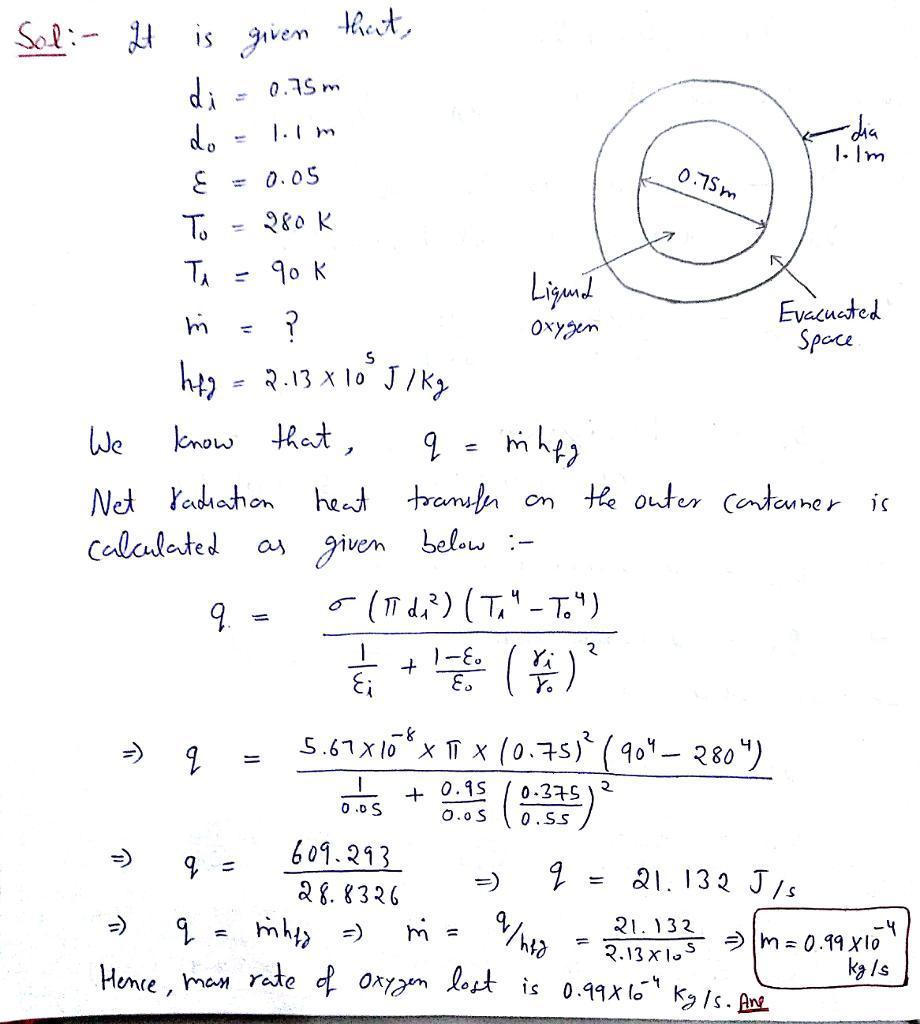
Liquid oxygen is stored in a thin-walled, spherical container 0.75 m in diameter, which is enclosed within a second thin-walled,
nadezda [96]

Answer:

Explanation:

the solution is well stated

3 0
2 years ago
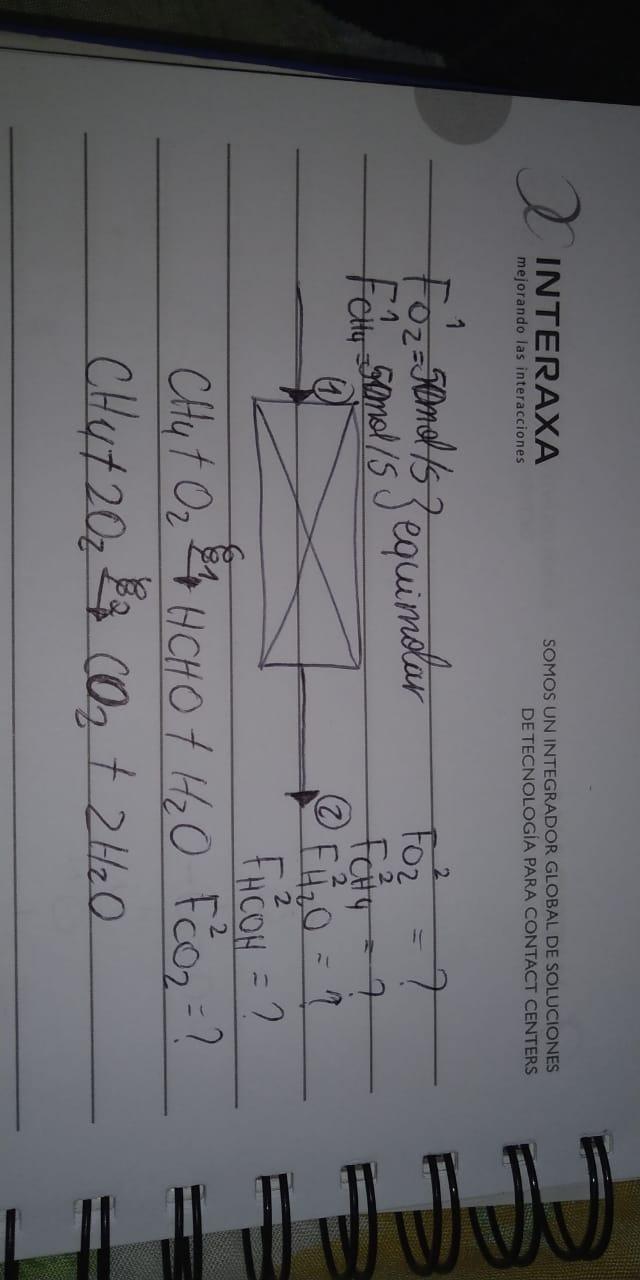
Methane and oxygen react in the presence of a catalyst to form formaldehyde. In a parallel reaction, methane is oxidized to carb
Nezavi [6.7K]

Answer:

y_{CH_4}^2=\frac{5mol/s}{100mol/s}=0.05\\y_{O_2}^2=\frac{3mol/s}{100mol/s}=0.03\\y_{H_2O}^2=\frac{47mol/s}{100mol/s}=0.47\\y_{HCHO}^2=\frac{43mol/s}{100mol/s}=0.43\\y_{CO_2}^2=\frac{2mol/s}{100mol/s}=0.02

Explanation:

Hello,

a. On the attached document, you can see a brief scheme of the process. Thus, to know the degrees of freedom, we state the following unknowns:

- \xi_1 and \xi_2: extent of the reactions (2).

- F_{O_2}^2, F_{CH_4}^2, F_{H_2O}^2, F_{HCHO}^2 and F_{CO_2}^2: Molar flows at the second stream (5).

On the other hand, we've got the following equations:

- F_{O_2}^2=50mol/s-\xi_1-2\xi_2: oxygen mole balance.

- F_{CH_4}^2=50mol/s-\xi_1-\xi_2: methane mole balance.

- F_{H_2O}^2=\xi_1+2\xi_2: water mole balance.

- F_{HCHO}^2=\xi_1: formaldehyde mole balance.

- F_{CO_2}^2=\xi_2: carbon dioxide mole balance.

Thus, the degrees of freedom are:

DF=7unknowns-5equations=2

It means that we need two additional equations or data to solve the problem.

b. Here, the two missing data are given. For the fractional conversion of methane, we define:

0.900=\frac{\xi_1+\xi_2}{50mol/s}

And for the fractional yield of formaldehyde we can set it in terms of methane as the reagents are equimolar:

0.860=\frac{F_{HCHO}^2}{50mol/s}

In such a way, one realizes that the output formaldehyde's molar flow is:

F_{HCHO}^2=0.860*50mol/s=43mol/s

Which is equal to the first reaction extent \xi_1, therefore, one computes the second one from the fractional conversion of methane as:

\xi_2=0.900*50mol/s-\xi_1\\\xi_2=0.900*50mol/s-43mol/s\\\xi_2=2mol/s

Now, one computes the rest of the output flows via:

- F_{O_2}^2=50mol/s-43mol/s-2*2mol/s=3mol/s

- F_{CH_4}^2=50mol/s-43mol/s-2mol/s=5mol/s

- F_{H_2O}^2=43mol/s+2*2mol/s=47mol/s

- F_{HCHO}^2=43mol/s

- F_{CO_2}^2=2mol/s

The total output molar flow is:

F_{O_2}+F_{CH_4}+F_{H_2O}+F_{HCHO}+F_{CO_2}=100mol/s

Therefore the output stream composition turns out into:

y_{CH_4}^2=\frac{5mol/s}{100mol/s}=0.05\\y_{O_2}^2=\frac{3mol/s}{100mol/s}=0.03\\y_{H_2O}^2=\frac{47mol/s}{100mol/s}=0.47\\y_{HCHO}^2=\frac{43mol/s}{100mol/s}=0.43\\y_{CO_2}^2=\frac{2mol/s}{100mol/s}=0.02

Best regards.

7 0
2 years ago
Other questions:
  • A circular ceramic plate that can be modeled as a blackbody is being heated by an electrical heater. The plate is 30 cm in diame
    15·1 answer
  • If the electric field just outside a thin conducting sheet is equal to 1.5 N/C, determine the surface charge density on the cond
    9·1 answer
  • Refrigerant-134a at 400 psia has a specific volume of 0.1384 ft3/lbm. Determine the temperature of the refrigerant based on (a)
    6·1 answer
  • The Gill Art Gallery wishes to maintain data on their customers, artists and paintings. They may have several paintings by each
    7·1 answer
  • In this module you learned about searching, sorting and algorithms in C++ and how to implement these elements in your C++ progra
    6·1 answer
  • Two airstreams are mixed steadily and adiabatically. The first stream enters at 35°C and 30 percent relative humidity at a rate
    6·1 answer
  • An ideal Diesel cycle has a compression ratio of 18 and a cutoff ratio of 1.5. Determine the maximum air temperature and the rat
    9·1 answer
  • 2.24 Carbon dioxide (CO2) gas in a piston-cylinder assembly undergoes three processes in series that begin and end at the same s
    6·1 answer
  • The typical Canadian worker is able to produce 100 board feet (a unit of measure) of lumber or 1000 light bulbs per year. The wo
    12·1 answer
  • What are some goals of NYFEA? Select three options.
    9·2 answers
Add answer
Login
Not registered? Fast signup
Signup
Login Signup
Ask question!