answer.
Ask question
Login Signup
Ask question
All categories
  • English
  • Mathematics
  • Social Studies
  • Business
  • History
  • Health
  • Geography
  • Biology
  • Physics
  • Chemistry
  • Computers and Technology
  • Arts
  • World Languages
  • Spanish
  • French
  • German
  • Advanced Placement (AP)
  • SAT
  • Medicine
  • Law
  • Engineering
Dafna11 [192]
2 years ago
5

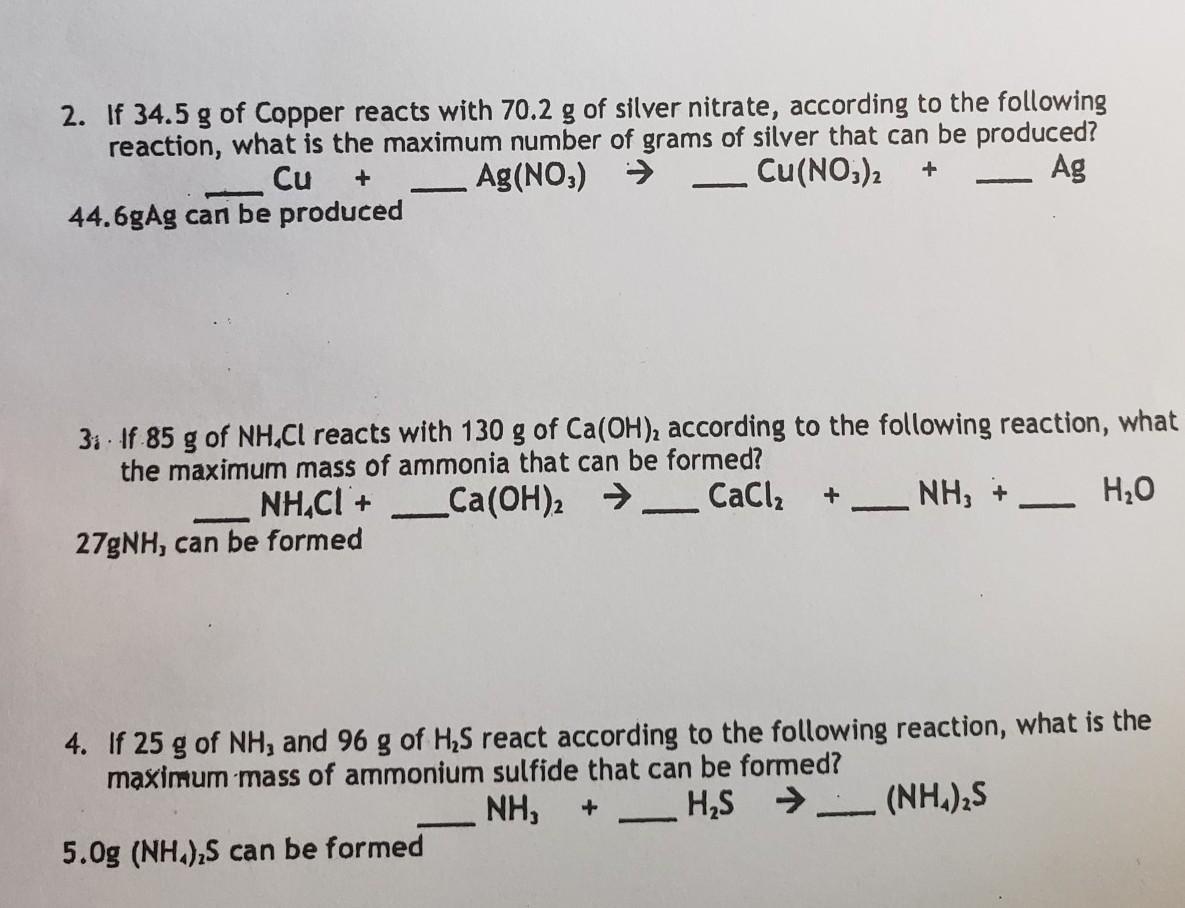
If 34.5 g of Copper reacts with 70.2 g of silver nitrate, according to the following

Chemistry
2 answers:
Verizon [17]2 years ago
6 0

Answer:

m_{Ag}=44.3gAg

Explanation:

Hello,

In this case, the first step is to write the balanced chemical reaction:

Cu + 2 Ag(NO_3) \rightarrow Cu(NO_3)_2 + 2Ag

Next, we find the limiting reactant, for that reason we compute the moles of copper that are available and the moles that will react with 70.2 g of silver nitrate as shown below:

n_{Cu}^{available}=34.5gCu*\frac{1mol Cu}{ 63.546 gCu}=0.543molCu \\n_{Cu}^{reacted \ with \ Ag(NO_3) }=70.2gAg(NO_3)*\frac{1molAg(NO_3)}{169.87gAg(NO_3)}*\frac{1molCu}{2molAg(NO_3)} =0.207molCuIn such a way, since there are more available moles of copper, it is in excess, so the silver nitrate is the limiting reactant, this, the maximum grams of silver result:

m_{Ag}=0.207molCu*\frac{2molAg}{1molCu} *\frac{108gAg}{1molAg} =44.3gAg

Best regards.

Vlada [557]2 years ago
4 0

Answer:

44,55 can be produced.

Explanation:

First, we balanced the equation

1Cu + 2AgNO3 → 1Cu(NO3)2 + Ag

Then, we find the moles of each reagent

mol Cu = \frac{34,5g}{63,55\frac{g}{mol} } = 0,543 mol\\

mol AgNO3 = \frac{70,2g}{169,87\frac{g}{mol} } = 0,413 mol\\

Now, we find the limiting reagent from the quantities of product that can be formed from each reagent

mol AgNO3= 0,543mol Cu . \frac{2 mol AgNo3}{1 mol Cu} = 1,086 mol

mol Cu= 0,413 mol AgNO3 . \frac{1 mol Cu}{2 mol AgNO3} = 0,206 mol

1,086 moles of AgNO3 is necessary for each mole of Cu since we have 0.413 moles of Ag(NO3), the nitrate is the limiting reagent

the value of the limiting reagent determines the amount of product that is generated

∴ 0,413 mol of Ag can be produced

Ag = 0,413 mol . 107,87\frac{g}{mol} = 44,55g

Ag≈ 44,6g

You might be interested in
What do a banana and a human have in common?
Dmitry [639]

Answer:

DNA between a human and a banana is 41 percent similar.

Explanation:

3 0
2 years ago
Read 2 more answers
Which of the following are examples of plasma?
artcher [175]
The answers are "t<span>ails of comets, the ionosphere, and a neon sign." or options A, D, and E. Tails of comments are mainly made of plasma. Ice cubes are examples of a solid. A gas fire key word gas is example of a gas. The ionosphere is also mainly made of plasma. A neon sign uses plasma in order to work. A flashlight uses a light bulb which isn't a example of plasma therefore  thats a no.

Hope this helps!
</span>
4 0
2 years ago
Read 2 more answers
HA and HB are two strong monobasic acids. 25.0cm3 of 6.0mol/dm3 HA is mixed with 45.0cm3 of 3.0mol/dm3 HB.
Lostsunrise [7]

Answer:

The H+ (aq) concentration of the resulting solution is 4.1 mol/dm³

(Option C)

Explanation:

Given;

concentration of HA, C_A = 6.0mol/dm³

volume of HA, V_A  = 25.0cm³, = 0.025dm³

Concentration of HB, C_B = 3.0mol/dm³

volume of HB, V_B = 45.0cm³ = 0.045dm³

To determine the H+ (aq) concentration in mol/dm³ in the resulting solution, we apply concentration formula;

C_iVi = C_fV_f

where;

C_i is initial concentration

V_i is initial volume

C_f is final concentration of the solution

V_f is final volume of the solution

C_iV_i = C_fV_f\\\\Based \ on \ this\ question, we \ can \ apply\ the \ formula\ as;\\\\C_A_iV_A_i + C_B_iV_B_i = C_fV_f\\\\C_A_iV_A_i + C_B_iV_B_i = C_f(V_A_i\ +V_B_i)\\\\6*0.025 \ + 3*0.045 = C_f(0.025 + 0.045)\\\\0.285 = C_f(0.07)\\\\C_f = \frac{0.285}{0.07} = 4.07 = 4.1 \ mol/dm^3

Therefore, the H+ (aq) concentration of the resulting solution is 4.1 mol/dm³

7 0
2 years ago
A 63.5 g sample of an unidentified metal absorbs 355 ) of heat when its temperature changes
insens350 [35]

0.208 is the specific heat capacity of the metal.

Explanation:

Given:

mass (m)  = 63.5 grams 0R 0.0635 kg

Heat absorbed (q) = 355 Joules

Δ T (change in temperature) = 4.56 degrees or 273.15+4.56 = 268.59 K

cp (specific heat capacity) = ?

the formula used for heat absorbed  and to calculate specific heat capacity of a substance will be calculated by using the equation:

q = mc Δ T

c = \frac{q}{mΔ T}

c = \frac{355}{63.5X 268.59}

 = 0.208 J/gm K

specific heat capacity of 0.208 J/gm K

The specific heat capacity is defined as  the heat required to raise the temperature of a substance which is 1 gram. The temperature is in Kelvin and energy required is in joules.


5 0
2 years ago
The first eighteen chemical elements on the periodic table are described below in a series of statements. The first 1S letters o
Aleonysh [2.5K]

Answer: The questions looks unclear

Explanation: Periodic table is a table that contains elements arranged according to their increasing atomic number.

1. D belongs to group 4

E. Belongs to group 7

B belongs to group 1

A belongs to group 8. A noble gas.

R belongs to group 3. K belongs to group 6 C belongs to group 1. H belongs to group 8

3 0
2 years ago
Other questions:
  • Suppose that a certain fortunate person has a net worth of $79.0 billion ($7.90×10¹⁰). If her stock has a good year and gains $3
    9·1 answer
  • jan is holding an ice cube. what causes the ice to melt? thermal energy from the ice is transferred to the air. thermal energy f
    12·2 answers
  • Explain why the actual electron configurations of 2-7-1-1 represents a sodium in an excited state
    10·1 answer
  • Ms. Block's students are studying chemical reactions. A classic reaction occurs when a metal is added to hydrochloric acid. Migu
    11·2 answers
  • Water is dissolved into n-butanol (a polar liquid). Which is the second step at the molecular level as water dissolves into n-bu
    8·2 answers
  • How many free ions are there on the products side of the total ionic equations that results from the reaction between bismuth 3
    10·1 answer
  • 0.9775 grams of an unknown compound is dissolved in 50.0 ml of water. Initially the water temperature is 22.3 degrees Celsius. A
    6·1 answer
  • For the reaction A+B↽−−⇀C+D, assume that the standard change in free energy has a positive value. Changing the conditions of the
    8·1 answer
  • Will is learning about a new kind of plastic used to make models. He learns that infrared light is absorbed by the plastic, X-ra
    7·2 answers
  • Empirical Formula of P3O4H2?
    14·1 answer
Add answer
Login
Not registered? Fast signup
Signup
Login Signup
Ask question!