answer.
Ask question
Login Signup
Ask question
All categories
  • English
  • Mathematics
  • Social Studies
  • Business
  • History
  • Health
  • Geography
  • Biology
  • Physics
  • Chemistry
  • Computers and Technology
  • Arts
  • World Languages
  • Spanish
  • French
  • German
  • Advanced Placement (AP)
  • SAT
  • Medicine
  • Law
  • Engineering
nordsb [41]
2 years ago
11

Ms. Block's students are studying chemical reactions. A classic reaction occurs when a metal is added to hydrochloric acid. Migu

el and Kai added 30g of hydrochloric acid (HCl) to 30g of magnesium (Mg) in a large test tube; bubbles appeared, the test tube felt warm, and they could no longer see the magnesium. They found that the mass of the products of the reaction was 52g. Since the Law of Conservation of Matter stated that matter cannot be created or destroyed, they was puzzled about the difference in mass. What is the best explanation for the missing 8g?
Chemistry
2 answers:
choli [55]2 years ago
7 0
The boys should cover the end of the test tube to a ballon
Alik [6]2 years ago
5 0

<u>Answer:</u> The missing mass of 8 grams was of hydrogen.

<u>Explanation:</u>

Law of conservation of mass states that mass can neither be created nor be destroyed but it can only be transformed from one form to another form.

This also means that total mass on the reactant side must be equal to the total mass on the product side.

The chemical equation for the reaction of magnesium metal and hydrochloric acid follows:

Mg+2HCl\rightarrow MgCl_2+H_2

Let the mass of hydrogen gas be 'x' grams

We are given:

Mass of hydrochloric acid = 30 grams

Mass of magnesium metal = 30 grams

Mass of magnesium chloride = 52 grams

Total mass on reactant side = 30 + 30 = 60 g

Total mass on product side = 52 + x  

So, by applying law of conservation of mass, we get:

60=52+x\\\\x=(60-52)g=8g

The missing mass of 8 grams was the mass of hydrogen gas which was also formed in the reaction but got disappeared in the air.

Hence, the missing mass of 8 grams was of hydrogen.

You might be interested in
Sulfurous acid, h2so3, breaks down into water (h2o) and sulfur dioxide (so2). if only one molecule of sulfurous acid was involve
devlian [24]

Explanation:

The given reaction equation will be as follows.

  H_{2}SO_{3} \rightarrow H_{2}O + SO_{2}

Now, number of atoms on reactant side are as follows.

  • H = 2
  • S = 1
  • O = 3

Number of atoms on product side are as follows.

  • H = 2
  • S = 1
  • O = 3

Therefore, this equation is balanced since atoms on both reactant and product sides are equal.

Thus, we can conclude that there is one sulfur atom in the products.

6 0
2 years ago
Read 2 more answers
At 10°c one volume of water dissolves 3.10 volumes of chlorine gas at 1.00 atm pressure. what is the henry's law constant of cl2
s344n2d4d5 [400]
Answer is:  0,133 mol/ l· atm.
T(chlorine) = 10°C = 283K.
p(chlorine) = 1 atm.
V(chlorine) = 3,10 l.
R - gas constant, R = 0.0821 atm·l/mol·K. 
Ideal gas law: p·V = n·R·T
n(chlorine) = p·V ÷ R·T.
n(chlorine) = 1atm · 3,10l ÷ 0,0821 atm·l/mol·K · 283K = 0,133mol.
Henry's law: c = p·k.
k - <span>Henry's law constant.
</span>c - solubility of a gas at a fixed temperature in a particular solvent.
c = 0,133 mol/l.
k = 0,133 mol/l ÷ 1 atm = 0,133 mol/ l· atm.

4 0
2 years ago
In your own words, explain what the concept of density means—without using the formula.
vladimir1956 [14]

Answer:

The amount of mass in a certain volume

Explanation:

4 0
2 years ago
Read 2 more answers
A 0.465 g sample of an unknown compound occupies 245 ml at 298 k and 1.22 atm. what is the molar mass of the unknown compound? a
Solnce55 [7]
We know that PV = nRT is the ideal Gas equation.

P = 1.22 atm.
V = 245 ml = 0.245 L
n = 0.465/M and M=molar mass
R = 8.314 J/Kmol = 0.08206 Latm / K mol
T = 298 K

So, putting in the equation:
1.22 * 245/1000 = 0.465/M * 0.08206 * 298
<span>M =  38.677 g/mol</span>
4 0
2 years ago
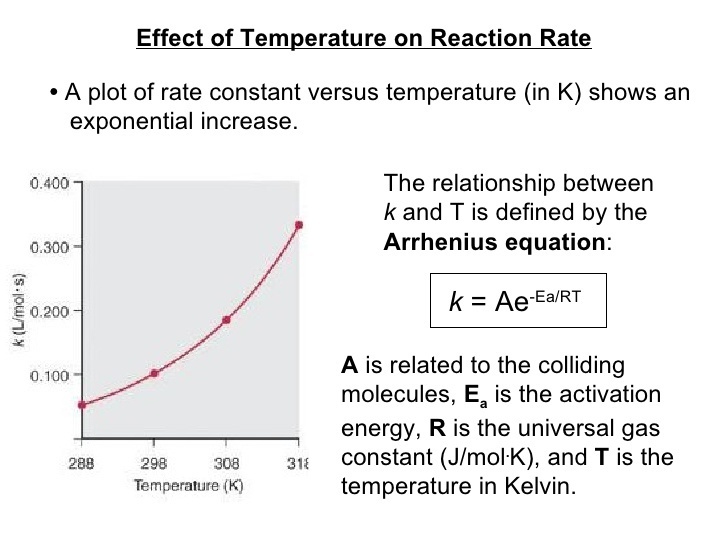
The first order reaction of methyl isonitrile to form acetonitrile has a rate constant of k = 1.7 × 10⁻¹⁵ at 298 K. What will ha
ludmilkaskok [199]
Refer to to this chart 

Credits to <span>https://image.slidesharecdn.com/nybf09-unit2slides26-57-100125181507-phpapp01/95/nyb-f09-unit-2-slid...

As temperature decreases, rate decreases. 

As temp increases, k also increases. </span>

3 0
2 years ago
Read 2 more answers
Other questions:
  • A hydrogen atom has a diameter of about 10 nm. Express this diameter in micrometers, meters, and millimeters.
    5·2 answers
  • Which of these is a base? a-vinegar b-ammonia c-HCl d- HNO3
    5·2 answers
  • What is the mass of nickel(ii) nitrate (182.71 g/mol) dissolved in 25.0 ml of 0.100 m ni(no3)2 solution?
    13·2 answers
  • It takes 330 j of energy to raise the temperature of 14.6 g of benzene from 21.0 °c to 28.7 °c at constant pressure. What is the
    9·1 answer
  • How many free ions are there on the products side of the total ionic equations that results from the reaction between bismuth 3
    10·1 answer
  • Determine the volume of hexane that contains 5.33 × 10²² molecules of hexane. The density of hexane is 0.6548 g/ml and its molar
    10·1 answer
  • When a 3.25 g sample of solid sodium hydroxide was dissolved in a calorimeter in 100.0 g of water, the temperature rose from 23.
    11·1 answer
  • Please help!!
    13·1 answer
  • Draw the three structures of the aldehydes with molecular formula C5H10O that contain a branched chain.
    6·1 answer
  • When aqueous solutions of AgNO3 and KI are mixed, AgI precipitates. The balanced net ionic equation is ________. When aqueous so
    6·1 answer
Add answer
Login
Not registered? Fast signup
Signup
Login Signup
Ask question!