answer.
Ask question
Login Signup
Ask question
All categories
  • English
  • Mathematics
  • Social Studies
  • Business
  • History
  • Health
  • Geography
  • Biology
  • Physics
  • Chemistry
  • Computers and Technology
  • Arts
  • World Languages
  • Spanish
  • French
  • German
  • Advanced Placement (AP)
  • SAT
  • Medicine
  • Law
  • Engineering
dalvyx [7]
2 years ago
4

You make 1.000 L of an aqueous solution that contains 35.0 g of ribose (C5H10O5). How many liters of water would you have to add

to this solution to reduce the molarity you calculated in Part A (.233 moles) by a factor of two?
Chemistry
1 answer:
Greeley [361]2 years ago
7 0

Answer:

  • <em>You must add </em><u><em>   1.000   </em></u><em> liters of pure water to the 1.000 liters of solution, to dilute the molarity by a factor of two.</em>

Explanation:

<em>To reduce the molarity by a fraction of two</em> you need to duplicate the volume of the solution.

Molarity is defined as the number of moles of solute per liter of solution. Hence, if you want to dilute, i.e. to reduce the concentration, by a factor of two, given that you have the number of moles of solute constant, you need to add water to duplicate the volume of the solution.

          Molarity=\frac{\text{number of moles of solute}}{\text{volume of solution in liters}}

Mathematically, in the formula above you want to reduce the quotient by a factor of two, while the numerator does not change. Then, you need to multiply the denominator by two.

Thus, <em>you must add 1.000 liters of pure water to the 1.000 liters of solution, to dilute the molarity by a factor of two.</em>

You might be interested in
Before landing, the brakes and the tires of an airliner have a temperature of 15.0∘C. Upon landing, the 90.7 kg carbon fiber bra
Goryan [66]

Answer:

0.921 J/g degrees C

Explanation:

Recall that the First Law of Thermodynamics demands that the total internal energy of an isolated system must remain constant. Any amount of energy lost by the brakes must be gained by the tires (in the form of heat in this situation).  Therefore, heat given off by the brakes = −heat taken in by tires, or:

−qbrakes=qtires

The equation used to calculate the quantity of heat energy exchanged in this process is:

−qbrakes=−cbrakes mbrakes ΔTbrakes=ctires mtires ΔTtires=qtires

First we must convert the mass of the tires and the brakes from  kg to  g.

massbrakes=90.7 kg×1,000. g1 kg=9.07×10⁴ g

masstires=123 kg×1,000. g1 kg=1.23×10⁵ g

Next, substitute in known values and rearrange to solve for ctires. Note that the final temperature for both the tires and the brakes is 172∘C, the initial temperature of the brakes is 312∘C and the initial temperature of the tires is 15∘C.

−(1.400Jg∘C)(9.07×10⁴ g)(172∘C−312∘C)=(ctires)(1.23×10⁵ g)(172∘C−15∘C)

ctires=−(1.400 Jg∘C)(9.07×10⁴ g)(−140∘C)(1.23×10⁵ g)(157∘C)=17,777,200 J19311000 g∘C=0.9206Jg∘C

The answer should have three significant figures, so round to 0.921Jg∘C.

6 0
2 years ago
A precipitate of zinc hydroxide can be formed using the reaction below.
worty [1.4K]

Answer:

Option B is correct. KOH is the limiting reagent, and 0.27 mole of Zn(OH)2 precipitate is produced.

Explanation:

Step 1: Data given

Number of moles ZnCl2 = 0.36 moles

Number of moles KOH  = 0.54 moles

Step 2: The balanced equations

ZnCl2(aq) + 2 KOH(aq) → Zn(OH)2(s) + 2 KCl(aq)

For 1 mol ZnCl2 we need 2 moles KOH to produce 1 mol Zn(OH)2 and 2 moles KCl

Step 3: Calculate the limiting reactant.

KOH is the limiting reactant. It will completely be consumed (0.54 moles). ZnCl2 is in excess. There will react 0.54/2 = 0.27 moles

There will remain 0.36 - 0.27 = 0.09 moles.

Step 4: The products

There will be produced 2 moles KCl and 1 mol Zn(OH)2. Zn(OH)2 is the precipitate produced.

For 1 mol ZnCl2 we need 2 moles KOH to produce 1 mol Zn(OH)2 and 2 moles KCl

For 0.54 moles KOH, we will produce 0.27 moles precipitate (Zn(OH)2)

Option A is not correct because 0.27 mol of Zn(OH)2 will precipitate, not 0.54 mol

Option B is correct

Option C is not correct because ZnCl2 is not the limiting reactant, but the excess reactant

Option D is not correct because ZnCl2 is not the limiting reactant, but the excess reactant

7 0
2 years ago
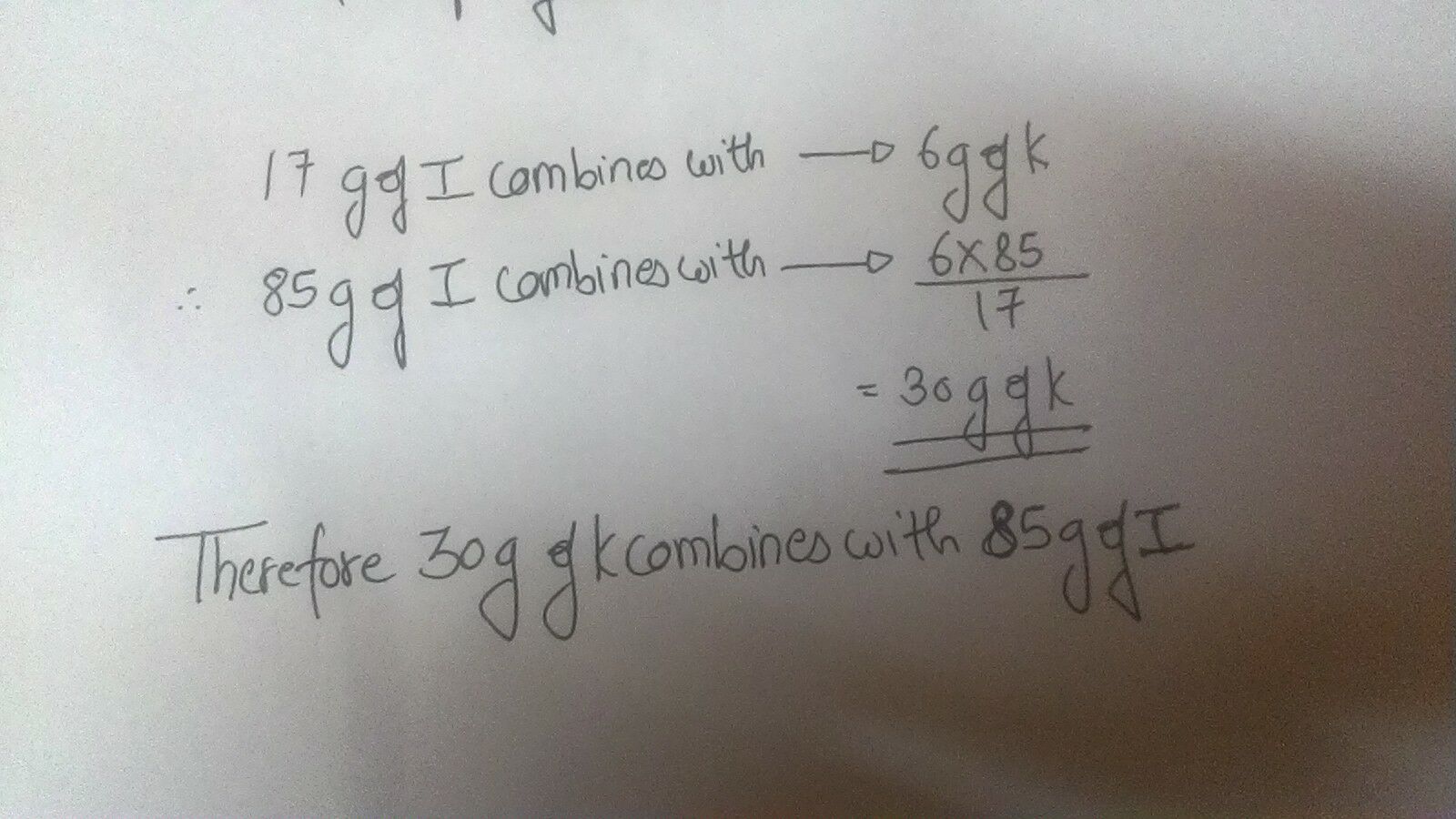
If 6 g of element k combine with 17 g of element l, how many grams of element k combine with 85 g of element l?
Ede4ka [16]
Hope this helps you.

5 0
2 years ago
When adjusted for any changes in ΔHΔH and ΔSΔS with temperature, the standard free energy change ΔG∘TΔGT∘Delta G_{T}^{\circ} at
STALIN [3.7K]

The equilibrium constant is 0.0022.

Explanation:

The values given in the problem is

ΔG° = 1.22 ×10⁵ J/mol

T = 2400 K.

R = 8.314 J mol⁻¹ K⁻¹

The Gibbs free energy should be minimum for a spontaneous reaction and equilibrium state of any reaction is spontaneous reaction. So on simplification, the thermodynamic properties of the equilibrium constant can be obtained as related to Gibbs free energy change at constant temperature.

The relation between Gibbs free energy change with equilibrium constant is ΔG° = -RT ln K

So, here K is the equilibrium constant. Now, substitute all the given values in the corresponding parameters of the above equation.

We get,

1.22 * 10^{5} = - 8.314* 2400 * ln K

\\ 1.22 * 10^{5} = -19953.6 * ln K

ln K = \frac{-1.22*10^{5} }{19953.6} =-6.114\\\\k =e^{-6.114}=0.0022

So, the equilibrium constant is 0.0022.

4 0
2 years ago
Most of the ultraviolet radiation reaching the surface of the earth is UV-A radiation, which has a wavelength range of 315 nm to
posledela

Answer:

6.1 ×10^-19 J

Explanation:

From E= hc/λ

h= planks constant = 6.6×10^-34 Js

c= speed of light = 3×10^8 ms^1

λ= wavelength = 325 nm

E= 6.6 × 10^-34 × 3×10^8/325 × 10^-9

E= 0.061 × 10^ -17 J

E= 6.1 ×10^-19 J

4 0
2 years ago
Other questions:
  • In the adjoining figure, the circles with the + sign represent protons and the empty circles represent neutrons. Determine which
    6·2 answers
  • Formaldehyde, ch2o, is used as an embalming agent. draw the structure of ch2o including lone pairs.formaldehyde, ch2o, is used a
    14·1 answer
  • Determine the number of bonding electrons and the number of nonbonding electrons in the structure of cs2.
    14·2 answers
  • Draw the alcohol needed to form isobutyl benzoate
    9·2 answers
  • The dry adiabatic rate, characterized by rising unsaturated air, can be expressed as a temperature change of _____ Celsius for e
    10·1 answer
  • A 3.0-L sample of helium was placed in container fitted with a porous membrane. Half of the helium effused through the membrane
    11·1 answer
  • An object at 20∘C absorbs 25.0 J of heat. What is the change in entropy ΔS of the object? Express your answer numerically in jou
    12·1 answer
  • The stock concentration of dye is 3.4E-5M. The stock concentration of bleach is 0.36M. Assuming that the reaction goes to comple
    5·1 answer
  • How many grams of Boron can be obtained from 234 grams of B2O3?
    8·1 answer
  • Suppose a metal will eject electrons from its surface when struck by yellow light. What will happen if the surface is struck wit
    12·1 answer
Add answer
Login
Not registered? Fast signup
Signup
Login Signup
Ask question!