answer.
Ask question
Login Signup
Ask question
All categories
  • English
  • Mathematics
  • Social Studies
  • Business
  • History
  • Health
  • Geography
  • Biology
  • Physics
  • Chemistry
  • Computers and Technology
  • Arts
  • World Languages
  • Spanish
  • French
  • German
  • Advanced Placement (AP)
  • SAT
  • Medicine
  • Law
  • Engineering
Nostrana [21]
3 years ago
11

A 3.0-L sample of helium was placed in container fitted with a porous membrane. Half of the helium effused through the membrane

in 24 hours. A 3.0-L sample of oxygen was placed in an identical container. How many hours will it take for half of the oxygen to effuse through the membrane?
Chemistry
1 answer:
zhenek [66]3 years ago
3 0

Explanation:

It is known that rate of effusion of gases are inversely proportional to the square root of their molar masses.

And, half of the helium (1.5 L) effused in 24 hour. So, the rate of effusion of He gas is calculated as follows.

          \frac{1.5 L}{24 hr}

            = 0.0625 L/hr

As, molar mass of He is 4 g/mol  and molar mass of O_{2} is 32 g/ mol.

Now,

   \frac{\text{Rate of He}}{\text{Rate of Oxygen}} = \sqrt{\frac{32}{4}

                               = 2.83

or, rate of O_{2} = \frac{\text{Rate of He}}{2.83}

                       = \frac{0.0625 L/hr}{2.83}

          Rate of O_{2} = 0.022 L/hr.

This means that 0.022 L of O_{2} gas effuses in 1 hr

So, time taken for the effusion of 1.5 L of O_{2} gas is calculated as follows.

         \frac{1.5 L}{0.022 L/hr}

                = 68.18 hour

Thus, we can conclude that 68.18 hours will it take for half of the oxygen to effuse through the membrane.

You might be interested in
A family of four lives in a three-bedroom house and uses an average of 900 kWh of electricity per month. The family cools their
agasfer [191]
<h2>Answer:</h2><h2>The percentage of the family’s total annual electricity that is used to run the two air conditioners for the three summer months = 19.4 %</h2>

Explanation:

Average electricity consumed per month = 900 kWh

The family cools their house for three months during the summer with two window-unit air conditioners

The power consumed by one window-unit air conditioners = 350 kWh

The power consumed by two window-unit air conditioners = 350(2) = 700 kWh

Power consumed for two air conditioners for the three summer months = 700 (3) = 2100 kWh

Total power consumed for 1 year = 900 (12) = 10800kWh

The percentage of the family’s total annual electricity that is used to run the two air conditioners for the three summer months = \frac{2100}{10800}100 = 19.4 %

5 0
2 years ago
If a collision between molecules is very gentle the molecules are
Nadya [2.5K]
If  collision  between   molecules  is  very gentle  the   molecules  are  more   likely  to   bound  without  reaction

     c
ollision   is  process  in  which  molecules  come  together   or  collide   with  one  another.Molecules  must  collide  with  sufficient   energy  so  that   chemical  bond can break.  In  addition  for  collision  to  occur  there  must  have  favorable  orientation.
6 0
2 years ago
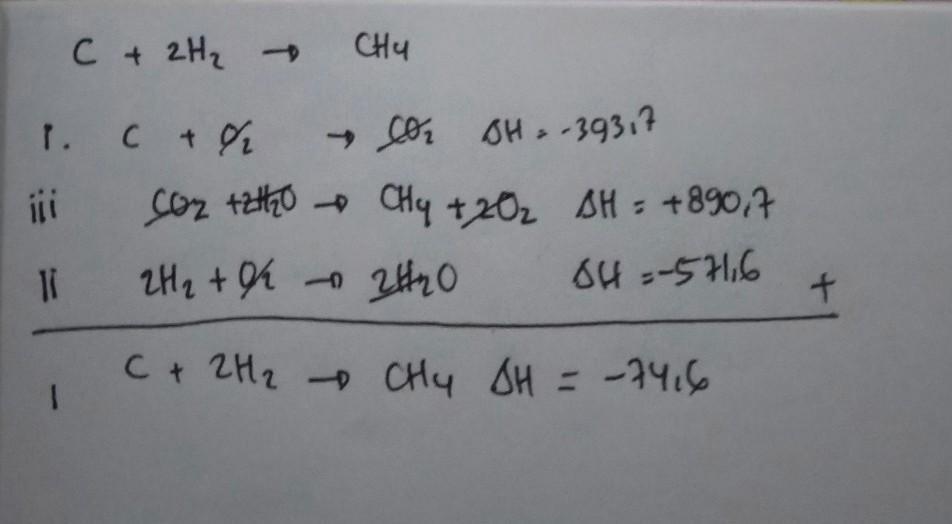
State Hess' law of constant heat summation.
AveGali [126]

Answer:

-74.6 kj/mol

Explanation:

you can see the answer at the pic

8 0
2 years ago
A nugget of GOLD has a mass 9.66 gram and a volume of 0.5 cm3, It's density is<br>grams/cm3 *​
dalvyx [7]

Answer:

P=19.32g/cm³

Explanation:

m=9.66g

v=0.5cm³

P=mass/volume (density formula)

=9.66/0.5

=19.32g/cm³

4 0
2 years ago
A concentration cell is constructed using two Ni electrodes with Ni2+ concentrations of 1.0 M and 1.00 � 10�4 M in the two half-
Komok [63]

<u>Answer:</u> The cell potential of the cell is +0.118 V

<u>Explanation:</u>

The half reactions for the cell is:

<u>Oxidation half reaction (anode):</u>  Ni(s)\rightarrow Ni^{2+}+2e^-

<u>Reduction half reaction (cathode):</u>  Ni^{2+}+2e^-\rightarrow Ni(s)

In this case, the cathode and anode both are same. So, E^o_{cell} will be equal to zero.

To calculate cell potential of the cell, we use the equation given by Nernst, which is:

E_{cell}=E^o_{cell}-\frac{0.0592}{n}\log \frac{[Ni^{2+}_{diluted}]}{[Ni^{2+}_{concentrated}]}

where,

n = number of electrons in oxidation-reduction reaction = 2

E_{cell} = ?

[Ni^{2+}_{diluted}] = 1.00\times 10^{-4}M

[Ni^{2+}_{concentrated}] = 1.0 M

Putting values in above equation, we get:

E_{cell}=0-\frac{0.0592}{2}\log \frac{1.00\times 10^{-4}M}{1.0M}

E_{cell}=0.118V

Hence, the cell potential of the cell is +0.118 V

5 0
2 years ago
Other questions:
  • 2.1 liters is the same as cm3 and ml
    15·1 answer
  • Humans affect Earth in many ways. The use of fossil fuels, the clear-cutting of forests, and controlled burns can affect the car
    8·2 answers
  • A 1.25 g gas sample occupies 663 ml at 25∘ c and 1.00 atm. what is the molar mass of the gas?
    15·1 answer
  • An ordered list of chemical substances is shown.
    5·1 answer
  • Element z reacts with bromine to form an ionic compound zbr2. A) state with reasons i) the physical properties of zbr2 at room t
    7·1 answer
  • Consider the ammonolysis of benzoyl chloride by adding concentrated ammonium hydroxide to form the final product, benzamide. Rea
    9·1 answer
  • A precipitate forms when mixing solutions of sodium fluoride (NaF) and lead II nitrate (Pb(NO3)2). Complete and balance the net
    13·1 answer
  • At STP, a 50-gram sample of H20(I) and a 100-gram sample of H20(I) have
    15·2 answers
  • Which events most likely occurred at the boundary between the South American Plate and the Nazca Plate? Check all that apply.
    11·2 answers
  • How many molecules are present in 0.336 mol of acetylene (C2H2)?
    11·1 answer
Add answer
Login
Not registered? Fast signup
Signup
Login Signup
Ask question!