answer.
Ask question
Login Signup
Ask question
All categories
  • English
  • Mathematics
  • Social Studies
  • Business
  • History
  • Health
  • Geography
  • Biology
  • Physics
  • Chemistry
  • Computers and Technology
  • Arts
  • World Languages
  • Spanish
  • French
  • German
  • Advanced Placement (AP)
  • SAT
  • Medicine
  • Law
  • Engineering
Bezzdna [24]
2 years ago
7

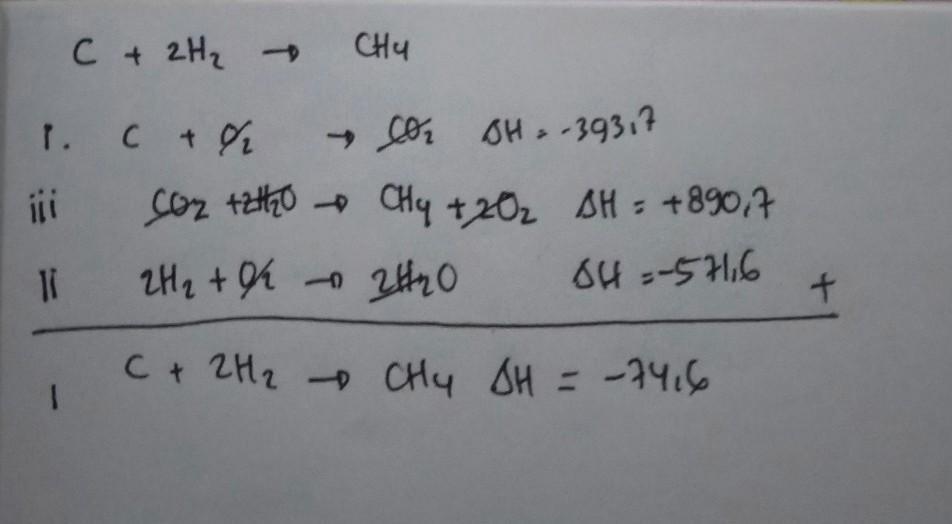
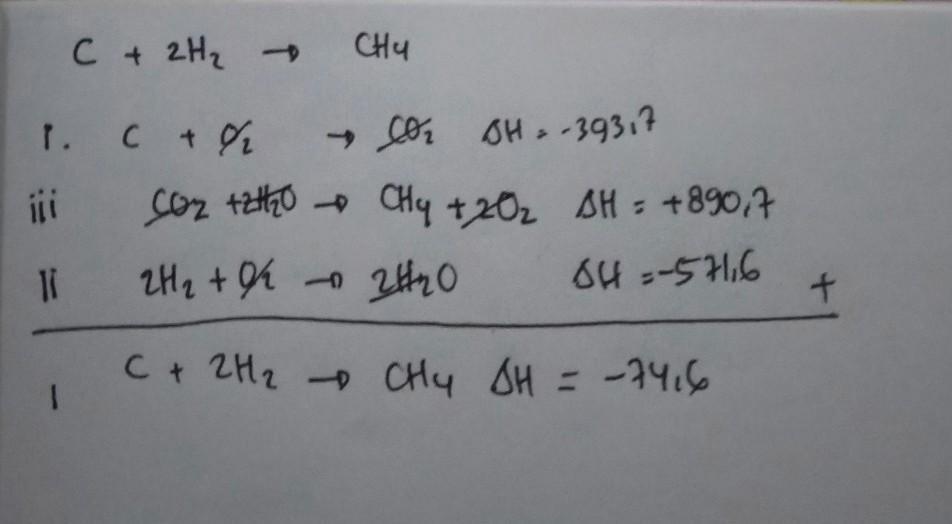
State Hess' law of constant heat summation.

Chemistry
1 answer:
AveGali [126]2 years ago
8 0

Answer:

-74.6 kj/mol

Explanation:

you can see the answer at the pic

You might be interested in
This means that the steel bar lost 14900 J of thermal energy. What is the change in temperature of the steel bar? Recall that th
stiv31 [10]

Answer:

ΔT=-747,13°C

Explanation:

Sensible heat is<em> the amount of thermal energy that is required to change the temperature of an object</em>, the equation for calculating the heat change is  given by:

Q=msΔT

where:

  • Q, heat that has been absorbed or realeased by the substance [J]
  • m, mass of the substance [g]
  • s, specific heat capacity [J/g°C] (
  • ΔT, changes in the substance temperature [°C]

To solve the problem, we clear ΔT of the equation and then replace our data:

Q=msΔT

ΔT=Q/ms

ΔT=\frac{-14900 J}{40,7g*0,49\frac{J}{gC} }=-747,13°C

<em>(Note that Q=-14900 J because there is a </em><u><em>LOST</em></u><em> of thermal energy)</em>

Thus, the change in temperature of the steel bar is -747,13°C, meaning that the temperature of the bar decreases.

5 0
2 years ago
Read 2 more answers
a.) The diameter of a uranium atom is 3.50 Å . Express the radius of a uranium atom in both meters and nanometers. b.) How many
Svetradugi [14.3K]

Answer:

Th answer to your question is:

a)  3.5 x10⁻¹⁰ meters; 0.35 nm

b) 6857142.86 atoms

c) Volume = 2.06 x 10⁻²³ cm³

Explanation:

a) data

Uranium atoms = 3.5A°

meters

           1 A° ----------------  1 x 10 ⁻¹⁰ m

         3.5A° ---------------  x

 x = 3.5(1 x10⁻¹⁰)/ 1 = 3.5 x10⁻¹⁰ meters

          1 A° ------------------ 0.1 nm

        3.5 A° ---------------- 0.35 nm

b) 2.4 mm

Divide 2,40 mm / uranium diameter

But, first convert 3,5A° to mm   = 3.5 x 10⁻⁷ mm

# of uranium atoms = 2.4 / 3.5 x 10⁻⁷ = 6857142.86

c) volume in cubic cm

Convert 3.5A° to cm  = 3.5 x 10⁻⁸

Volume = 4/3 πr³ = (4/3) (3.14)(1.7 x10⁻⁸)³

Volume = 2.06 x 10⁻²³ cm³
6 0
2 years ago
Compare and contrast the functions of each of the following types of flasks: filter, Erlenmeyer, volumetric.
harkovskaia [24]
The Erlenmeyer Flask was <span>introduced in 1861 by German chemist </span>Emil Erlenmeyer and is shaped like a cone. This has a triangular shape and mouth wide for it to be easier to pour and store liquids. The Volumetric flask<span> is used for preparing liquids with volumes of high precision. It has a </span>pear-shaped body and a long neck with a circumferential fill line. The Filter Flask is also known as the <span>A Büchner </span><span>flask. It is like the Erlenmeyer but this one is thick-walled and has a special arm in the side. It is used for filtering liquid. </span>
4 0
2 years ago
Rank the following from highest to lowest priority according to the Cahn-Ingold-Prelog system: -CH2CH3, -CHCH2, -CCH, -CH3.
mario62 [17]

Answer:

The order will be:

CCH > CHCH₂ > CH₂CH₃> CH₃

Explanation:

According to Cahn-Ingold-Prelog system we rank the groups based on the atomic number of directly attached atom with the chiral carbon.

For example: between C and H, we rank Carbon first.

If the same atoms are attached for different groups then we prioritized based on the second element with highest atomic number.

For example:

Among CH₃ and C₂H₅, the priority will be given to C₂H₅.

If an atom is double or triple bonded to the directly attached atom then each pi bond is considered to be a new atom.

Hence CH=CH₂ means, that there are two carbons attached to CH carbon.

So the order based on above selection rules will be:

CCH > CHCH₂ > CH₂CH₃> CH₃

7 0
2 years ago
In chemistry we did a lab examining iron nails corroding in agar. One of the nails was wrapped in zinc, and the nail did not rus
forsale [732]

Answer:

Zn(OH)₂

<em>Explanation: </em>

Zn is above Fe in the activity series, so it is more readily oxidized:

Zn(s) ⟶ Zn²⁺(aq) + 2e⁻

The zinc ions go into solution.

The electrons travel from the Zn to the surface of the iron nail, where they reduce the water to hydrogen and hydroxide ions.

2H₂O(ℓ) + 2e⁻ ⟶ H₂(g) + 2OH⁻(aq)

Neither the zinc ions nor the hydroxide ions can move far through the gel.

Their concentration builds up around the hail. The ions find each other and form a precipitate.

Zn²⁺(aq) + 2OH⁻(aq) ⟶  Zn(OH)₂(s)

4 0
2 years ago
Other questions:
  • What happens as a result of the kinetic energy of the particles in a liquid being comparable with the intermolecular attractions
    15·2 answers
  • A 1.50-liter sample of dry air in a cylinder exerts a pressure of 3.00 atmospheres at a temperature of 25°C. Without changing th
    12·2 answers
  • What mass of AgBr can be produced starting with 34.3G of NaBr? (Stoichiometry method)
    6·1 answer
  • In an experiment, 0.42 mol of co and 0.42 mol of h2 were placed in a 1.00-l reaction vessel. at equilibrium, there were 0.29 mol
    6·1 answer
  • 86.1 g of nitrogen reacts with lithium, how many grams of lithium will react?
    13·1 answer
  • Which of the following can be best explained by temporary dipole moments?
    8·1 answer
  • An unopened, cold 2.00 L bottle of soda contains 46.0 mL of gas confined at a pressure of 1.30 atm at a temperature of 5.0oC. If
    10·1 answer
  • What is the lewis structure for C2H3OH?
    10·1 answer
  • How many hydrogen atoms are in 11C2H6
    9·2 answers
  • A metal crystallizes with a face-centered cubic lattice. The edge of the unit cell is 417 pm. The diameter of the metal atom is:
    15·1 answer
Add answer
Login
Not registered? Fast signup
Signup
Login Signup
Ask question!