answer.
Ask question
Login Signup
Ask question
All categories
  • English
  • Mathematics
  • Social Studies
  • Business
  • History
  • Health
  • Geography
  • Biology
  • Physics
  • Chemistry
  • Computers and Technology
  • Arts
  • World Languages
  • Spanish
  • French
  • German
  • Advanced Placement (AP)
  • SAT
  • Medicine
  • Law
  • Engineering
Tpy6a [65]
2 years ago
14

Determine the number of bonding electrons and the number of nonbonding electrons in the structure of cs2.

Chemistry
2 answers:
Rus_ich [418]2 years ago
5 0

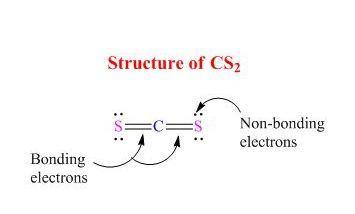
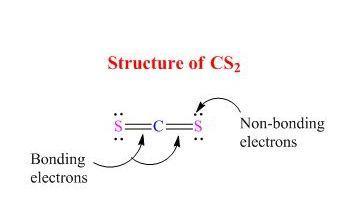
The number of bonding and non-bonding electrons in {\text{C}}{{\text{S}}_2} are \boxed8 and \boxed8 respectively.

Further explanation:

In order to determine the number of bonding and non-bonding electrons first, we need to draw the correct Lewis structure of {\text{C}}{{\text{S}}_2} the molecule.

The Lewis structure is the chemical representation of an element along with the nonbonding pairs. For covalent molecules, the number of electrons involved in bonding and the remaining nonbonding pairs can be represented while writing the Lewis structures. Lewis structures help predict the geometry, polarity, and reactivity of the molecules.

The central atom is usually the least electronegative atom other than hydrogen. Hence out of carbon and sulphur, the former will act as the central metal atom. So arrange the two sulphur atoms around the carbon. Next, determine the number of valence electrons.

The total number of valence electrons of {\text{C}}{{\text{S}}_2} is calculated as,

{\text{Total valence electrons}} = \left[ {\left( {\text{1}} \right)\left( {{\text{Valence electrons of Carbon}}} \right){t{ + }}\left( 2 \right)\left( {{\text{Valence electrons of sulphur}}} \right)} \right]  

Since carbon carries 4 valence electron and sulphur carries 6 valence electrons. So,

\begin{aligned}{\text{Total valence electrons}}\left( {{\text{TVE}}} \right) &= \left[ {\left( 1 \right)\left( 4 \right)+\left( 2\right)\left( 6 \right)}\right]\\&= 16\\\end{aligned}  

Lewis structure of {\mathbf{C}}{{\mathbf{S}}_{\mathbf{2}}} and its linear shape along with the bonding and non-bonding electron pairs is apparent in the attached image.

Out of 16 electrons, eight electrons are involved in the formation of four bonds between the carbon and two sulfur atom. Carbon forms one sigma and one pi bond with each sulfur atom respectively. So now we are left with 8 electrons. These will constitute the non-bonding (lone pairs). 2 lone are present on each sulfur atom.

Learn more:

1. Coordination number for lithium sulfide crystals: brainly.com/question/75586212

2. Scientific notation: brainly.com/question/4935921

Answer details:  

Grade: High School

Subject: Chemistry

Chapter: Molecular structure and chemical bonding.

Keywords: Lewis structure, valence electrons, CS2, a single bond, bonding electrons, non-bonding electrons, and total valence electrons.

trapecia [35]2 years ago
3 0
Carbon disulfide ( S=C=S)  is made up of one carbon atom and two sulfur atom. 
Carbon has 4 valence electrons while sulfur has 6 electrons. 
During bonding all the four carbon valence electrons are used in bonding while each sulfur atom contributes two electrons two the bond formation.
Therefore; 4 + 2(2) = 8 electrons are used for bonding, while 8 electrons ( four from each sulfur atom) are not used for bond formation. 
You might be interested in
According to the lab guide, which changes below will you look for in order to test the hypothesis? check all that apply. changes
viktelen [127]

Answer:

All of them are.

Explanation:

8 0
2 years ago
Read 2 more answers
Carbon monoxide and molecular oxygen react to form carbon dioxide. A 50.0 L reactor at 25.0 oC is charged with 1.00 bar of CO. T
Umnica [9.8K]

Answer:

CO = zero

CO2 =1 bar

O2  = 2.02 bar

Explanation:

We are given

initial pressure of CO = 1bar

total pressure = 3.52 bar

so initial pressure of O2 = 3.52 - 1 = 2.52 bar

the reaction is

2CO + O2 →  2CO2

using the unitary method

2 moles of CO2 → 1 mole of O2

1  bar of CO → \frac{1}{2} * 1= 0.5 bar (required)

but we have more oxygen present , that means CO is the limiting reagent

  • Final pressure of CO will be zero as it is the limiting reagent so it will be consumed completely
  • 1 bar of CO → \frac{2mol CO2}{2mol CO} * 1= 1 bar of CO2
  • 2.52 bar O2 (initially) - 0.5 bar (reacted) = 2.02bar O2
6 0
2 years ago
________ is the study of matter and the energy that causes matter to combine, break apart and recombine in everything living and
Kipish [7]

Answer: Emperical formula

Explanation:

8 0
2 years ago
Which of the compounds above are strong enough acids to react almost completely with a hydroxide ion (pka of h2o = 15.74) or wit
luda_lava [24]

The compounds can react with OH⁻ and HCO₃⁻ only C₅H₆N pyridinium

<h3><em>Further explanation </em></h3>

In an acid-base reaction, it can be determined whether or not a reaction occurs by knowing the value of pKa or Ka from acid and conjugate acid (acid from the reaction)

Acids and bases according to Bronsted-Lowry

Acid = donor (donor) proton (H + ion)

Base = proton (receiver) acceptor (H + ion)

If the acid gives (H +), then the remaining acid is a conjugate base because it accepts protons. Conversely, if a base receives (H +), then the base formed can release protons and is called the conjugate acid from the original base.

From this, it can be seen whether the acid in the product can give its proton to a base (or acid which has a lower Ka value) so that the reaction can go to the right to produce the product.

The step that needs to be done is to know the pKa value of the two acids (one on the left side and one on the right side of the arrow), then just determine the value of the equilibrium constant

Can be formulated:

K acid-base reaction = Ka acid on the left : K acid on the right.

or:

pK = acid pKa on the left - pKa acid on the right

K = equilibrium constant for acid-base reactions

pK = -log K;

K~=~10^{-pK}

K value> 1 indicates the reaction can take place, or the position of equilibrium to the right.

There is some data that we need to complete from the problem above, which is the pKa value of some compounds that will react, namely:

pyridinium pKa = 5.25

acetone pKa = 19.3

butan-2-one pKa = 19

Let's look at the K value of each possible reaction:

pka H₂O = 15.74, pka of H₂CO₃ = 6.37)

  • 1. C₅H₆N pyridinium

* with OH⁻

C₅H₆N + OH- ---> C₅H₅N- + H₂O

pK = pKa pyridinium - pKa H₂O

pK = 5.25 - 15.74

pK = -10.49

K~=~10^{4.9}

K values> 1 indicate the reaction can take place

* with HCO3⁻

C₅H₆N + HCO₃⁻-- ---> C₅H₅N⁻ + H₂CO₃

pK = 5.25 - 6.37

pK = -1.12

K`=~10^{1.12]

Reaction can take place

  • 2. Acetone C₃H₆O

* with OH-

C₃H₆O + OH⁻ ---> C₃H₅O- + H₂O

pK = 19.3 - 15.74

pK = 3.56

K~=~10^{ -3.56}

Reaction does not happen

* with HCO₃-

C₃H₆O + HCO₃⁻ ----> C₃H₅O⁻ + H₂CO₃

pK = 19.3 - 6.37

pK = 12.93

K`=~10 ^{-12.93}

Reaction does not happen

  • 3. butan-2-one C₄H₇O

* with OH-

C₄H₇O + OH- ---> C₄H₆O- + H₂O

pK = 19 - 15.74

pK = 3.26

K~=~10^{-3.26}

Reaction does not happen

* with HCO₃⁻

C₄H₇O + HCO₃⁻ ---> C₄H₆O⁻ + H₂CO₃

pK = 19 - 6.37

pK = 12.63

K~=~ 10^{-12.63}

Reaction does not happen

So that can react with OH⁻ and HCO₃⁻ only C₅H₆N pyridinium

<h3><em>Learn more </em></h3>

the lowest ph

brainly.com/question/9875355

the concentrations at equilibrium.

brainly.com/question/8918040

the ph of a solution

brainly.com/question/9560687

Keywords : acid base reaction, the equilibrium constant
5 0
2 years ago
Read 2 more answers
The specific heats of two natural substances are shown in the table. Specific Heat Natural Substance Specific Heat Wet Mud 2.5 J
Novay_Z [31]

The specific heat of a substance is heat released or absorbed by one gram for a change in 1 degree celsius

so higher the specific heat, more the heat required to raise the temperature by same extent or more the heat released on decrease in temperature upto same extent (for two substance)

Here the specific heat of sandy clay is 1.4 J/g °C

So it is less than that of wet mud hence sandy clay is needs to release less energy to decrease its temperature

5 0
2 years ago
Other questions:
  • Uranium–232 has a half–life of 68.9 years. A sample from 206.7 years ago contains 1.40 g of uranium–232. How much uranium was or
    12·2 answers
  • How many molecules of water are needed to completely hydrolyze a polymer that is 11 monomers long?
    9·1 answer
  • Which species has the smaller bond angle, h3o+ or h2o?
    15·1 answer
  • Calculate the freezing point of a 0.100 m aqueous solution of k2so4, taking interionic attractions into consideration by using t
    5·1 answer
  • Which biomolecule is composed of five basic elements: carbon, hydrogen, oxygen, nitrogen, and phosphorus arranged into two types
    13·1 answer
  • A 30.0 g sample of a metal was heated in a hot water bath to 80°c. it was then quickly transferred to a coffee-cup calorimeter.
    15·2 answers
  • Two beach balls collide, deforming during a collision. They bounce off in opposite directions. What type of collision was this?
    6·2 answers
  • Nickel can be plated from aqueous solution according to the following half reaction. How long would it take (in min) to plate 29
    14·1 answer
  • Rubbing alcohol contains 615g of isopropanol (C3H7OH) per liter (aqueous solution). Calculate the molality of this solution. Giv
    12·1 answer
  • Which of the following organisms are carnivores?
    12·1 answer
Add answer
Login
Not registered? Fast signup
Signup
Login Signup
Ask question!