answer.
Ask question
Login Signup
Ask question
All categories
  • English
  • Mathematics
  • Social Studies
  • Business
  • History
  • Health
  • Geography
  • Biology
  • Physics
  • Chemistry
  • Computers and Technology
  • Arts
  • World Languages
  • Spanish
  • French
  • German
  • Advanced Placement (AP)
  • SAT
  • Medicine
  • Law
  • Engineering
snow_tiger [21]
2 years ago
11

During a laboratory experiment, 36.12 grams of Al2O3 was formed when O2 reacted with aluminum metal at 280.0 K and 1.4 atm. What

was the volume of O2 used during the experiment?
3O2 + 4Al → 2Al2O3
Chemistry
1 answer:
photoshop1234 [79]2 years ago
4 0

Answer:

8.70 liters

Explanation:

You might be interested in
Hypothesis and Observations
KATRIN_1 [288]

Answer:

his experiment can show the movement of pollutants through the groundwater!

Explanation:

8 0
1 year ago
1.00 g of a compound is combusted in oxygen and found to give 3.14g of CO2 and 1.29 g of H2O. From these data we can tell thatA.
lora16 [44]

Answer:

the compound contains C, H, and some other element of unknownidentity, so we can’t calculate the empirical formula

Explanation:

Mass of CO2 obtained = 3.14 g

Hence number of moles of CO2 = 3.14g/44.0 g = 0.0714 mol

The mass of the carbon in the sample = 0.0714 mol × 12.0g/mol = 0.857 g

Mass of H2O obtained = 1.29 g

Hence number of moles of H2O = 1.29g/18.0 g = 0.0717 mol

The mass of the carbon in the sample = 0.0717 mol × 1g/mol = 0.0717 g

% by mass of carbon = 0.857/1 ×100 = 85.7 %

% by mass of hydrogen = 0.0717/1 × 100 = 7.17%

Mass of carbon and hydrogen = 85.7 + 7.17 = 92.87 %

Hence, there must be an unidentified element that accounts for (100 - 92.87) = 7.13% of the compound.

5 0
2 years ago
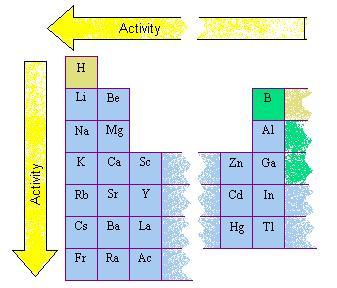
More active metals will cause the reduction of less active metals. Less active metals will cause no reaction (N.R.) in more acti
beks73 [17]

Activity of metals with most active and less active metals are given below.

Explanation:

1. Activity of metals -Divide metals Based on the activity.

2. The primary difference between metals is the ability with which they undergo chemical reactions. The elements toward the bottom left corner of the periodic table are the metals that are the most active in the sense of being the most reactive. Lithium, sodium, and potassium all react with water, for example. The rate of this reaction increases as we go down this column, however, because these elements become more active as they become more metallic.

3. Common Metals Divided into Classes on the Basis of Their Activity

  • Class I Metals: The Active Metals -Li, Na, K, Rb, Cs (Group IA)  ,Ca, Sr, Ba (Group IIA)
  • Class II Metals: The Less Active Metals -Mg, Al, Zn, Mn
  • Class III Metals: The Structural Metals -Cr, Fe, Sn, Pb, Cu
  • Class IV Metals: The Coinage Metals -Ag, Au, Pt, Hg

4. The most active metals are so reactive that they readily combine with the O2 and H2O vapor in the atmosphere and are therefore stored under an inert liquid, such as mineral oil. These metals are found exclusively in Groups IA and IIA of the periodic table.

5. Metals in the second class are slightly less active. They don't react with water at room temperature, but they react rapidly with acids.

6.The third class contains metals such as chromium, iron, tin, and lead, which react only with strong acids. It also contains even less active metals such as copper, which only dissolves when treated with acids that can oxidize the metal.

7. Metals in the fourth class are so unreactive they are essentially inert at room temperature. These metals are ideal for making jewelry or coins because they do not react with the vast majority of the substances with which they come into daily contact. As a result, they are often called the "coinage metals."

Fe⁺² (aq)+Zn(s)=>Zn⁺² (aq)+Fe(s)

3 0
2 years ago
What tool would you need discover whether a mineral has fracture?
maria [59]

Answer:

D

Explanation:

We in same class

5 0
2 years ago
Complete the chemical formula for each ionic compound. Consult the periodic table to help you answer the question. beryllium nit
Montano1993 [528]

The answers would be:

Be₃N₂

Al₂S₃

Here's more about the question:

To find the chemical formula first you need to know the charges. You can do that by first figuring out the transfer of valence electrons of each so that it can complete the octet rule.

Let's start with Beryllium Nitride

Beryllium is a cation with a charge of 2+ and Nitrogen is an anion with a charge of 3-.

We write charges as superscripts:

Be³⁺ N²⁻

Now to get the formula, all you need to do is exchange superscripts but write them as subscripts.

Be₂N₃

Let's do the second one:

Aluminum sulfide

Another way I do this though, is just think of the first element and think about how many valence electrons it has, this is how many it can give away.

When you think about the second element, think about how many valence electrons it has, then think how many does it need to have 8.

Aluminum has 3 valence electrons (It can give away 3)

Sulfur has 6 valence electrons, (it needs 2 to complete 8)

Now those are your superscripts!

Al³⁺S²⁻

Then exchange!

Al₂S₃

4 0
2 years ago
Read 2 more answers
Other questions:
  • Please help 30 pts!!!!! A friend needs these answers and I don't know what to say. If you don't know the answer, please ask some
    8·1 answer
  • If 3.45 grams of Mg are burned how many grams of MgO are produced
    15·2 answers
  • 5. Given the cell notation Cu(s)|Cu2+(aq)||Ag+(aq)|Ag(s), what is the half-reaction that occurs at the anode?
    5·2 answers
  • A mixture of three gases has a total pressure at 298 K of 1560 mm Hg. the mixture is analyzed and is found to contain 1.50 mol N
    10·1 answer
  • Suppose you have exactly 1 cup (237 g) of hot (100.0 °C) brewed tea in an insulated mug and that you add to it 2.50 × 10² g of i
    15·1 answer
  • Mercury and bromine willreact with each other to produce mercury (II) bromide:Hg(l)+Br2(l)-->HgBr2(s)Consider an experimentwh
    5·2 answers
  • A 0.944 M solution of glucose, C6H12O6, in water has a density of 1.0624 g/mL at 20∘C. What is the concentration of this solutio
    10·1 answer
  • Determine the percent yield for the reaction
    5·1 answer
  • A tetrahedral carbon is ____________ hybridized while a linear carbon is ____________ hybridized. Two different compounds that h
    14·1 answer
  • The enthalpy of Sodium is 235 calories. The enthalpy Chlorine is 435 calories. The enthalpy of Sodium chloride 670 joules, what
    6·1 answer
Add answer
Login
Not registered? Fast signup
Signup
Login Signup
Ask question!