answer.
Ask question
Login Signup
Ask question
All categories
  • English
  • Mathematics
  • Social Studies
  • Business
  • History
  • Health
  • Geography
  • Biology
  • Physics
  • Chemistry
  • Computers and Technology
  • Arts
  • World Languages
  • Spanish
  • French
  • German
  • Advanced Placement (AP)
  • SAT
  • Medicine
  • Law
  • Engineering
Nataliya [291]
2 years ago
8

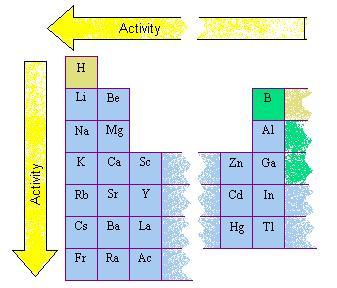
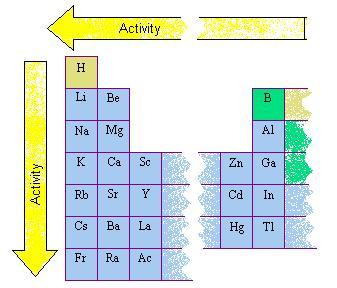
More active metals will cause the reduction of less active metals. Less active metals will cause no reaction (N.R.) in more acti

ve metals. What is the complete and balanced reaction of solid iron with aqueous zinc(II)? Use the following activity series to arrive at your answer:

Chemistry
1 answer:
beks73 [17]2 years ago
3 0

Activity of metals with most active and less active metals are given below.

Explanation:

1. Activity of metals -Divide metals Based on the activity.

2. The primary difference between metals is the ability with which they undergo chemical reactions. The elements toward the bottom left corner of the periodic table are the metals that are the most active in the sense of being the most reactive. Lithium, sodium, and potassium all react with water, for example. The rate of this reaction increases as we go down this column, however, because these elements become more active as they become more metallic.

3. Common Metals Divided into Classes on the Basis of Their Activity

  • Class I Metals: The Active Metals -Li, Na, K, Rb, Cs (Group IA)  ,Ca, Sr, Ba (Group IIA)
  • Class II Metals: The Less Active Metals -Mg, Al, Zn, Mn
  • Class III Metals: The Structural Metals -Cr, Fe, Sn, Pb, Cu
  • Class IV Metals: The Coinage Metals -Ag, Au, Pt, Hg

4. The most active metals are so reactive that they readily combine with the O2 and H2O vapor in the atmosphere and are therefore stored under an inert liquid, such as mineral oil. These metals are found exclusively in Groups IA and IIA of the periodic table.

5. Metals in the second class are slightly less active. They don't react with water at room temperature, but they react rapidly with acids.

6.The third class contains metals such as chromium, iron, tin, and lead, which react only with strong acids. It also contains even less active metals such as copper, which only dissolves when treated with acids that can oxidize the metal.

7. Metals in the fourth class are so unreactive they are essentially inert at room temperature. These metals are ideal for making jewelry or coins because they do not react with the vast majority of the substances with which they come into daily contact. As a result, they are often called the "coinage metals."

Fe⁺² (aq)+Zn(s)=>Zn⁺² (aq)+Fe(s)
You might be interested in
Montrel takes a trip to Central America during the winter. He finds out that the temperature in Central America is about the sam
wolverine [178]

Answer:

C

Explanation

Because My teacher told me that for an example Florida is hot but in Central America is cold or hot and you don’t need a jacket. I don’t remember much

6 0
2 years ago
Consider a general reaction A ( aq ) enzyme ⇌ B ( aq ) A(aq)⇌enzymeB(aq) The Δ G ° ′ ΔG°′ of the reaction is − 5.980 kJ ⋅ mol −
Grace [21]

Answer : The value of K_{eq} is, 11.2

The value of \Delta G_{rxn} is -9.04 kJ/mol

Explanation :

The relation between the equilibrium constant and standard Gibbs free energy is:

\Delta G^o=-RT\times \ln K_{eq}

where,

\Delta G^o = standard Gibbs free energy  = -5.980 kJ/mol = -5980 J/mol

R = gas constant = 8.314 J/K.mol

T = temperature = 25^oC=273+25=298K

K_{eq}  = equilibrium constant  = ?

Now put all the given values in the above formula, we get:

\Delta G^o=-RT\times \ln K_{eq}

-5980J/mol=-(8.314J/K.mol)\times (298K)\times \ln K_{eq}

K_{eq}=11.2

Thus, the value of K_{eq} is, 11.2

Now we have to calculate the \Delta G_{rxn}.

The formula used for \Delta G_{rxn} is:

The given reaction is:

A(aq)\rightleftharpoons B(aq)

\Delta G_{rxn}=\Delta G^o+RT\ln Q

\Delta G_{rxn}=\Delta G^o+RT\ln \frac{[B]}{[A]}    ............(1)

where,

\Delta G_{rxn} = Gibbs free energy for the reaction  = ?

\Delta G_^o =  standard Gibbs free energy  = -30.5 kJ/mol

R = gas constant = 8.314\times 10^{-3}kJ/mole.K

T = temperature = 37.0^oC=273+37.0=310K

Q = reaction quotient

[A] = concentration of A = 1.8 M

[B] = concentration of B = 0.55 M

Now put all the given values in the above formula 1, we get:

\Delta G_{rxn}=(-5980J/mol)+[(8.314J/mole.K)\times (310K)\times \ln (\frac{0.55}{1.8})

\Delta G_{rxn}=-9035.75J/mol=-9.04kJ/mol

Therefore, the value of \Delta G_{rxn} is -9.04 kJ/mol

3 0
2 years ago
Your task is to measure the amount of energy evolved during the combustion of some hydrocarbon. Which of the following would be
Dahasolnce [82]

Answer:

c. Bomb calorimetry

Explanation:

The hydrocarbons are combustibles, it means that they can react in a combustion reaction to release energy. To measure this amount of energy, it's necessary equipment that the reaction can be placed in a controlled way. The bomb calorimeter is this equipment, which is an adiabatic vessel, with water. The heat is calculated based on the increase in the water temperature.

The coffee-cup calorimetry is used to measure the heat of a dissolution reaction and the bomb manometry is used to measure the pressure.

7 0
2 years ago
If Co(NH3)63+ has a λmax at 440 nm, calculate ΔE for the complex. A) 2.72 x 10⁻⁴ kJ/mol B) 4.52 x 10⁻² kJ/mol C) 2.72 x 10 2 kJ/
riadik2000 [5.3K]

<u>Answer:</u> The energy of the complex is 2.72\times 10^2kJ

<u>Explanation:</u>

To calculate the energy of the complex, we use the equation given by Planck which is:

\Delta E=\frac{N_Ahc}{\lambda}

where,

\lambda = Wavelength of the complex = 440nm=4.40\times 10^{-7}m    (Conversion factor:  1m=10^9nm )

h = Planck's constant = 6.624\times 10^{-34}Js

c = speed of light = 3\times 10^8m/s

N_A = Avogadro's number = 6.022\times 10^{23}

\Delta E = energy of the complex

Putting values in above equation, we get:

\Delta E=\frac{6.022\times 10^{23}\times 6.624\times 10^{-34}\times 3\times 10^8}{4.40\times 10^{-7}}\\\\\Delta E=2.72\times 10^{5}J=2.72\times 10^2kJ

Conversion factor used:  1 kJ = 1000 J

Hence, the energy of the complex is 2.72\times 10^2kJ

5 0
2 years ago
Recalling that a beaker of water is two dimensional, what is the three dimensional shape of the micelle
saul85 [17]
A micelle refers to an aggregate of a surfactant molecule, which a dispersed in a liquied colloid. In an aqueous liquid, a micelle is arranged in such a way that its hydrophillic head region will be in contact with the surrounding solvents while the hydrophobic tail region will be embedded in its center. 
The three dimensional shape of a micelle is A SPHERE. 
7 0
2 years ago
Other questions:
  • As ice transforms into steam, A)new molecules are formed. B)the types of atoms are changed. C)energy is absorbed by the molecule
    9·2 answers
  • If a runner completes a 10 kilometer race in 32.50 minutes, what is the 10.0 km pace in miles per hour? (1.609 km = 1 mile appro
    8·1 answer
  • What is the mass of 3.0 x 10^23 atoms of neon
    8·1 answer
  • Consider a triprotic acid like phosphoric acid or citric acid. which expression correctly describes the relative magnitudes of t
    11·1 answer
  • Which has a lower freezing point ice or ice cream?
    6·2 answers
  • During an experiment, the percent yield of calcium chloride from a reaction was 85.22%. Theoretically, the expected amount shoul
    10·2 answers
  • For which of these processes is the value of ΔH expected to be negative?I. The temperature (of water) increases when calcium chl
    15·1 answer
  • How many moles of ions are in 1.45 mol of K2SO4 ?
    7·1 answer
  • The pressure and temperature inside a bike tire is 10 atm and 10k respectively. What will the pressure become in the tire when t
    7·1 answer
  • At STP, a 50-gram sample of H20(I) and a 100-gram sample of H20(I) have
    15·2 answers
Add answer
Login
Not registered? Fast signup
Signup
Login Signup
Ask question!