answer.
Ask question
Login Signup
Ask question
All categories
  • English
  • Mathematics
  • Social Studies
  • Business
  • History
  • Health
  • Geography
  • Biology
  • Physics
  • Chemistry
  • Computers and Technology
  • Arts
  • World Languages
  • Spanish
  • French
  • German
  • Advanced Placement (AP)
  • SAT
  • Medicine
  • Law
  • Engineering
Liono4ka [1.6K]
2 years ago
4

Use the reactions below and their equilibrium constants to predict the equilibrium constant for the reaction 2A(s)⇌3D(g)2A(s)⇌3D

(g). A(s)A(s) ⇌⇌ 1212 B(g)+C(g), K1=0.0334B(g)+C(g), K1=0.0334 3D(g)3D(g) ⇌⇌ B(g)+2C(g), K2=2.35
Chemistry
1 answer:
ladessa [460]2 years ago
3 0

Answer:

K = 0,0285

Explanation:

It is possible to obtain the equilibrium constant of a reaction using the sum of another different reactions. In this case the reactions are:

<em>(1) </em>A(s) ⇌ 1/2 B(g) + C(g), K1=0.0334

<em>(2) </em>3D(g) ⇌ B(g) + 2C(g), K2=2.35

2*<em>(1) </em>2A(s) ⇌ B(g) + 2C(g), 2* K1 = 2* 0.0334 = 0,0668

-<em>(2) </em>B(g) + 2C(g) ⇌ 3D(g)  1/K2 = 1/2,35 = 0,426

<em>2*(1) - (2)</em>: 2A(s) ⇌ 3D(g) <em>K = 0,0285</em>

<em />

I hope it helps!

You might be interested in
For the reaction below, Kp 5 1.16 at 800.8C. CaCO3(s) 34 CaO(s) 1 CO2(g) If a 20.0-g sample of CaCO3 is put into a 10.0-L contai
Elena L [17]

Answer:

The mass percentage of calcium carbonated reacted is 2.5%.

Explanation:

The reaction is:

CaCO_{3}(s)--->CaO(s)+CO_{2}(g)

Thus the Kp of the equilibrium will be:

Kp = partial pressure of carbon dioxide [as the other are solid]

Moles of calcium carbonate initially present = \frac{mass}{molarmass}=\frac{20}{100}=0.2

Let us apply ICE table to the equilibrium given:

                        CaCO_{3}(s)--->CaO(s)+CO_{2}(g)

Initial                       0.2                       0          0

Change                 -x                            +x        +x

Equilibrium           0.2-x                         x          x

Kp = partial pressure of carbon dioxide

Kp = Kc(RT)ⁿ

where n = difference in the number of moles of gaseous products and reactants

for given reaction n = 1

R = gas constant = 8.314 J /mol K

T = temperature = 800 ⁰C = 1073 K

Putting values

Kc =\frac{Kp}{RT}=\frac{1.16}{8.314X1073}=1.3X10^{-4}

Kc = \frac{[CO_{2}][CaO]}{[CaCO_{3}]}= \frac{x^{2} }{(0.2-x)}=1.3X10^{-4}

1.3X10^{-4}(0.2-x)=x^{2}

x^{2} = 0.26X10^{-4}-1.3X10^{-4}x

On calculating

x =  0.005

where x = the moles of calcium carbonate dissociated or reacted.

Percentage of the moles or mass reacted = \frac{molesreacted X100}{initialmoles}=\frac{0.005X100}{0.2}=2.5%

7 0
2 years ago
How many grams of nitrogen are in 125g of NH3
Leno4ka [110]
The molar mass of NH3
N = 14
H3 = 3
total = 17
The fraction of nitrogen is 14/17
So 14/17 x 125 = 102.94g
3 0
2 years ago
3. The following data of decomposition reaction of thionyl chloride (SO2Cl2) were collected at a certain temperature and the con
KonstantinChe [14]

Answer:

a) First-order.

b) 0.013 min⁻¹

c) 53.3 min.

d) 0.0142M

Explanation:

Hello,

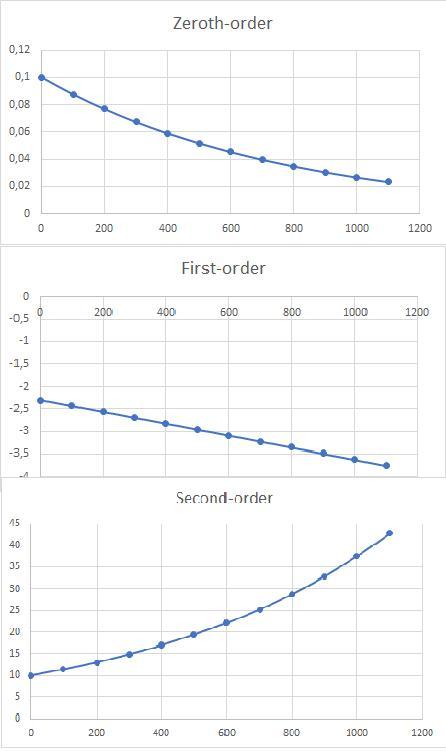
In this case, on the attached document, we can notice the corresponding plot for each possible order of reaction. Thus, we should remember that in zeroth-order we plot the concentration of the reactant (SO2Cl2 ) versus the time, in first-order the natural logarithm of the concentration of the reactant (SO2Cl2 ) versus the time and in second-order reactions the inverse of the concentration of the reactant (SO2Cl2 ) versus the time.

a) In such a way, we realize the best fit is exhibited by the first-order model which shows a straight line (R=1) which has a slope of -0.0013 and an intercept of -2.3025 (natural logarithm of 0.1 which corresponds to the initial concentration). Therefore, the reaction has a first-order kinetics.

b) Since the slope is -0.0013 (take two random values), the rate constant is 0.013 min⁻¹:

m=\frac{ln(0.0768)-ln(0.0876)}{200min-100min} =-0.0013min^{-1}

c) Half life for first-order kinetics is computed by:

t_{1/2}=\frac{ln(2)}{k}=\frac{ln(2)}{0.013min^{-1}}  =53.3min

d) Here, we compute the concentration via the integrated rate law once 1500 minutes have passed:

C=C_0exp(-kt)=0.1Mexp(-0.013min^{-1}*1500min)\\\\C=0.0142M

Best regards.

6 0
2 years ago
Which graphic below shows the correct orientation of each water molecule when it is near the cl- ion in the aqueous solution?
andrew-mc [135]
The question is missing the graphics required to answer which I have attached as an image.

There are four different representations of the orientation of water molecules around chloride anion. Let's first analyze the water molecule.

We have H-O-H as the structure of water. The oxygen atom is more electronegative than the hydrogen atoms, which results in a partial positive charge on the hydrogen atoms and a partial negative charge on the oxygen atom.

The chloride anion is a negative charge. Therefore, the water molecules should orient themselves with the hydrogen atoms facing the chlorine atom as the partial positive charge on the hydrogen atoms will be attracted to the negative charge of the chlorine atom.

The correct representation is shown in graph 3 which shows all hydrogen atoms facing the chlorine anion.

8 0
2 years ago
This means that the steel bar lost 14900 J of thermal energy. What is the change in temperature of the steel bar? Recall that th
stiv31 [10]

Answer:

ΔT=-747,13°C

Explanation:

Sensible heat is<em> the amount of thermal energy that is required to change the temperature of an object</em>, the equation for calculating the heat change is  given by:

Q=msΔT

where:

  • Q, heat that has been absorbed or realeased by the substance [J]
  • m, mass of the substance [g]
  • s, specific heat capacity [J/g°C] (
  • ΔT, changes in the substance temperature [°C]

To solve the problem, we clear ΔT of the equation and then replace our data:

Q=msΔT

ΔT=Q/ms

ΔT=\frac{-14900 J}{40,7g*0,49\frac{J}{gC} }=-747,13°C

<em>(Note that Q=-14900 J because there is a </em><u><em>LOST</em></u><em> of thermal energy)</em>

Thus, the change in temperature of the steel bar is -747,13°C, meaning that the temperature of the bar decreases.


5 0
2 years ago
Read 2 more answers
Other questions:
  • How many moles of ions are in 285 ml of 0.0150 m mgcl2?
    10·2 answers
  • choose the reaction that illustrates delta H *f for Ca(NO3)2.(A) Ca (s) + N2 (g) + 3O2 ---&gt; Ca(NO3)2 (s)(B) Ca2 (aq) + 2 NO3-
    15·1 answer
  • 27. Scott travels north 5 miles and then goes west 3 miles before coming straight back south 2 miles. What is his distance? *
    5·1 answer
  • Two weak acids, A and B, have pKa values of 4 and 6, respectively. Which statement is true?A) Acid A dissociates to a greater ex
    12·1 answer
  • Which of the following represents a propagation step in the monochlorination of methylene chloride (CH2Cl2)?a. CHCl3 + Cl. Right
    15·1 answer
  • Lin received 200 new laptops to be issued to company employees. Lin was asked to set them up and distribute them to everyone on
    12·2 answers
  • The decantate from Question 1 that possibly contains K, Zn, or Cr, is neutralized with acetic acid and divided into the appropri
    9·1 answer
  • Which statement describes a chemical property of an object? A:The object is white in color.B:The object has a powdery texture.C:
    15·1 answer
  • Weak noncovalent interactions:__________ a. do not include ionic interactions b. always involve water. c. can have a large cumul
    13·1 answer
  • Which statements describe lattice energy?
    7·1 answer
Add answer
Login
Not registered? Fast signup
Signup
Login Signup
Ask question!