answer.
Ask question
Login Signup
Ask question
All categories
  • English
  • Mathematics
  • Social Studies
  • Business
  • History
  • Health
  • Geography
  • Biology
  • Physics
  • Chemistry
  • Computers and Technology
  • Arts
  • World Languages
  • Spanish
  • French
  • German
  • Advanced Placement (AP)
  • SAT
  • Medicine
  • Law
  • Engineering
Masteriza [31]
2 years ago
4

Two thick walls made of the same material are separated by a vacuum gap of thickness L. A cylinder, made of the same material as

the walls, and of diameter D runs between the walls. All surfaces are highly polished (their emissivity is small). The walls are at temperatures Tbi and Tbz at locations far from the cylinder. The thermal conductivity of the walls and the rod is k.
(a) Draw the thermal resistance network.

(b) Derive an expression for the shape factor, S, associated with conduction between Tb, and Tba Use: S = k(Tb,1-Tb,2)

(c) Determine the value of the shape factor for D = 0.01 m, L = 0.5 m, and k = 23 W/mK.

Engineering
1 answer:
dmitriy555 [2]2 years ago
5 0

Answer:

q = -

T

overall

Rth

Explanation:

First consider the plane wall where a direct application of Fourier’s law [Equation (1-1)]

may be made. Integration yields

q = − kA

-

x (T2 − T1) [2-1]

when the thermal conductivity is considered constant. The wall thickness is -

x, and T1

and T2 are the wall-face temperatures. If the thermal conductivity varies with temperature

according to some linear relation k = k0(1 + βT ), the resultant equation for the heat flow

is

q = −k0A

-

x -

(T2 − T1) + β

2 (T 2

2 − T 2

1 )

[2-2]

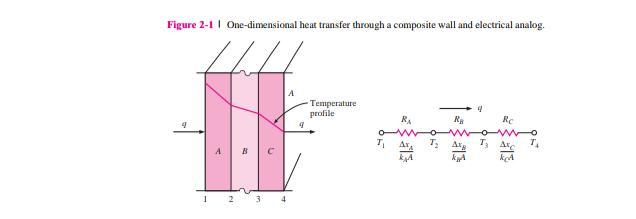
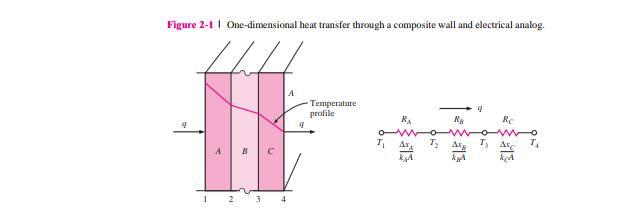
If more than one material is present, as in the multilayer wall shown in Figure 2-1, the

analysis would proceed as follows: The temperature gradients in the three materials are

shown, and the heat flow may be written

q = −kAA

T2 − T1

-

xA

= −kBA

T3 − T2

-

xB

= −kCA

T4 − T3

-

xC

Note that the heat flow must be the same through all sections.

Solving these three equations simultaneously, the heat flow is written

q = T1 − T4

-

xA/kAA + -

xB/kBA + -

xC/kCA [2-3]

At this point we retrace our development slightly to introduce a different conceptual view-

point for Fourier’s law. The heat-transfer rate may be considered as a flow, and the combina-

tion of thermal conductivity, thickness of material, and area as a resistance to this flow. The

temperature is the potential, or driving, function for the heat flow, and the Fourier equation

may be written

Heat flow = thermal potential difference

thermal resistance [2-4]

a relation quite like Ohm’s law in electric-circuit theory. In Equation (2-1) the thermal

resistance is -

x/kA, and in Equation (2-3) it is the sum of the three terms in the denominator.

We should expect this situation in Equation (2-3) because the three walls side by side act as

three thermal resistances in series. The equivalent electric circuit is shown in Figure 2-1b.

The electrical analogy may be used to solve more complex problems involving both

series and parallel thermal resistances. A typical problem and its analogous electric circuit

are shown in Figure 2-2. The one-dimensional heat-flow equation for this type of problem

may be written

q = -

T

overall

Rth

[2-5]

where the Rth are the thermal resistances of the various materials. The units for the thermal

resistance are ◦C/W or ◦F · h/Btu.

It is well to mention that in some systems, like that in Figure 2-2, two-dimensional

heat flow may result if the thermal conductivities of materials B, C, and D differ by an

appreciable amount. In these cases other techniques must be employed to effect a solution.

You might be interested in
The 10-kg block slides down 2 m on the rough surface with kinetic friction coefficient μk = 0.2. What is the work done by the fr
Rashid [163]

Answer:

153.2 J

Explanation:

Let's first list our given parameters;

mass (m) of the block = 10 kg

which slides down ( i.e displacement) = 2 m

kinetic coefficient of friction (μk) = 0.2

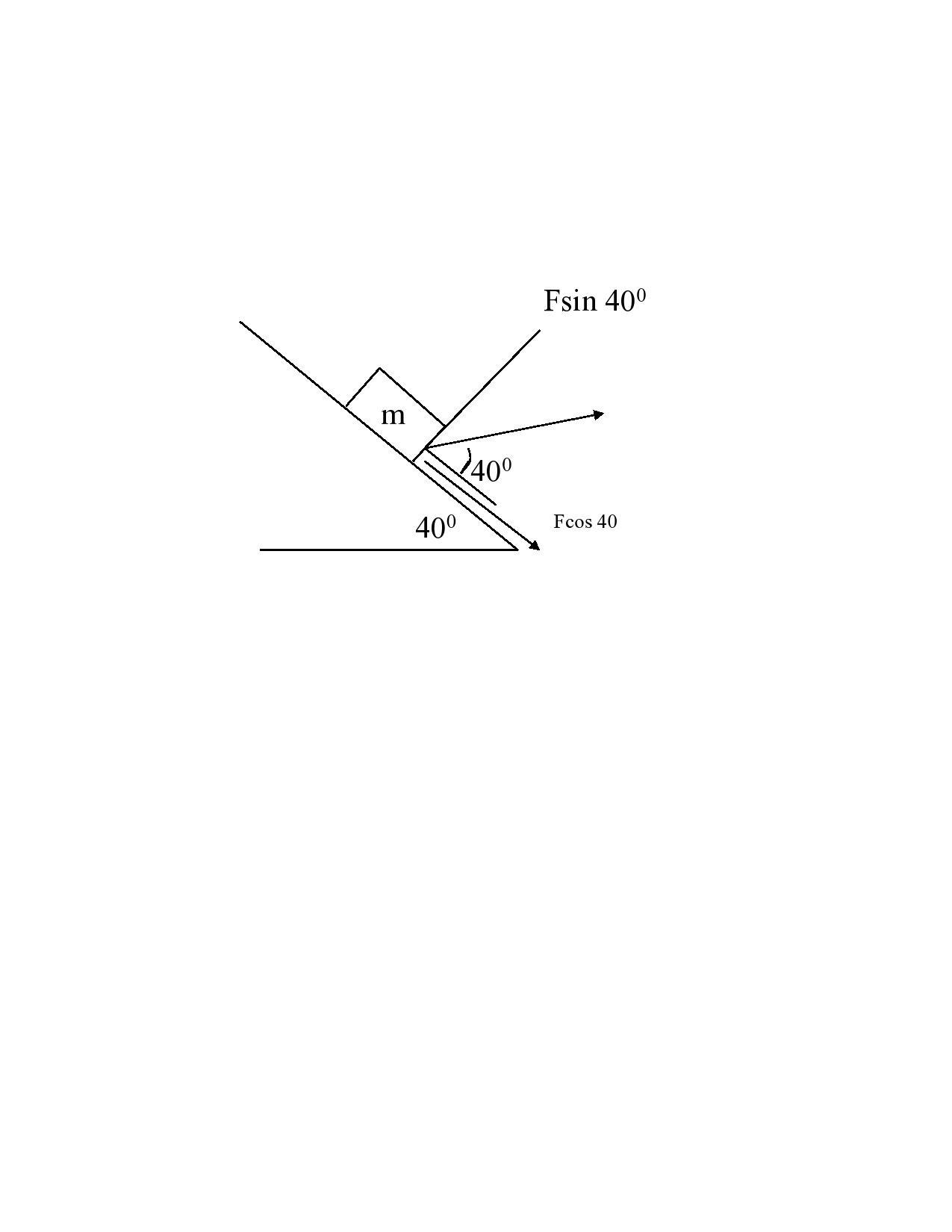
In the diagram shown below;  if we take an integral look at the component of force in the direction of the displacement; we have

F_x= Fcos 40°

F_x= 100 (cos 40°)

F_x= 76.60 N

Workdone by the friction force can now be determined as:

W = F_x × displacement

W = 76.60 × 2

W = 153.2 J

∴  the work done by the friction force = 153.2 J

7 0
2 years ago
The pressure drop across a valve through which air flows is expected to be 10 kPa. If this differential were applied to the two
ozzi

Answer:hit that soulja boy

Explanation:

6 0
2 years ago
You work in Madison, Wisconsin. It is January and the area has been hit with bad weather. Another weather front is expected to a
Lelu [443]

Answer:

The best first sentence of your e-mail will be-

<u>Weather forecasters are predicting a blizzard this afternoon, so, as a result of this news, our supervisor has decided to close the office at noon so people can travel home safely.</u>

<u />

5 0
2 years ago
The ingredient weights for making 1 yd (cyd) of concrete by assuming aggregates in SSD state are given below. The volume of air
Pachacha [2.7K]

Answer:

Explanation:

Ans) Given batch weight of each component :

Cement = 700 lb

Water = 315 lb

Coarse aggregate = 1575 lb

Fine aggregate = 1100 lb

Part 1) Amount of water = 328.5 lb

Amount of water is needed to be increased if the aggregates has absorption capacity, To maintain constant water cement ratio, the mixing water is increased because some of the water is absorbed by aggregates.

Amount of water absorbed = 328.5 lb - 315 lb = 13.5 lb

Total amount of aggregates = 1575 + 1100 = 2675 lb

=> % Absorption capacity = 13.5 x 100 / 2675 = 0.5 %

Hence, new amount of Coarse aggregate = (1 - 0.005) x 1575 lb = 1567.125 lb

New amount of fine aggregate = (1 - 0.005) x 1100 = 1094.5 lb

Since, water cement ratio is maintained constant , amount of cement remains unchanged

=> Volume of water = 328.5 / 62.4 = 5.26 ft3

=> Volume of cement = 700 / (3.15 x 62.4) = 3.56 ft3

=> Volume of coarse aggregate = 1567.125 / (2.4 x 62.4) = 10.46 ft3

=> Volume of fine aggregate = 1100 / (2.4 x 62.4) = 7.34 ft3

Volume of air = 2% = 0.02 x 27 = 0.54 ft3

Total concrete volume = 5.26 + 3.56 + 10.46 + 7.34 + 0.54 \approx 27 ft3 = 1 yd3

Hence, calculated amount of each component is correct

Part 2) We know, minus sign indicated that the aggregate will absorb some moisture from concrete, hence mixing water amount needed to be corrected .

=> Amount of water absorbed by coarse aggregate = 0.01 x 1567.125 lb = 15.67 lb

=> Amount of water absorbed by fine aggregate = 0.02 x 1094.50 lb = 21.89 lb

Total amount of water absorbed = 15.67 + 21.89 = 37.56 lb

To maintain same water cement ratio, amount of mixing water is needed to be increased

=> Corrected amount of mixing water = 328.5 lb + 37.56 lb = 366 lb

=> Corrected amount of coarse aggregate = (1 - 0.01) x 1567.125 = 1551.45 lb

=> Corrected amount of fine aggregate = (1 - 0.02) x 1094.5 = 1072.6 lb

Part 3) We know,

Unit weight = Sum of weight of each material / Total volume

=> Sum of weight = 366 + 700 + 1551.45 + 1072.6 = 3690.05 lb

Total volume = 1 yd3 or 27 ft3

=> Expected Unit Weight = 3690.05 lb / 27 ft3 = 136.67 lb/ft3

Also, Concrete Yield = Weight of all components / Unit weight of concrete

=> Yield = 3690.05 / 136.67 = 27 ft3 or 1 yd3
4 0
2 years ago
A thermal energy storage unit consists of a large rectangular channel, which is well insulated on its outer surface and encloses
yaroslaw [1]

Answer:

the temperature of the aluminum at this time is 456.25° C

Explanation:

Given that:

width w of the aluminium slab = 0.05 m

the initial temperature T_1 = 25° C

T{\infty} =600^0C

h = 100 W/m²

The properties of Aluminium at temperature of 600° C by considering the conditions for which the storage unit is charged; we have ;

density ρ = 2702 kg/m³

thermal conductivity k = 231 W/m.K

Specific heat c = 1033 J/Kg.K

Let's first find the Biot Number Bi which can be expressed by the equation:

Bi = \dfrac{hL_c}{k} \\ \\ Bi = \dfrac{h \dfrac{w}{2}}{k}

Bi = \dfrac{hL_c}{k} \\ \\ Bi = \dfrac{100 \times \dfrac{0.05}{2}}{231}

Bi = \dfrac{2.5}{231}

Bi = 0.0108

The time constant value \tau_t is :

\tau_t = \dfrac{pL_cc}{h} \\ \\ \tau_t = \dfrac{p \dfrac{w}{2}c}{h}

\tau_t = \dfrac{2702* \dfrac{0.05}{2}*1033}{100}

\tau_t = \dfrac{2702* 0.025*1033}{100}

\tau_t = 697.79

Considering Lumped capacitance analysis since value for Bi is less than 1

Then;

Q= (pVc)\theta_1 [1-e^{\dfrac {-t}{ \tau_1}}]

where;

Q = -\Delta E _{st} which correlates with the change in the internal energy of the solid.

So;

Q= (pVc)\theta_1 [1-e^{\dfrac {-t}{ \tau_1}}]= -\Delta E _{st}

The maximum value for the change in the internal energy of the solid  is :

(pVc)\theta_1 = -\Delta E _{st}max

By equating the two previous equation together ; we have:

\dfrac{-\Delta E _{st}}{\Delta E _{st}{max}}= \dfrac{  (pVc)\theta_1 [1-e^{\dfrac {-t}{ \tau_1}}]} { (pVc)\theta_1}

Similarly; we need to understand that the ratio of the energy storage to the maximum possible energy storage = 0.75

Thus;

0.75=  [1-e^{\dfrac {-t}{ \tau_1}}]}

So;

0.75=  [1-e^{\dfrac {-t}{ 697.79}}]}

1-0.75=  [e^{\dfrac {-t}{ 697.79}}]}

0.25 =  e^{\dfrac {-t}{ 697.79}}

In(0.25) =  {\dfrac {-t}{ 697.79}}

-1.386294361= \dfrac{-t}{697.79}

t = 1.386294361 × 697.79

t = 967.34 s

Finally; the temperature of Aluminium is determined as follows;

\dfrac{T - T _{\infty}}{T_1-T_{\infty}}= e ^ {\dfrac{-t}{\tau_t}}

\dfrac{T - 600}{25-600}= e ^ {\dfrac{-967.34}{697.79}

\dfrac{T - 600}{25-600}= 0.25

\dfrac{T - 600}{-575}= 0.25

T - 600 = -575 × 0.25

T - 600 = -143.75

T = -143.75 + 600

T = 456.25° C

Hence; the temperature of the aluminum at this time is 456.25° C

3 0
2 years ago
Other questions:
  • A thin metal disk of mass m=2.00 x 10^-3 kg and radius R=2.20cm is attached at its center to a long fiber. When the disk is turn
    11·1 answer
  • Given a 5x5 matrix for Playfair cipher a. How many possible keys does the Playfair cipher have? Ignore the fact that some keys m
    6·1 answer
  • Air whose density is 0.082 lbm/ft3 enters the duct of an air-conditioning system at a volume flow rate of 450 ft3/min. If the di
    8·2 answers
  • Two resistors of values 7.0 and 15.0 Ω are connected in parallel. This combination in turn is hooked in series with a 3.8- Ω res
    7·1 answer
  • Why is it that dislocations play an important role in controlling the mechanical properties of metallic materials, however, they
    10·1 answer
  • With thermodynamics, one cannot determine ________.
    14·1 answer
  • An air standard cycle with constant specific heats is executed in a closed pistoncylinder system and is composed of the followin
    10·1 answer
  • When encountering low visibility from rain or fog, you should use your ____.
    12·1 answer
  • Question 14<br> Which of these is true of a spray wash cabinet?
    6·1 answer
  • How does Accenture generate value for clients through Agile and DevOps?
    15·2 answers
Add answer
Login
Not registered? Fast signup
Signup
Login Signup
Ask question!