answer.
Ask question
Login Signup
Ask question
All categories
  • English
  • Mathematics
  • Social Studies
  • Business
  • History
  • Health
  • Geography
  • Biology
  • Physics
  • Chemistry
  • Computers and Technology
  • Arts
  • World Languages
  • Spanish
  • French
  • German
  • Advanced Placement (AP)
  • SAT
  • Medicine
  • Law
  • Engineering
Mama L [17]
2 years ago
15

7–97 A commercial refrigerator with refrigerant-134a as the working fluid is used to keep the refrigerated space at 235°C by rej

ecting waste heat to cooling water that enters the condenser at 18°C at a rate of 0.25 kg/s and leaves at 26°C. The refrigerant enters the condenser at 1.2 MPa and 50°C and leaves at the same pressure subcooled by 5°C. If the compressor consumes 3.3 kW of power, determine (a) the mass flow rate of the refrigerant, (b) the refrigeration load, (c) the COP, and (d) the minimum power input to the compressor for the same refrigeration load.
Engineering
1 answer:
Andreyy892 years ago
4 0

Answer:

note:

<u><em>solution is attached in word form due to error in mathematical equation. furthermore i also attach Screenshot of solution in word due to different version of MS Office please find the attachment</em></u>

Download docx
You might be interested in
The rigid bar CDE is attached to a pin support at E and rests on the 30 mm diameter brass cylinder BD. A 22 mm diameter steel ro
Leno4ka [110]

Answer:

stress = 38.84 MPa

Explanation:

S_{D} = \alpha _{brass} * (delta T) *(L_{BD} )\\= (18.8 * 10^(-6) )*(30)*(0.3)\\= 0.0001692 m\\\\E_{BD} = stress / strain\\stress = E_{BD} * S_{D}\\stress = (200 *10^9) * (0.0001692)\\stress = 33.84 MPa

3 0
2 years ago
Small droplets of carbon tetrachloride at 68 °F are formed with a spray nozzle. If the average diameter of the droplets is 200 u
Licemer1 [7]

Answer:

the difference in pressure between the inside and outside of the droplets is 538 Pa

Explanation:

given data

temperature = 68 °F

average diameter = 200 µm

to find out

what is the difference in pressure between the inside and outside of the droplets

solution

we know here surface tension of carbon tetra chloride at 68 °F is get from table 1.6 physical properties of liquid that is

σ = 2.69 × 10^{-2} N/m

so average radius = \frac{diameter}{2} =  100 µm = 100 ×10^{-6} m

now here we know relation between pressure difference and surface tension

so we can derive difference pressure as

2π×σ×r = Δp×π×r²    .....................1

here r is radius and  Δp pressure difference and σ surface tension

Δp = \frac{2 \sigma }{r}    

put here value

Δp = \frac{2*2.69*10^{-2}}{100*10^{-6}}  

Δp = 538

so the difference in pressure between the inside and outside of the droplets is 538 Pa

7 0
2 years ago
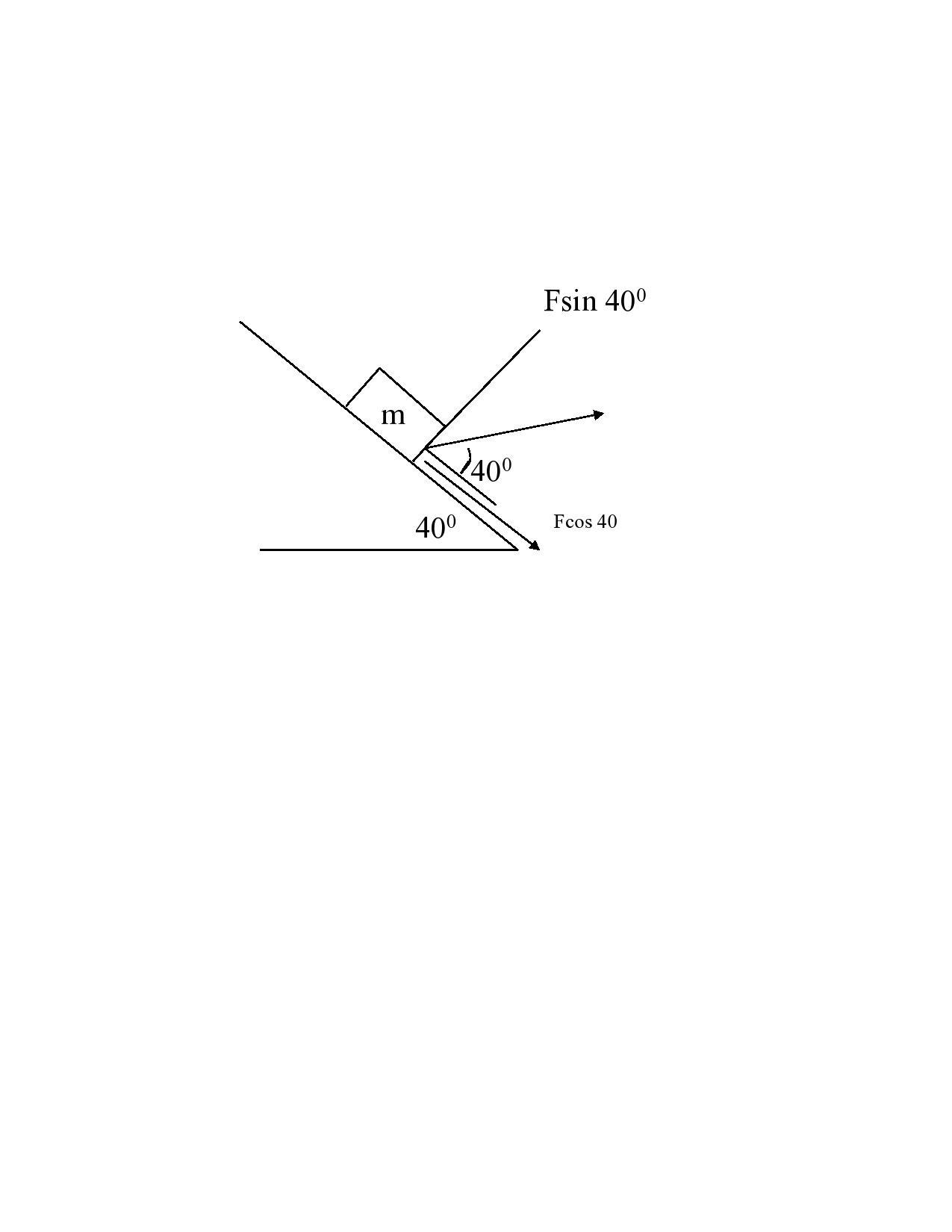
The 10-kg block slides down 2 m on the rough surface with kinetic friction coefficient μk = 0.2. What is the work done by the fr
Rashid [163]

Answer:

153.2 J

Explanation:

Let's first list our given parameters;

mass (m) of the block = 10 kg

which slides down ( i.e displacement) = 2 m

kinetic coefficient of friction (μk) = 0.2

In the diagram shown below;  if we take an integral look at the component of force in the direction of the displacement; we have

F_x= Fcos 40°

F_x= 100 (cos 40°)

F_x= 76.60 N

Workdone by the friction force can now be determined as:

W = F_x × displacement

W = 76.60 × 2

W = 153.2 J

∴  the work done by the friction force = 153.2 J

7 0
2 years ago
Oliver is designing a new children’s slide to increase the speed at which a child can descend. His first design involved steel b
AVprozaik [17]

Answer:

The correct option is;

A) Steel becomes too hot in the Sun and can burn the children

Explanation:

The properties of steel includes;

Low specific heat capacity, high thermal and electrical toughness, high hardness, high tensile strength, high yield strength, appreciable elongation, high fatigue strength, can easily corrode, high malleability and ability to creep

Therefore, due to the low specific heat capacity, which is 0.511 J/(g·°C) and high conductivity of steel which is about 32 W/(m·k), the temperature of the steel can rapidly rise and the hot steel surface can readily conduct the heat, (due to the temperature difference) to other bodies that come in contact

8 0
2 years ago
An adiabatic gas turbine expands air at 1300 kPa and 500◦C to 100 kPa and 127◦C. Air enters the turbine through a 0.2-m2 opening
Viktor [21]

Given:

Pressure, P_{1} = 1300 kPa

Temperature,  T_{1} = 500^{\circ}

P_{2} = 100 kPa

T_{2} = 127^{\circ}  

velocity, v = 40 m/s

A = 1m^{2}

Solution:

For air propertiess at

P_{1} = 1300 kPa

T_{1} = 500^{\circ}

h_{1} = 793kJ/K

v_{1} = 0.172\frac{m^{3}}{kg}

and also at

P_{2} = 100 kPa

T_{2} = 127^{\circ}  

h_{2} = 401 KJ/K

v_{2} =  1.15\frac{m^{3}}{kg}

a) Mass flow rate is given by:

m' = \frac{Av}{v_{1}}

Now,

m = \frac{0.2\times 40}{0.172} = 46.51 kg/s

b) for the power produced by turbine, P = m'(h_{1} - h_{2})

P = 46.51\times(793 - 401) = 18.231 MW

5 0
2 years ago
Other questions:
  • Compute the mass fractions of α ferrite and cementite in pearlite. Assume T=726⁢ C∘.
    15·1 answer
  • Which of the two materials (brittle vs. ductile) usually obtains the highest ultimate strength and why?
    5·1 answer
  • A meter stick can be read to the nearest millimeter and a travelling microscope can be read to the nearest 0.1 mm. Suppose you w
    11·1 answer
  • An aircraft component is fabricated from an aluminum alloy that has a plane-strain fracture toughness of 40 MPa1m (36.4 ksi1in.)
    15·1 answer
  • Sea water with a density of 1025 kg/m3 flows steadily through a pump at 0.21 m3 /s. The pump inlet is 0.25 m in diameter. At the
    8·1 answer
  • Argon contained in a closed, rigid tank, initially at 33.7°C, 2.1 bar, and a volume of 4.2 m3, is heated to a final pressure of
    12·1 answer
  • Consider water at 27°C in parallel flow over an isothermal, 1‐m‐long flat plate with a velocity of 2 m/s. a) Plot the variation
    15·1 answer
  • Refrigerant-134a is compressed from 2 bar, saturated vapor, to 10 bar, 90o C in a compressor operating at steady state. The mass
    11·1 answer
  • Consider the time domain waveforms below on the left. Match waveforms (a) - (e) to their respective frequency spectrum represent
    11·1 answer
  • What should always be done before beginning any diagnosis?
    9·1 answer
Add answer
Login
Not registered? Fast signup
Signup
Login Signup
Ask question!