answer.
Ask question
Login Signup
Ask question
All categories
  • English
  • Mathematics
  • Social Studies
  • Business
  • History
  • Health
  • Geography
  • Biology
  • Physics
  • Chemistry
  • Computers and Technology
  • Arts
  • World Languages
  • Spanish
  • French
  • German
  • Advanced Placement (AP)
  • SAT
  • Medicine
  • Law
  • Engineering
Svetllana [295]
2 years ago
12

Explain the four criteria for proving the correctness of a logical pretest loop construct of the form "while B do S end". And pr

ove the correctness of the following:
while B do S end
Engineering
1 answer:
evablogger [386]2 years ago
6 0

Answer:

Check the explanation

Explanation:

The loop invariant has to satisfy some amount of requirements to be of good use. Another complex factor as to why a loop is the question of loop termination. A loop that doesn’t terminate can’t invariably be correct, and in fact the computation in whatever form amounts to nothing. The total axiomatic description of a while construct will have to involve all of the following to be true, in which I is the loop invariant:

P => I

{I and B} S {I}

(I and (not B)) => Q

Then the loop terminates

You might be interested in
Use the predicate specifications(x, y): x beats yF (x): x is an (American) football teamQ(x, y): x is quarterback of yL(x,y): x
attashe74 [19]

Answer:

a) ∀y∃x(Q(x, y))

b) (B(Jayhawks, W ildcats)→¬∀y(L(Jayhawks, y)))

c) ∃x(B(Wildcats, x) ∧ B(x, Jayhawks))

Explanation:

a) The statement can be rewritten as "For all football teams, there exists a quarterback" which is written in logical symbols.

b) The statement is an implication and thus have a premise and a conclusion. The premise states "Jayhawks beat the Wildcats" which is translated using B(x, y). The conclusion can be rewritten as "It is not the case that Jayhawks lose to all football teams".

c) The statement is a simple conjunction which can be written as "There exists a team x such that the Wildcats beats x and x beats Jayhawks"

7 0
2 years ago
The 30-kg gear is subjected to a force of P=(20t)N where t is in seconds. Determine the angular velocity of the gear at t=4s sta
tatyana61 [14]

Answer:

\omega =\frac{24}{1.14375}=20.983\frac{rad}{s}

Explanation:

Previous concepts

Angular momentum. If we consider a particle of mass m, with velocity v, moving under the influence of a force F. The angular  momentum about point O is defined as the “moment” of the particle’s linear momentum, L, about O. And the correct formula is:

H_o =r x mv=rxL

Applying Newton’s second law to the right hand side of the above equation, we have that r ×ma = r ×F =

MO, where MO is the moment of the force F about point O. The equation expressing the rate of change  of angular momentum is this one:

MO = H˙ O

Principle of Angular Impulse and Momentum

The equation MO = H˙ O gives us the instantaneous relation between the moment and the time rate of change of angular  momentum. Imagine now that the force considered acts on a particle between time t1 and time t2. The equation MO = H˙ O can then be integrated in time to obtain this:

\int_{t_1}^{t_2}M_O dt = \int_{t_1}^{t_2}H_O dt=H_0t2 -H_0t1

Solution to the problem

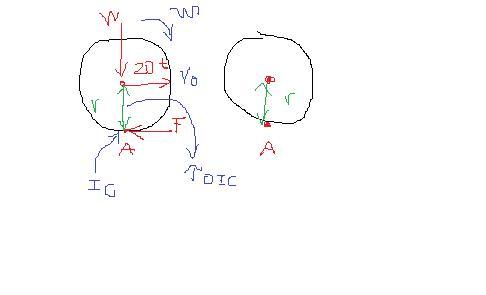
For this case we can use the principle of angular impulse and momentum that states "The mass moment of inertia of a gear about its mass center is I_o =mK^2_o =30kg(0.125m)^2 =0.46875 kgm^2".

If we analyze the staritning point we see that the initial velocity can be founded like this:

v_o =\omega r_{OIC}=\omega (0.15m)

And if we look the figure attached we can use the point A as a reference to calculate the angular impulse and momentum equation, like this:

H_Ai +\sum \int_{t_i}^{t_f} M_A dt =H_Af

0+\sum \int_{0}^{4} 20t (0.15m) dt =0.46875 \omega + 30kg[\omega(0.15m)](0.15m)

And if we integrate the left part and we simplify the right part we have

1.5(4^2)-1.5(0^2) = 0.46875\omega +0.675\omega=1.14375\omega

And if we solve for \omega we got:

\omega =\frac{24}{1.14375}=20.983\frac{rad}{s}

8 0
2 years ago
Determine the deflection at the center of the beam. Express your answer in terms of some or all of the variables LLL, EEE, III,
Rom4ik [11]

Answer:

See explanations for step by step procedures to get answer.

Explanation:

Given that;

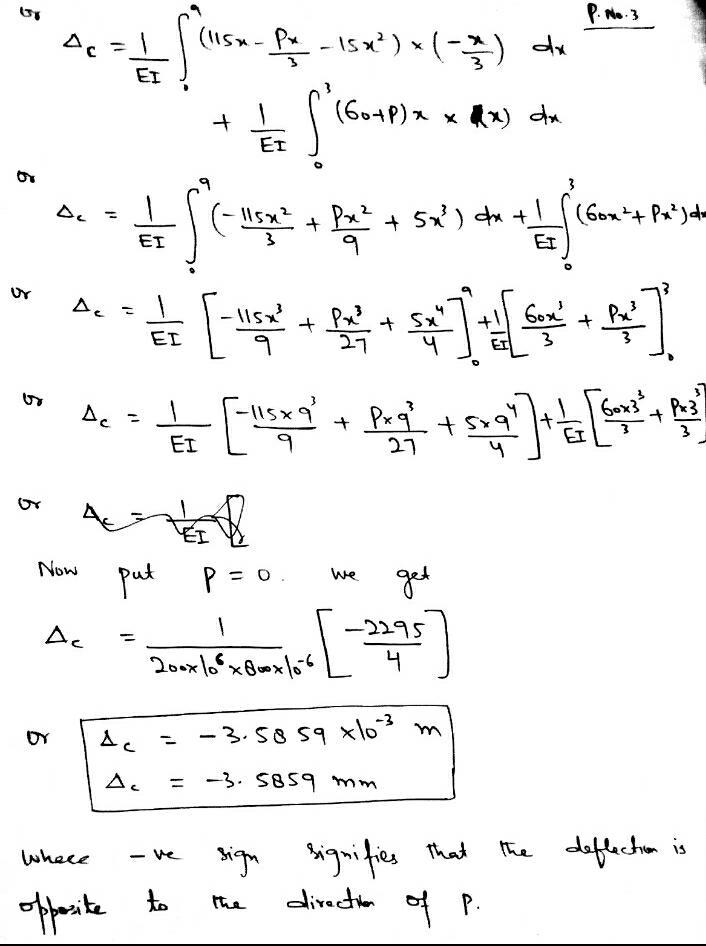
Determine the deflection at the center of the beam. Express your answer in terms of some or all of the variables LLL, EEE, III, and M0M0M_0. Enter positive value if the deflection is upward and negative value if the deflection is downward.

4 0
2 years ago
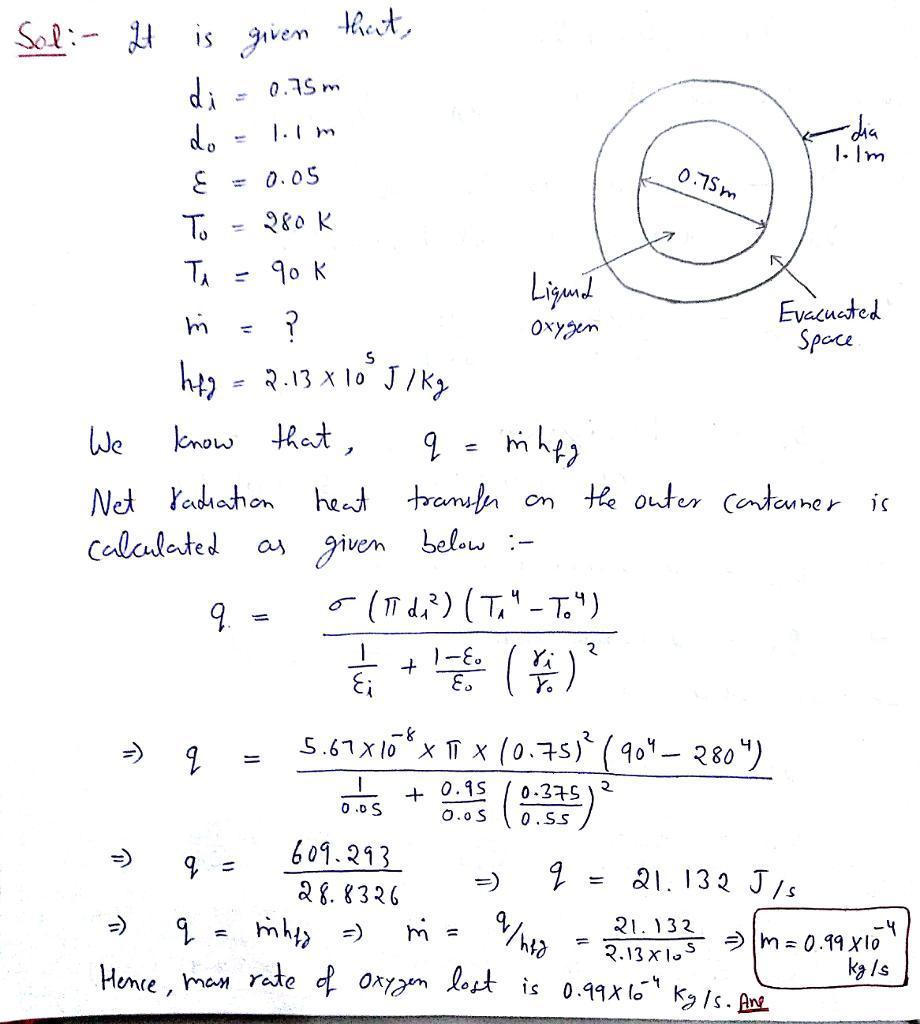
Liquid oxygen is stored in a thin-walled, spherical container 0.75 m in diameter, which is enclosed within a second thin-walled,
nadezda [96]

Answer:

Explanation:

the solution is well stated

3 0
2 years ago
Methane and oxygen react in the presence of a catalyst to form formaldehyde. In a parallel reaction, methane is oxidized to carb
Nezavi [6.7K]

Answer:

y_{CH_4}^2=\frac{5mol/s}{100mol/s}=0.05\\y_{O_2}^2=\frac{3mol/s}{100mol/s}=0.03\\y_{H_2O}^2=\frac{47mol/s}{100mol/s}=0.47\\y_{HCHO}^2=\frac{43mol/s}{100mol/s}=0.43\\y_{CO_2}^2=\frac{2mol/s}{100mol/s}=0.02

Explanation:

Hello,

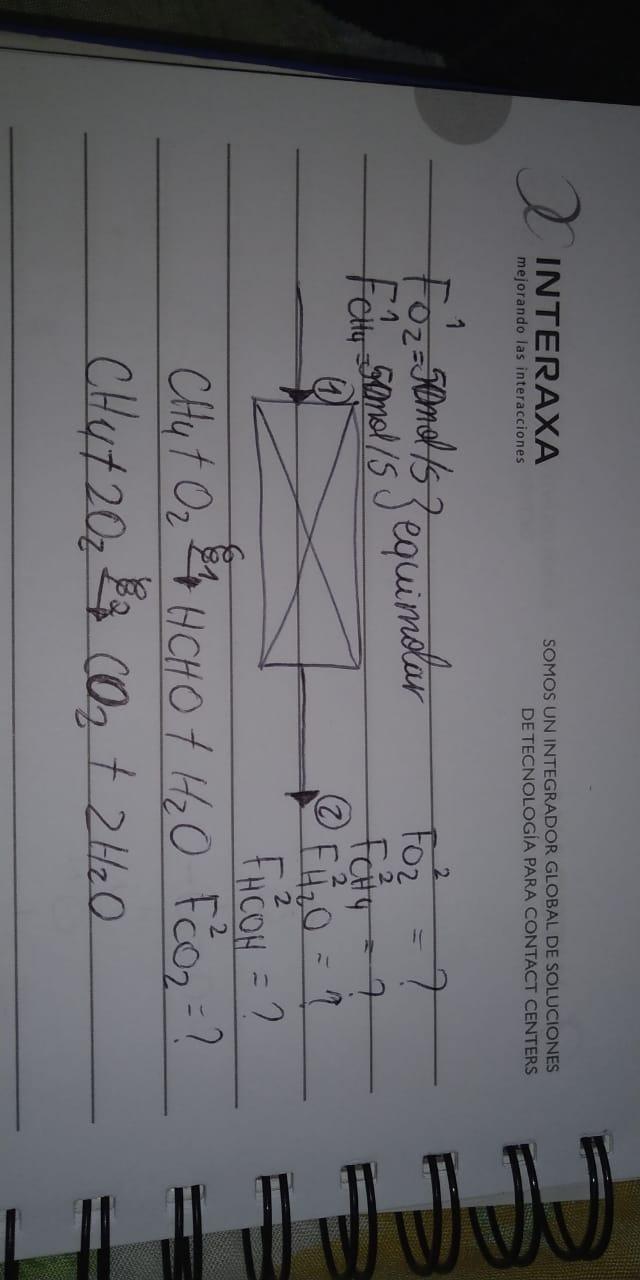
a. On the attached document, you can see a brief scheme of the process. Thus, to know the degrees of freedom, we state the following unknowns:

- \xi_1 and \xi_2: extent of the reactions (2).

- F_{O_2}^2, F_{CH_4}^2, F_{H_2O}^2, F_{HCHO}^2 and F_{CO_2}^2: Molar flows at the second stream (5).

On the other hand, we've got the following equations:

- F_{O_2}^2=50mol/s-\xi_1-2\xi_2: oxygen mole balance.

- F_{CH_4}^2=50mol/s-\xi_1-\xi_2: methane mole balance.

- F_{H_2O}^2=\xi_1+2\xi_2: water mole balance.

- F_{HCHO}^2=\xi_1: formaldehyde mole balance.

- F_{CO_2}^2=\xi_2: carbon dioxide mole balance.

Thus, the degrees of freedom are:

DF=7unknowns-5equations=2

It means that we need two additional equations or data to solve the problem.

b. Here, the two missing data are given. For the fractional conversion of methane, we define:

0.900=\frac{\xi_1+\xi_2}{50mol/s}

And for the fractional yield of formaldehyde we can set it in terms of methane as the reagents are equimolar:

0.860=\frac{F_{HCHO}^2}{50mol/s}

In such a way, one realizes that the output formaldehyde's molar flow is:

F_{HCHO}^2=0.860*50mol/s=43mol/s

Which is equal to the first reaction extent \xi_1, therefore, one computes the second one from the fractional conversion of methane as:

\xi_2=0.900*50mol/s-\xi_1\\\xi_2=0.900*50mol/s-43mol/s\\\xi_2=2mol/s

Now, one computes the rest of the output flows via:

- F_{O_2}^2=50mol/s-43mol/s-2*2mol/s=3mol/s

- F_{CH_4}^2=50mol/s-43mol/s-2mol/s=5mol/s

- F_{H_2O}^2=43mol/s+2*2mol/s=47mol/s

- F_{HCHO}^2=43mol/s

- F_{CO_2}^2=2mol/s

The total output molar flow is:

F_{O_2}+F_{CH_4}+F_{H_2O}+F_{HCHO}+F_{CO_2}=100mol/s

Therefore the output stream composition turns out into:

y_{CH_4}^2=\frac{5mol/s}{100mol/s}=0.05\\y_{O_2}^2=\frac{3mol/s}{100mol/s}=0.03\\y_{H_2O}^2=\frac{47mol/s}{100mol/s}=0.47\\y_{HCHO}^2=\frac{43mol/s}{100mol/s}=0.43\\y_{CO_2}^2=\frac{2mol/s}{100mol/s}=0.02

Best regards.

7 0
2 years ago
Other questions:
  • What can your employer do to protect you from overhead power lines?
    8·1 answer
  • A pitfall cited in Section 1.10 is expecting to improve the overall performance of a computer by improving only one aspect of th
    6·1 answer
  • The velocity of a particle which moves along the s-axis is given by v = 2-4t+5t^(3/2), where t is in seconds and v is in meters
    11·2 answers
  • 4.9 Given that I 4 amps when Vs 40 volts and Is 4 amps and I 1 amp when Vs 20 volts and Is 0, use superposition and linearity to
    5·1 answer
  • The driving force for fluid flow is the pressure difference, and a pump operates by raising the pressure of a fluid (by converti
    13·1 answer
  • Add a calculated field named AccountTime that calculates the number of days each client's accounts have been open. Assume today'
    6·1 answer
  • With thermodynamics, one cannot determine ________.
    14·1 answer
  • Argon contained in a closed, rigid tank, initially at 33.7°C, 2.1 bar, and a volume of 4.2 m3, is heated to a final pressure of
    12·1 answer
  • The atomic radii of a divalent cation and a monovalent anion are 0.77 nm and 0.136 nm, respectively.1- Calculate the force of at
    11·1 answer
  • 11 Notează, în caiet, trăsăturile personajelor ce se pot
    13·1 answer
Add answer
Login
Not registered? Fast signup
Signup
Login Signup
Ask question!