answer.
Ask question
Login Signup
Ask question
All categories
  • English
  • Mathematics
  • Social Studies
  • Business
  • History
  • Health
  • Geography
  • Biology
  • Physics
  • Chemistry
  • Computers and Technology
  • Arts
  • World Languages
  • Spanish
  • French
  • German
  • Advanced Placement (AP)
  • SAT
  • Medicine
  • Law
  • Engineering
MAVERICK [17]
2 years ago
9

A bottle rocket experiences a 500 N force to the right and 300 N of air resistance to the left. Will it accelerate to the left,

right, or not accelerate at all?
A box experiences a 20 N force to the left and two different 8 N forces to the right. Will it accelerate to the left, right, or not at all?

A car experiences a 300 N force to the right from the engine and separate 150 N force due to friction and air resistance to the left. Will it accelerate to the left, right, or not at all?

A rope experiences three 400 N forces to the left and three different 410 N forces to the right.

A skateboard is pushed up a hill with a 90 N force to the left and experiences a gravitational force of 100 N to the right


A box experiences a 20 N force to the left and a 19 N frictional force to the right.
Chemistry
2 answers:
VikaD [51]2 years ago
8 0
The bottle rocket,200 N to the right
the box not at all
the car probably 200N

Finger [1]2 years ago
4 0
<h2>Answer 1) Right </h2><h3> Explanation :  </h3>

To find that the acceleration will be on right or left, we need to find the net force between them.


Which is Net F = 500 N - 300 N = 200 N  


Therefore, the acceleration will be on right side as it has greater difference as compared to left.


<h2>Answer 2) Left </h2><h3> Explanation : </h3>

Here, the right side will have 2 forces of 8 N which gives the total of 16 N.  

Using the net force calculation = 20 N - 16 N = 4 N.


Therefore, the box will accelerate towards left-side.


<h2>Answer 3) Right </h2><h3>Explanation : </h3>

In this case, the car is experiencing +300 N to the right and -150 N on left.


On calculating the net force = +300 N- 150 N = +150 N.


Here, right side has 150 N greater force than left side. Therefore, the car will accelerate towards right.


<h2>Answer 4) Right </h2><h3>Explanation : </h3>

The rope will move towards right as the net force will be 10 N towards right.


By calculating the net force = 410 N - 400 N = 10 N.


This clearly indicates that the rope will move towards right.


<h2>Answer 5) Right </h2><h3>Explanation: </h3>

The skateboard will accelerate towards right as the force will be 10 N more on right than on left.


As the net force will be = 100 N - 90 N = 10 N.


Since, the 10 N more force is on right the acceleration will be on right.


<h2>Answer 6) Left </h2><h3>Explanation : </h3>

The box will experience acceleration towards left as there will be greater 1 N force on left as compared to right.


On calculating the net force = 20 N - 19 N = 1 N


This shows that the box will accelerate on left side.

You might be interested in
3 Ni2+(aq) + 2 Cr(OH)3(s) + 10 OH− (aq) → 3 Ni(s) + 2 CrO42−(aq) + 8 H2O(l) ΔG∘ = +87 kJ/molGiven the standard reduction potenti
Mrrafil [7]

Answer:

The standard reduction potential E°cell (Cr6+/Cr3+) is -0.13V

Explanation:

<u>Step 1</u>: Data given

3 Ni^2+(aq) + 2 Cr(OH)3(s) + 10 OH− (aq) → 3 Ni(s) + 2 CrO4^2−(aq) + 8 H2O(l) ΔG∘ = +87000 J/mol

Ni2+(aq) + 2 e− → Ni(s)    E∘red = -0.28 V

<u>Step 2:</u> The half reactions:

Cathode:  Ni2+(aq) + 2 e− → Ni(s)    E° = -0.28 V

Anode: CrO4^2-(aq) + 4H2O(l) +3e- → Cr(OH)3(s) + 5OH- (aq)   E°= unknown

<u>Step 3:</u> Calculate E°cell

ΔG° = -n*F*E°cell

⇒ with ΔG° = the gibbs free energy

⇒ n = the number of electrons in the net reaction = 6

⇒ F = the Faraday constant = 96485 C

⇒ E°cell= the standard cell potential

<u>Step 4:</u> Calculate E°(Cr6+/Cr3+

E°cell= ΔG°/(-n*F)

E°cell = 87000 /(-6*96485)

E°cell = -0.150 V

E°cell = E°(Ni2+/Ni) - E°(Cr6+/Cr3+)

E°(Cr6+/Cr3+) = -0.13V

The standard reduction potential E°cell (Cr6+/Cr3+) is -0.13V

7 0
2 years ago
If you were to perform the reaction KCl (s)→K+ (g)+ Cl−(g), would energy be absorbed or released? Lattice Energies for Some Ioni
lina2011 [118]

Answer:

Energy would be absorbed.

Explanation:

Lattice energy is defined as the energy required to break apart an ionic solid and convert its component atoms into gaseous ions. That is what you're doing in:

KCl (s) → K⁺(g) + Cl⁻(g)

The energy you require to obtain this reaction is 701 kJ/mol. As the value is positive, <em>energy would be absorbed.</em>

<em />

I hope it helps!

6 0
2 years ago
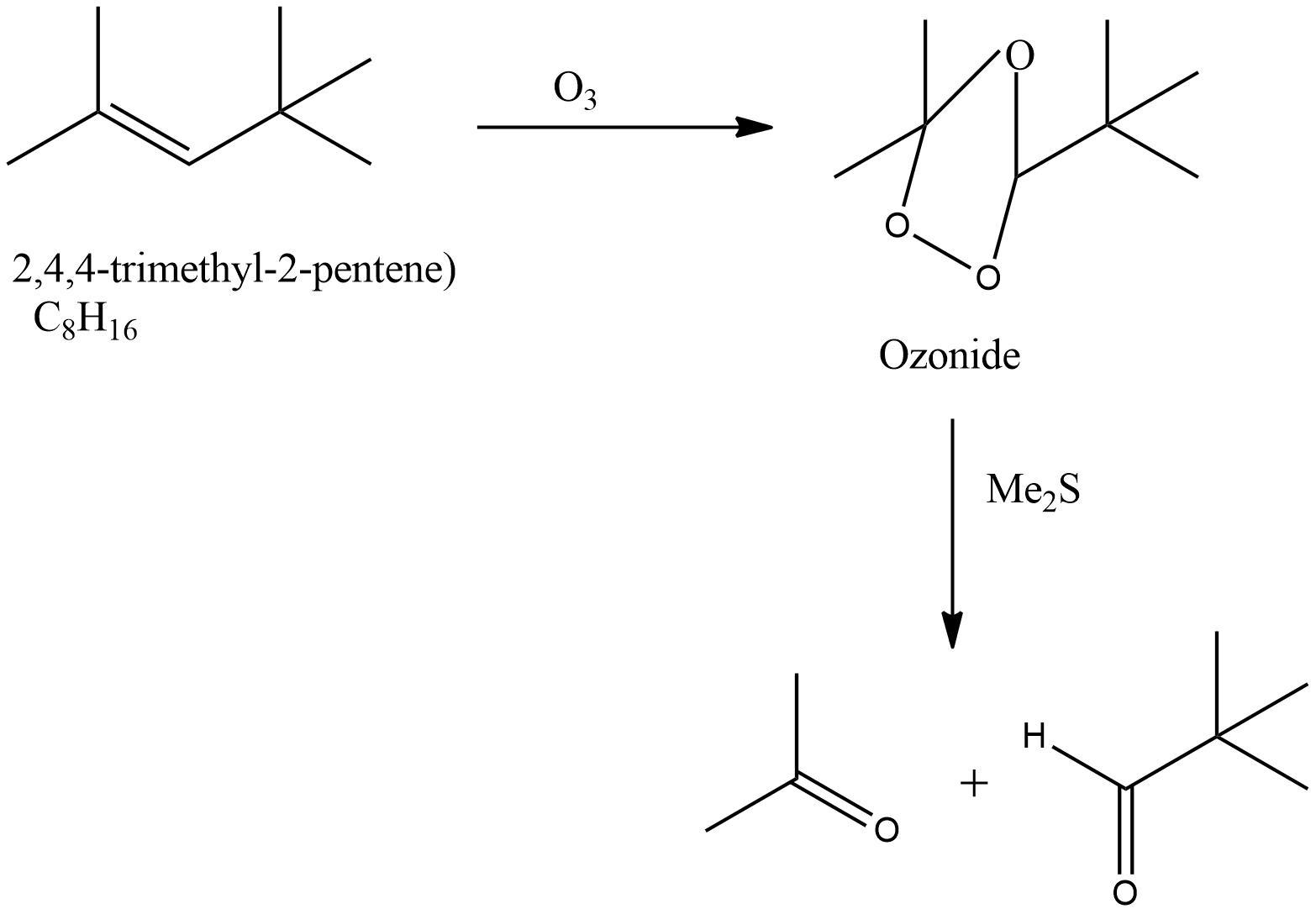
An alkene with the molecular formula C8H16 undergoes ozonolysis to yield a mixture of (CH3)2C=O and (CH3)3CCHO. The alkene is:
aalyn [17]

Answer:

2,4,4-trimethyl-2-pentene yields mixture of (CH_{3})_{2}C=O and (CH_{3})_{3}CHO

Explanation:

In ozonolysis (hydrolysis step involve a reducing agent such as Zn, Me_{2}S etc.), a pi bond is broken to form ketone/aldehyde.

Ketone is formed from di-substituted side of double bond and aldehyde is formed from mono-substituted side of double bond.

Ozoznolysis involves two consecutive steps : (1) formation of ozonide, (2) hydrolysis of ozonide.

Hydrolysis can be done with/without using reducing agent. Carboxylic acid/carbon dioxide/ketone is produced when hydrolysis is done without using reducing agent.

Here, 2,4,4-trimethyl-2-pentene yields mixture of (CH_{3})_{2}C=O and (CH_{3})_{3}CHO

Reaction steps are shown below.

8 0
2 years ago
To determine the concentration of ethanol in cognac a 5.00 mL sample of the cognac is diluted to 0.500 L. Analysis of the dilute
julia-pushkina [17]

Answer : The molar concentration of ethanol in the undiluted cognac is 8.44 M

Explanation :

Using neutralization law,

M_1V_1=M_2V_2

where,

M_1 = molar concentration of undiluted cognac = ?

M_2 = molar concentration of diluted cognac = 0.0844 M

V_1 =  volume of undiluted cognac = 5.00 mL = 0.005 L

V_2 = volume of diluted cognac = 0.500 L

Now put all the given values in the above law, we get molar concentration of ethanol in the undiluted cognac.

M_1\times 0.005L=0.0844M\times 0.500L

M_1=8.44M

Therefore, the molar concentration of ethanol in the undiluted cognac is 8.44 M

4 0
2 years ago
Suppose a soap manufacturer starts with a triglyceride that has the fatty acid chains arachidic acid, palmitic acid and palmitic
DIA [1.3K]

Answer:

Sodium arachidate; Sodium palmitate and Sodium palmitate

Explanation:

Triglycerides are esters of fatty acids with glycerol. In triglycerides, three fatty acid molecules are linked by ester bonds to each of the three carbon atoms in a glycerol molecule. The fatty acids may be same or different fatty acid molecules. Hydrolysis of triglycerides yields the three fatty acid molecules and glycerol.

Saponification is the process by which a base is used to catalyst the hydrolysis of the ester bonds in glycerides. The products of this base-catalyzed hydrolysis of triglycerides are the metallic salts of the three fatty acids and glycerol. The salts of the fatty acids are known as soaps.

For a triglyceride that has the fatty acid chains arachidic acid, palmitic acid and palmitic acid attached to the three backbone carbons glycerol, the saponification of the triglyceride with NaOH will yield the sodium salts or soaps of the three fatty acids as well as glycerol.

Arachidic acid will react with NaOH to yield sodium arachidate.

The two palmitic acid molecules will each react with NaOH to yield sodium palmitate.

8 0
1 year ago
Other questions:
  • A solid is 5 cm tall 3 cm wide and 2 cm thick it has a mass of 129 g what is the density
    7·2 answers
  • Magnesium has an atomic mass of 24.3. there are two isotopes of magnesium - one contains 12 neutrons and the other contains 13 n
    7·1 answer
  • Ethyl achohol has a heat of vaporization of 850. J/g. What mass of ethyl alcohol can be boiled using 15000 j of energy
    14·2 answers
  • What type of star has an absolute brightness of 1 and a surface temperature around 7,500 °C?
    10·2 answers
  • Identify all actions that you should take if you have chipped or broken glassware. Notify your teacher. Have the custodian clean
    8·2 answers
  • Select the reagent(s) that would efficiently convert the starting material to the product for the following transformations (if
    11·1 answer
  • A 8.5-liter sample of a gas at 2.0 atm and 300.0 K has 1.2 moles of the gas. If 0.65 mole of the gas is added to the sample at t
    15·2 answers
  • How do genetic factors influence the formation of "dead zones” around creosote bushes?
    8·2 answers
  • Suppose a metal will eject electrons from its surface when struck by yellow light. What will happen if the surface is struck wit
    12·1 answer
  • During a process called photoact, ________ give up an electron as a part of the light-dependent reactions.
    6·1 answer
Add answer
Login
Not registered? Fast signup
Signup
Login Signup
Ask question!