answer.
Ask question
Login Signup
Ask question
All categories
  • English
  • Mathematics
  • Social Studies
  • Business
  • History
  • Health
  • Geography
  • Biology
  • Physics
  • Chemistry
  • Computers and Technology
  • Arts
  • World Languages
  • Spanish
  • French
  • German
  • Advanced Placement (AP)
  • SAT
  • Medicine
  • Law
  • Engineering
Taya2010 [7]
2 years ago
10

An alkene with the molecular formula C8H16 undergoes ozonolysis to yield a mixture of (CH3)2C=O and (CH3)3CCHO. The alkene is:

Chemistry
1 answer:
aalyn [17]2 years ago
8 0

Answer:

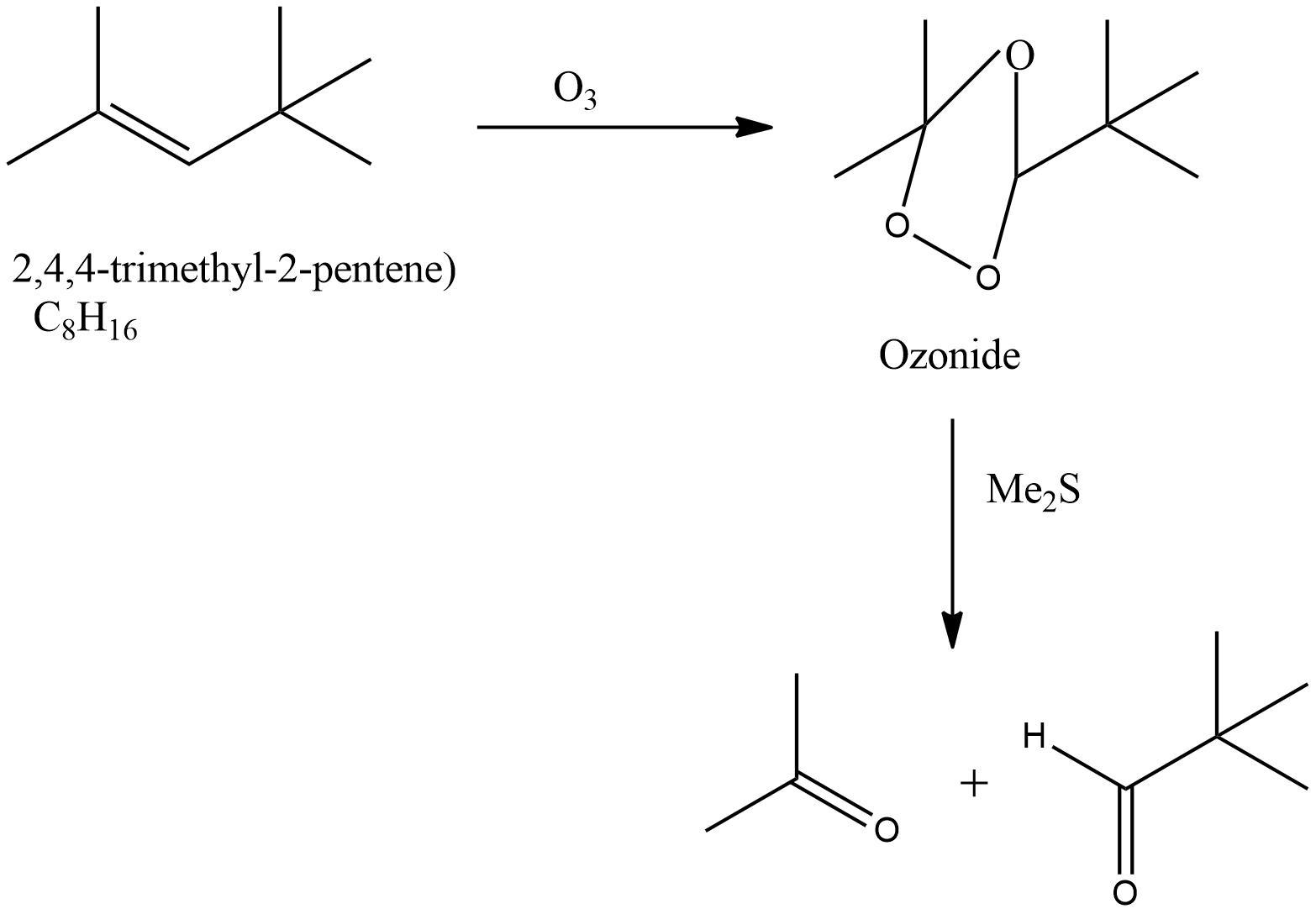
2,4,4-trimethyl-2-pentene yields mixture of (CH_{3})_{2}C=O and (CH_{3})_{3}CHO

Explanation:

In ozonolysis (hydrolysis step involve a reducing agent such as Zn, Me_{2}S etc.), a pi bond is broken to form ketone/aldehyde.

Ketone is formed from di-substituted side of double bond and aldehyde is formed from mono-substituted side of double bond.

Ozoznolysis involves two consecutive steps : (1) formation of ozonide, (2) hydrolysis of ozonide.

Hydrolysis can be done with/without using reducing agent. Carboxylic acid/carbon dioxide/ketone is produced when hydrolysis is done without using reducing agent.

Here, 2,4,4-trimethyl-2-pentene yields mixture of (CH_{3})_{2}C=O and (CH_{3})_{3}CHO

Reaction steps are shown below.

You might be interested in
Put the list in chronological order (1–5).
Leokris [45]

Explanation:

Filtration is a separation technique in which solid particles suspended in liquid medium are separated by allowing the mixture through the pores of the filter paper. By this solid particles get collect on filter paper and liquid drains out from the pores of the filter paper.

The chronological order for given steps will be:

  1. Weigh and fold the filter paper.
  2. Place the filter paper in the funnel, then place the funnel in the Erlenmeyer flask.
  3. Allow the solid/liquid mixture to drain through the filter.
  4. Use water to rinse the filter paper containing the mixture.
  5. Weigh the dried filter paper and copper.
4 0
2 years ago
Read 2 more answers
A. Consider four different samples: aqueous LiI, molten LiI, aqueous AgI, and molten AgI. Current run through each sample produc
Rudiy27

Answer:

Explanation:

At the cathode

In case of molten AgI

Silver  will be collected

In case of molten LiI

lithium will be collected

in case of aqueous LiI,

hydrogen gas will be collected as reduction potential of H⁺ is more than Li⁺

in case of aqueous AgI,

Silver will be obtained at cathode because reduction potential of silver is more than H⁺

At the Anode  

In case of molten NaBr  

Bromine   will be collected

In case of molten NaF

Fluorine  will be collected

in case of aqueous NaBr ,

Bromine  will be collected as reduction potential of Br⁻ is less than O⁻²

in case of aqueous NaF ,

oxygen will be obtained  because reduction potential of F⁻  is more than O⁻² .

5 0
2 years ago
Identify the compounds below as a brønsted-lowry acid or lewis acid by clicking and dragging it into the correct column
Vesna [10]
There are many types of acid or bases. Based on the Bronsted-Lowry definition,

* A Bronsted-Lowry acid is a proton donor
* A Bronsted-Lowry base is a proton acceptor

Take this reaction for example:
HCl(aq)+ N<span>H</span>₃(aq)→N<span>H</span>⁴⁺(aq)+C<span>l</span>⁻(aq<span>)
</span>
HCl donates a proton, so it is a Bronsted-Lowry acid. Consequently, ammonia accepts this proton, so it is the Bronsted-Lowry base.
3 0
2 years ago
Read 2 more answers
The accepted value is 1.43. Which correctly describes this student’s experimental data?
Natalija [7]

Answer:

Neither accurate nor precise

Explanation:

The values were not near or even the same as the accepted value thus making it neither accurate nor precise.

4 0
2 years ago
Read 2 more answers
Write the electron configurations for the following ions:
Ket [755]

Answer:

Co²⁺ : 1s² 2s² 2p⁶ 3s² 3p⁶ 3d⁷

Sn²⁺ : 1s² 2s² 2p⁶ 3s² 3p⁶ 4s² 3d¹⁰ 4p⁶ 5s² 4d¹⁰

Zr⁴⁺ : 1s² 2s² 2p⁶ 3s² 3p⁶ 4s² 3d¹⁰ 4p⁶

Ag⁺ : 1s² 2s² 2p⁶ 3s² 3p⁶ 4s² 3d¹⁰ 4p⁶ 4d¹⁰

S²⁻ : 1s² 2s² 2p⁶ 3s² 3p⁶

Explanation:

Cobalt (Co): atomic number 27

<u>The electronic configuration of Co in ground state: </u>

1s² 2s² 2p⁶ 3s² 3p⁶ 4s² 3d⁷

<u>The electronic configuration of Co in +2 oxidation state (Co²⁺) :</u>

1s² 2s² 2p⁶ 3s² 3p⁶ 3d⁷

Tin (Sn): atomic number 50

<u>The electronic configuration of Sn in ground state: </u>

1s² 2s² 2p⁶ 3s² 3p⁶ 4s² 3d¹⁰ 4p⁶ 5s² 4d¹⁰ 5p²

<u>The electronic configuration of Sn in +2 oxidation state (Sn²⁺) </u>:

1s² 2s² 2p⁶ 3s² 3p⁶ 4s² 3d¹⁰ 4p⁶ 5s² 4d¹⁰

Zirconium (Zr): atomic number 40

<u>The electronic configuration of Zr in ground state:</u>

1s² 2s² 2p⁶ 3s² 3p⁶ 4s² 3d¹⁰ 4p⁶ 5s² 4d²

<u>The electronic configuration of Zr in +4 oxidation state (Zr⁴⁺) :</u>

1s² 2s² 2p⁶ 3s² 3p⁶ 4s² 3d¹⁰ 4p⁶

Silver (Ag): atomic number 47

<u>The electronic configuration of Ag in ground state:</u>

1s² 2s² 2p⁶ 3s² 3p⁶ 4s² 3d¹⁰ 4p⁶ 5s¹ 4d¹⁰

<u>The electronic configuration of Ag in +1 oxidation state (Ag⁺) :</u>

1s² 2s² 2p⁶ 3s² 3p⁶ 4s² 3d¹⁰ 4p⁶ 4d¹⁰

Sulphur (S): atomic number 16

<u>The electronic configuration of S in ground state:</u>

1s² 2s² 2p⁶ 3s² 3p⁴

<u>The electronic configuration of S in -2 oxidation state (S²⁻) :</u>

1s² 2s² 2p⁶ 3s² 3p⁶

8 0
2 years ago
Read 2 more answers
Other questions:
  • One atom of silicon can properly combined in a compound with
    5·1 answer
  • The salt sodium sulfate, Na2SO4, can be formed by a reaction between...
    9·1 answer
  • A 15.0 kg iron weightlifting plate has a volume of 1910 cm3 . What is the density of the iron plate in g/cm3?
    9·1 answer
  • What are the missing coefficients for the skeleton equation below? cr(s) + fe(no3)2(aq) → fe(s) + cr(no3)3(aq)?
    9·1 answer
  • Does it take more, less, or the same amount of heat to melt 1.0 kg of ice at 0°C, or to bring 1.0 kg of liquid water at 0°C to t
    13·1 answer
  • You are given a sample resembling silver. Which of the following properties could be used to help determine whether the sample i
    13·1 answer
  • The sun shines with equal intensity on a farm field, an asphalt road, and the ocean. Which material will heat up most during the
    5·1 answer
  • When food spoils, it is a chemical reaction. For example, rancid butter is produced when the fat molecules in the butter undergo
    15·1 answer
  • A 0.944 M solution of glucose, C6H12O6, in water has a density of 1.0624 g/mL at 20∘C. What is the concentration of this solutio
    10·1 answer
  • C5H12, pentane, is a liquid at room temperature.
    15·1 answer
Add answer
Login
Not registered? Fast signup
Signup
Login Signup
Ask question!