answer.
Ask question
Login Signup
Ask question
All categories
  • English
  • Mathematics
  • Social Studies
  • Business
  • History
  • Health
  • Geography
  • Biology
  • Physics
  • Chemistry
  • Computers and Technology
  • Arts
  • World Languages
  • Spanish
  • French
  • German
  • Advanced Placement (AP)
  • SAT
  • Medicine
  • Law
  • Engineering
shusha [124]
2 years ago
8

Write the electron configurations for the following ions:

Chemistry
2 answers:
Ket [755]2 years ago
8 0

Answer:

Co²⁺ : 1s² 2s² 2p⁶ 3s² 3p⁶ 3d⁷

Sn²⁺ : 1s² 2s² 2p⁶ 3s² 3p⁶ 4s² 3d¹⁰ 4p⁶ 5s² 4d¹⁰

Zr⁴⁺ : 1s² 2s² 2p⁶ 3s² 3p⁶ 4s² 3d¹⁰ 4p⁶

Ag⁺ : 1s² 2s² 2p⁶ 3s² 3p⁶ 4s² 3d¹⁰ 4p⁶ 4d¹⁰

S²⁻ : 1s² 2s² 2p⁶ 3s² 3p⁶

Explanation:

Cobalt (Co): atomic number 27

<u>The electronic configuration of Co in ground state: </u>

1s² 2s² 2p⁶ 3s² 3p⁶ 4s² 3d⁷

<u>The electronic configuration of Co in +2 oxidation state (Co²⁺) :</u>

1s² 2s² 2p⁶ 3s² 3p⁶ 3d⁷

Tin (Sn): atomic number 50

<u>The electronic configuration of Sn in ground state: </u>

1s² 2s² 2p⁶ 3s² 3p⁶ 4s² 3d¹⁰ 4p⁶ 5s² 4d¹⁰ 5p²

<u>The electronic configuration of Sn in +2 oxidation state (Sn²⁺) </u>:

1s² 2s² 2p⁶ 3s² 3p⁶ 4s² 3d¹⁰ 4p⁶ 5s² 4d¹⁰

Zirconium (Zr): atomic number 40

<u>The electronic configuration of Zr in ground state:</u>

1s² 2s² 2p⁶ 3s² 3p⁶ 4s² 3d¹⁰ 4p⁶ 5s² 4d²

<u>The electronic configuration of Zr in +4 oxidation state (Zr⁴⁺) :</u>

1s² 2s² 2p⁶ 3s² 3p⁶ 4s² 3d¹⁰ 4p⁶

Silver (Ag): atomic number 47

<u>The electronic configuration of Ag in ground state:</u>

1s² 2s² 2p⁶ 3s² 3p⁶ 4s² 3d¹⁰ 4p⁶ 5s¹ 4d¹⁰

<u>The electronic configuration of Ag in +1 oxidation state (Ag⁺) :</u>

1s² 2s² 2p⁶ 3s² 3p⁶ 4s² 3d¹⁰ 4p⁶ 4d¹⁰

Sulphur (S): atomic number 16

<u>The electronic configuration of S in ground state:</u>

1s² 2s² 2p⁶ 3s² 3p⁴

<u>The electronic configuration of S in -2 oxidation state (S²⁻) :</u>

1s² 2s² 2p⁶ 3s² 3p⁶

Ivan2 years ago
5 0

Answer:

Co⁺²: 1s²2s²2p⁶3s²3p⁶3d⁷

Sn²⁺: 1s²2s²2p⁶3s²3p⁶4s²3d¹⁰4p⁶5s²4d¹⁰

Zr⁴⁺: 1s²2s²2p⁶3s²3p⁶4s²3d¹⁰4p⁶

Ag⁺: 1s²2s²2p⁶3s²3p⁶4s²3d¹⁰4p⁶5s¹4d⁹

S²⁻: 1s²2s²2p⁶3s²3p⁶

Explanation:

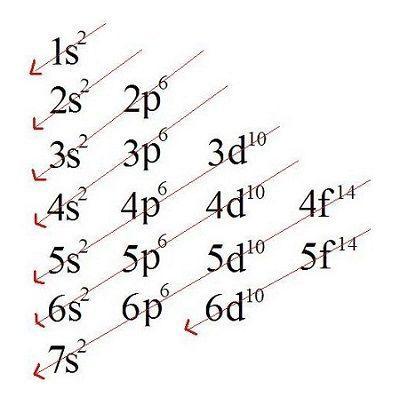
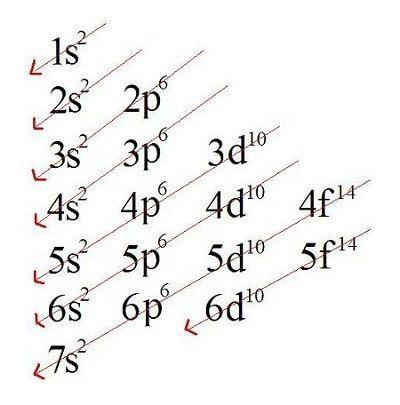
The electronic configuration is the distribution of the electrons through the orbitals, which are represented by the levels (by numbers) and sublevels (by letters) in the energetic order, which is determined by the Linus Pauling's diagram (which is shown below).

The sublevels maximum number of electrons is:

s = 2, p =6, d= 10, and f = 14.

To do the configuration of ions, we must first do it for the neutral atom (number of electrons = atomic number), and then if it is a cation (positive charge), remove electrons from the valence sublevel (most energetic), and if it's an anion, to added electrons to the most energetic sublevel.

Co⁺²

Neutral atom: Co

Atomic number: 27

Electron configuration of neutral atom:

1s²2s²2p⁶3s²3p⁶4s²3d⁷

In this case, because the atom is a transition metal, the electrons must be removed from the 4s sublevel, and not from the 3d sublevel, because the ion will be more stable if the electrons are removed from the valence shell. So, 2 electrons must be removed (+2).

Ion configuration:

1s²2s²2p⁶3s²3p⁶3d⁷

Sn²⁺

Neutral atom: Sn

Atomic number: 50

The electron configuration of neutral atom:

1s²2s²2p⁶3s²3p⁶4s²3d¹⁰4p⁶5s²4d¹⁰5p²

Two electrons must be removed from the most energetic subshell (5s).

Ion configuration:

1s²2s²2p⁶3s²3p⁶4s²3d¹⁰4p⁶5s²4d¹⁰

Zr⁴⁺

Neutral atom: Zr

Atomic number: 40

The electron configuration of neutral atom:

1s²2s²2p⁶3s²3p⁶4s²3d¹⁰4p⁶5s²4d²

It must lose 4 electrons. So, it will lose the 2 electrons of 5s (as explained above for Co), and the 2 electrons of 4d, because after that it will be the most energetic sublevel.

Ion configuration:

1s²2s²2p⁶3s²3p⁶4s²3d¹⁰4p⁶

Ag⁺

Neutral atom: Ag

Atomic number: 47

The electron configuration of neutral atom:

1s²2s²2p⁶3s²3p⁶4s²3d¹⁰4p⁶5s²4d⁹

It must lose 1 electron, so, as explained above, it must be removed from 5s.

Ion configuration:

1s²2s²2p⁶3s²3p⁶4s²3d¹⁰4p⁶5s¹4d⁹

S²⁻

Neutral atom: S

Atomic number: 16

The electron configuration of neutral atom:

1s²2s²2p⁶3s²3p⁴

It must gain 2 electrons (2-), which will be added to the most energetic sublevel, 3p.

Ion configuration:

1s²2s²2p⁶3s²3p⁶
You might be interested in
A person is pushing a box across a table. The measured forces on the box are 10N, 14N, 7N, 10N. Which force is represented by 7N
Vlad1618 [11]
Answer: The friction force.

Justification:

Since the box is sliding over the table, the normal force equals the weight of the object (and any other vertical force that is applied on the box).

So, the normal force and weight (along with any other vertical component of a force applied on the box) must be 10 N and 10 N.

The other two forces: 14 N and 7 N are the forces in the plane of the table and should be opposite in a same line. The 14 N force is the responsible of the motion and the 7N force is opposing the 14 N force, so the 7N force has to be the friction force. Of course, 14N - 7N > 0 which is why the box is moving.
3 0
2 years ago
Read 2 more answers
Look at the reaction below and state which direction the reaction would shift:
lorasvet [3.4K]

Answer:

there is no change at all!!!

4 0
2 years ago
Phosphine, ph3(g), combusts in oxygen gas to form water vapor and solid tetraphosphorus decaoxide. express your answer as a bala
djverab [1.8K]

Tetraphosphorus Decaoxide has a molecular formula of P4O10, all else are known. Therefore the balanced chemical equation would be:

4PH3 + 8O2 --> 6H2O + P4O10


Taking into account the phases:

4PH3(g) + 8O2(g) --> 6H2O(g) + P4O10(s)

6 0
2 years ago
Which equation shows the proper setup to find the volume of a 0.250 M CaCl2 solution that contains 39.5 g of CaCl2?
Jlenok [28]
Molarity = number of mole of substance(n) / volume of solution (V).

n(CaCl2) = mass (CaCl2)/M(CaCl2)

M(CaCl2) = 40+2*35.5 = 111 g/mol 

n(CaCl2) =39.5 g CaCl2*1 mol/111g

0.250 M = 39.5 g CaCl2*1 mol/111g*volume of solution (V).

volume of solution (V) = 39.5 g CaCl2*1 mol/(0.250 M*111g) = 1.42 L
4 0
2 years ago
Read 2 more answers
How would each of the following procedural errors affect the results to be expected in this experiment? Give your reasoning in e
Digiron [165]

Answer:

a) if the liquid is not vaporized completely, then the condensed vapor in the flask contains the air which is initially occupied before the liquid is heated. When calculating the molar mass of the vapor the moles of air which are initially present are not excluded, so that the molar mass of the vapor would be an increase in value.

b) While weighing the condensed vapor, the flask should be dried. If the weighing flask is not dried then the water which is layered on the surface of the flask is also added to the mass of the vapor. Therefore, the mass of the vapor that is calculated would be increase.

c) When condensing the vapor, the stopper should not be removed from the flask, because the vapor will escape from the flask and a small amount of vapor will condense in the flask. Therefore, the mass of the condensed vapor would be In small value.

d) If all the liquid is vaporized, when the flask is removed before the vapor had reached the temperature of boiling water, then the boiling

temperature of that liquid would be lower than that of the boiling temperature of the water.Therefore, the liquid may have more volatility.

7 0
2 years ago
Other questions:
  • A compound is found to have a molar mass of 598 g/mol. if 35.8 mg of the compound is dissolved in enough water to make 175 ml of
    10·1 answer
  • How many grams of water can be cooled from 41 ∘c to 19 ∘c by the evaporation of 62 g of water? (the heat of vaporization of wate
    12·1 answer
  • The lewis structure of pf3 shows that the central phosphorus atom has ________ nonbonding and ________ bonding electron pair(s)
    11·2 answers
  • From the list below, choose which groups are part of the periodic table. metals acids flammable gases nonmetals semimetals ores
    12·2 answers
  • (a) The bonding with electrostatic attraction between oppositely charged ions is called . The bonding with electron sharing betw
    5·1 answer
  • a mixture contains cobalt metal copper metal, and tin metal. This metal is mixed with nickel nitrate. Which metals, if any will
    8·1 answer
  • A higher temperature of fresh concrete results in a __________ hydration of cement.
    11·1 answer
  • From the following list of elements, select the elements that are likely to form a cation. Choose one or more: A. oxygen B. chlo
    12·1 answer
  • In recent years, assistive technologies have been developed to give people
    12·1 answer
  • 1. Carson completed conductivity testing on the solutions shown in the data table below and recorded his findings in the conduct
    6·1 answer
Add answer
Login
Not registered? Fast signup
Signup
Login Signup
Ask question!