answer.
Ask question
Login Signup
Ask question
All categories
  • English
  • Mathematics
  • Social Studies
  • Business
  • History
  • Health
  • Geography
  • Biology
  • Physics
  • Chemistry
  • Computers and Technology
  • Arts
  • World Languages
  • Spanish
  • French
  • German
  • Advanced Placement (AP)
  • SAT
  • Medicine
  • Law
  • Engineering
fredd [130]
2 years ago
12

From the list below, choose which groups are part of the periodic table. metals acids flammable gases nonmetals semimetals ores

conductors
Chemistry
2 answers:
iris [78.8K]2 years ago
8 0

The periodic table of the elements are describe the electronic configuration of the elements on which the properties of the elements depends. Among the given groups only metal, non-metal and semi-metal group are the part of periodic table. The metallic property depends upon the binding energy of the electrons with the nucleus. Thus the elements which have the valence electrons more near to the nucleus that is s-block elements are more metallic in nature. On the other hand the elements which have the valence electrons far from the nucleus are more non-metallic in nature like p-block elements. However the binding energy or the attraction of the outermost electrons to the nucleus depends not only its valence electrons position but also some other factors like shielding effect, effective nuclear charge etc.

The elements which are in between the metals and non-metals can be classified as semi-metals.

Although the conductivity of a material is an inherent property of the metals but sometime the nonmetals or semi-metals are also behave like a conductor due to presence of the other elements, thus it cannot be a p[property of the periodic table. Similarly acidity, flammable gases are not part of the periodic table.      

Kaylis [27]2 years ago
5 0

These 3 are correct on Edg. metals,nonmetals,semimetals


You might be interested in
How many moles of KCl will be<br> produced from 15.0 g of KClO3?
slega [8]

Answer:

0.12 mol KCl

Explanation:

2 KClO3 (s)   2 KCl (s) + 3 O2 (g)

15 g                x mol

x g KCl = 15 g KClO3 x[ (1 mol KClO3)/ (122.5 g KClO3) ] x [(2 mol KCl)/ (2 mol KClO3)]

x g KCl = 0.12 mol KCl

7 0
2 years ago
Read 2 more answers
What element is used in bright flashing advertising signs
Sergeu [11.5K]
The element used in advertising signs is neon.
4 0
2 years ago
A sample contains 2.2 g of the radioisotope niobium-91 and 15.4 g of its daughter isotope, zirconium-91. how many half-lives hav
dybincka [34]

Answer: 3

Explanation: This is a radioactive decay and all the radioactive process follows first order kinetics.

Equation for the reaction of decay of _{19}^{40}\textrm{K} radioisotope follows:

Moles of zirconium=\frac{\text{Given mass}}{\text{Molar mass}}=\frac{15.4}{91}=0.17moles  

Moles of niobium=\frac{\text{Given mass}}{\text{Molar mass}}=\frac{2.2}{91}=0.024moles  

_{41}^{91}\textrm{Nb}\rightarrow _{40}^{91}\textrm{Zr}+_{+1}^0e

By the stoichiometry of above reaction,

1 mole of _{40}^{91}\textrm{Zr} is produced by 1 mole _{41}^{91}\textrm{Nb}

So, 0.17 moles of _{40}^{91}\textrm{Zr} will be produced by = \frac{1}{1}\times 0.17=0.17\text{ moles of }_{40}^{91}\textrm{Nb}

Amount of _{82}^{212}\textrm{K}

decomposed will be = 0.17 moles

Initial amount of _{40}^{91}\textrm{Nb}  will be = Amount decomposed + Amount left = (0.17 + 0.024)moles =0.194 moles

a=\frac{a_o}{2^n}

where,

a = amount of reactant left after n-half lives = 0.024

a_o = Initial amount of the reactant = 0.194

n = number of half lives= ?

Putting values in above equation, we get:

0.024=\frac{0.194}{2^n}

n=3

Therefore, 3 half lives have passed.

3 0
2 years ago
Read 2 more answers
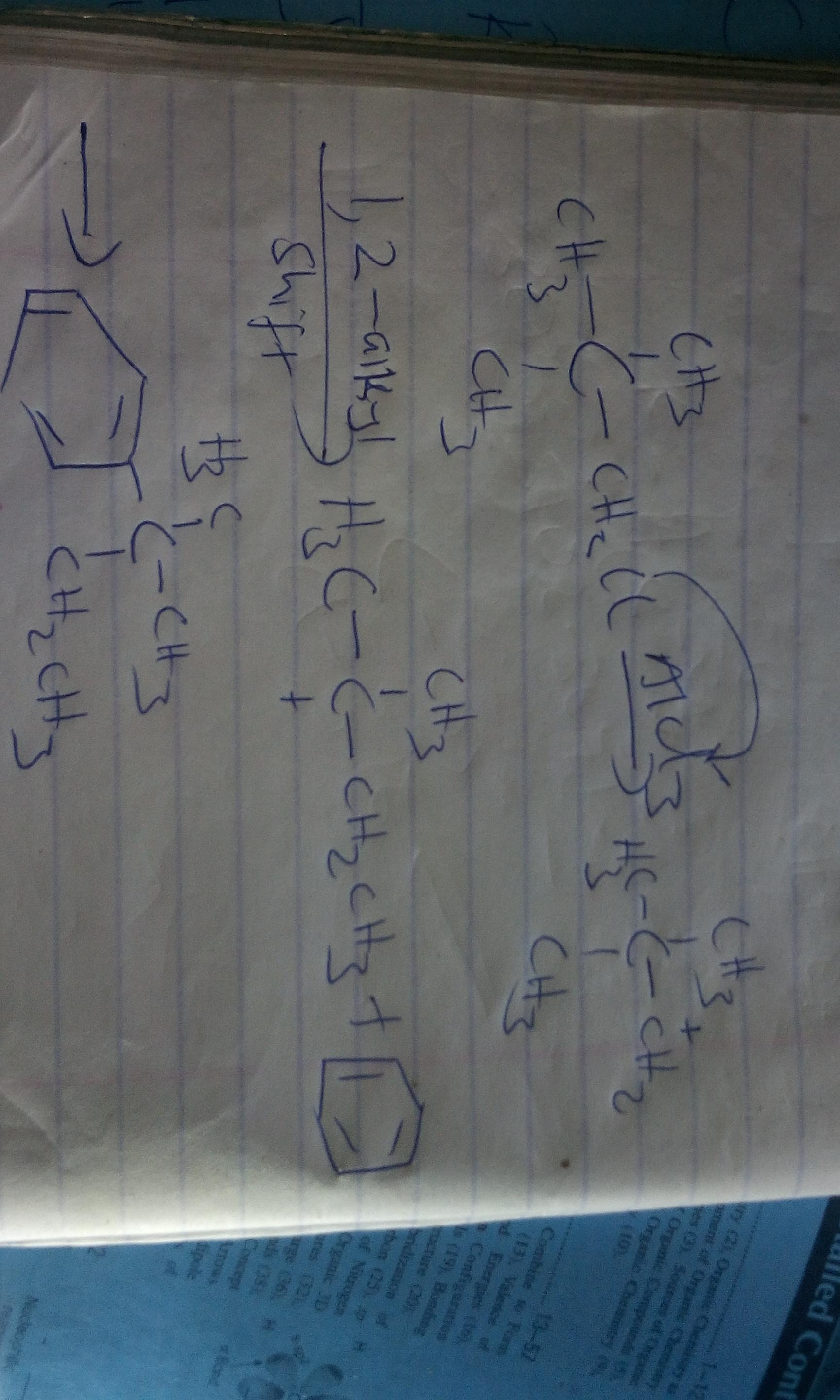
The reaction of benzene with (CH3)3CCH2Cl in the presence of anhydrous aluminum chloride produces principally which of these?
Sedaia [141]

Answer:

See explanation and image attached

Explanation:

When the carbocation is formed by the action of AlCl3 on the (CH3)3CCH2Cl, a primary carbocation is formed. The formation of the carbonation is followed by a 1,2-alkyl shift to give a tertiary carbocation which subsequently adds to the benzene ring as shown in the image attached to this answer.

6 0
2 years ago
A sample of hexane (C6H14) has a mass of 0.580 g. The sample is burned in a bomb calorimeter that has a mass of 1.900 kg and a s
Mama L [17]
Use the formula, Q= mcT

Q= heat
m= mass= 1.900Kg= 1.900 x 10^3 grams
c= specific heat= 3.21 
T= 4.542 K

Q= (1.900 x10^3g)(3.21)(4.542K)= 14.6 Joules.
7 0
2 years ago
Read 2 more answers
Other questions:
  • Why does it help to keep the distillation head warm?
    15·1 answer
  • How many kilograms are in 4 moles of Na2CO3?
    13·1 answer
  • Tear gas has the composition 40.25% carbon, 6.19% hydrogen, 8.94% oxygen, 44.62% bromine. what is the empirical formula of this
    14·2 answers
  • How many grams of antifreeze C2H4(OH)2 would be required per 500 g of water to prevent the water from freezing at a temperature
    6·1 answer
  • Rank the compounds below from slowest to Fastest rate of hydration. 1) formaldehyde 2) 3,3-dimethyIbutan-2-one 3) propanal 4)3-m
    7·1 answer
  • calculate the water potential of a solution of 0.15m sucrose. the solution is at standard temperature.
    7·1 answer
  • A car uses 12.5 L of gasoline to travel a distance of 275 km. Convert this into units of miles per gallon (mi/gal).
    14·1 answer
  • What is the main purpose of using NaOH in the saponification reaction . NaOH works as the catalyst b. NaOH solution is the solve
    14·1 answer
  • Student Exploration: Collision Theory Vocabulary: activated complex, catalyst, chemical reaction, concentration, enzyme, half-li
    7·1 answer
  • Could the other molecules in this simulation (argon, oxygen, and water) be considered pure substances? Explain your thinking.
    14·1 answer
Add answer
Login
Not registered? Fast signup
Signup
Login Signup
Ask question!