answer.
Ask question
Login Signup
Ask question
All categories
  • English
  • Mathematics
  • Social Studies
  • Business
  • History
  • Health
  • Geography
  • Biology
  • Physics
  • Chemistry
  • Computers and Technology
  • Arts
  • World Languages
  • Spanish
  • French
  • German
  • Advanced Placement (AP)
  • SAT
  • Medicine
  • Law
  • Engineering
denis-greek [22]
2 years ago
14

What is the main purpose of using NaOH in the saponification reaction . NaOH works as the catalyst b. NaOH solution is the solve

nt for the reaction c. NaOH acts as a reactant in the reaction d. NaOH facilitates the soap to salt out from the solution
Chemistry
1 answer:
Alex777 [14]2 years ago
7 0

Answer:

C. NaOH acts as a reactant in the reaction

Explanation:

Because during the saponification process, Na+ replaces the H+ in the fatty acid been used for the saponification process

You might be interested in
The molecular weight of table salt, NaCl, is 58.5 g/mol. A tablespoon of salt weighs 6.37 grams. Calculate the number of moles o
LiRa [457]
There are 0.109 moles of NaCl in one tablespoon of salt. This is found by dividing the number of grams you have by the molecular weight.
3 0
2 years ago
Read 2 more answers
Write a balanced half-reaction describing the oxidation of gaseous dihydrogen to aqueous hydrogen cations.
xz_007 [3.2K]
The oxidation state of hydrogen gas is 0 and oxidation state of hydrogen cation is +1.
There’s an increase in oxidation number therefore it’s an oxidation reaction.
Oxidation reactions give out electrons. The masses and charges on both sides should be balanced
Half reaction is
H2 —> 2H+ +2e
8 0
2 years ago
Read 2 more answers
The halogens, alkali metals, and alkaline earth metals have __________ valence electrons, respectively.
natima [27]
The valence electrons are as follows for these groups of elements:

Halogen- SEVEN  (halogens are group 7 elements that need one electron for the octet rule to be achieved)

Alkali Metals - ONE  (these are group one elements that lose a single electron to form an octet and cation)

Alkaline Earth Metals - TWO (group two elements that lose two electrons to form 2+ cations)

8 0
2 years ago
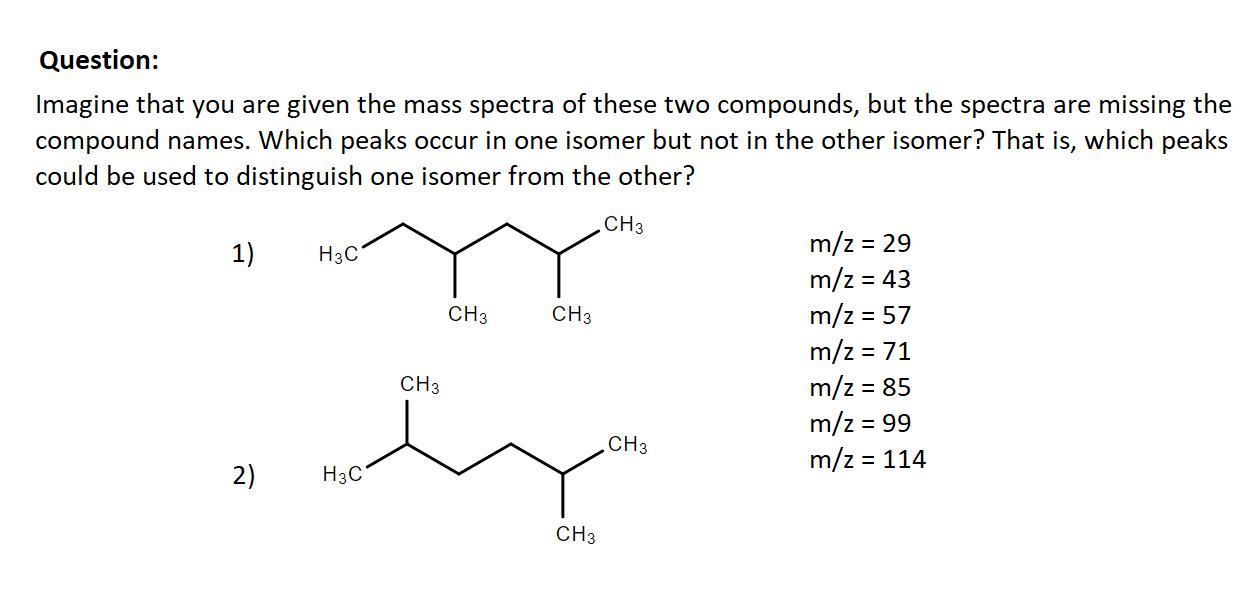
Imagine that you are given the mass spectra of these two compounds, but the spectra are missing the compound names.
12345 [234]

The structures of the isomers and the m/z values of their peaks are not given in the question. The complete question is provided in the attachment

Answer:

Compound 2 (2,5-dimethylhexane) will not have the peaks at 29 and 85 m/z

Explanation:

The fragmentation of molecules by electron ionization of mass spectrometer occurs according to Stevenson's Rule, which states that "The most probable fragmentation is the one that leaves the positive charge on the fragment with the lowest ionization energy". This is much like the Markovnikov's Rule in organic chemistry which has predicted the formation of most stable carbocation and the addition of hydrogen halide to it.

The mass spectra of compound 1 (2,4-dimethylhexane) will contain all the m/z values mentioned in the question. Each peak indicate towards homologous series of fragmentation product of the compound 1. The first peak can be attributed to ethyl carbocation (m/z = 29), with the increase of 14 units the next peak indicates towards propyl carbocation (m/z = 43) and onwards until molecular ion peak of 114 m/z.

Compound 2 (2,5-dimethylhexane) structure shows that the cleavage  of C-C bond will not yield a stable ethyl and hexyl carbocation. Hence, no peaks will be observed at 29 and 85 m/z. The absence of these two peaks can be used to distinguish one isomer from the other.

5 0
2 years ago
A bottle containing 1,665 g of sulfuric acid (H2SO4, 98.08 g/mol) was spilled in a laboratory. The emergency spill kit contained
Tamiku [17]

Answer:

A. Yes, there is more than enough sodium carbonate.

Explanation:

Hello,

In this case, based on the given reaction which is:

H_2SO_4(aq) + Na_2CO_3(s) \rightarrow  Na_2SO_4(aq) + CO_2(g) + H_2O(l)

By stoichiometry, one computes the grams of sodium carbonate that will neutralize 1,665 g of sulfuric acid as shown below:

1,665gH_2SO_4*\frac{1molH_2SO_4}{98.08gH_2SO_4}*\frac{1molNa_2CO_3}{1molH_2SO_4} *\frac{105.99gNa_2CO_3}{1molNa_2CO_3}*\frac{1kgNa_2CO_3}{1000gNa_2CO_3}\\m_{Na_2CO_3}=1.80gNa_2CO_3

Thus, the available mass is 2.0 kg so 0.2 kg are in excess, therefore: A. Yes, there is more than enough sodium carbonate.

Best regards.

5 0
2 years ago
Other questions:
  • The lab procedure involves several factors, listed below. Some were variable and some were constant. Label each factor below V f
    8·2 answers
  • Combustion of 8.652 g of a compound containing c, h, o, and n yields 11.088 g of coz, 3.780 g of h2o, and 3.864 g of no2. How ma
    9·1 answer
  • Which of these statements is/are true? Rewrite each false statement to make it true.
    5·2 answers
  • Old aspirin exposed to moisture often smells like acetic acid (vinegar). When aspirin is heated in boiling water, it decomposes
    8·1 answer
  • Carlos stomps a soda con flat and throw it away. Which of the following statements BEST describes the change made in the soda ca
    8·1 answer
  • The ph of an aqueous solution at 25.0°c is 10.66. what is the molarity of h+ in this solution? the ph of an aqueous solution at
    8·1 answer
  • Lisa’s book measures 40 cm x 10 cm x 2 cm. What is the volume of her book
    7·2 answers
  • NaOH+HCL=NaCL+H2O
    12·1 answer
  • When collecting temperature as a function of time for the reaction of KOH with HCL, which time is most significant
    8·1 answer
  • A 5-ounce cup of raspberry yogurt contains 5.0 g of protein, 3.0 g of fat, and 13.3 g of carbohydrate. The fuel values for prote
    14·1 answer
Add answer
Login
Not registered? Fast signup
Signup
Login Signup
Ask question!