answer.
Ask question
Login Signup
Ask question
All categories
  • English
  • Mathematics
  • Social Studies
  • Business
  • History
  • Health
  • Geography
  • Biology
  • Physics
  • Chemistry
  • Computers and Technology
  • Arts
  • World Languages
  • Spanish
  • French
  • German
  • Advanced Placement (AP)
  • SAT
  • Medicine
  • Law
  • Engineering
motikmotik
2 years ago
8

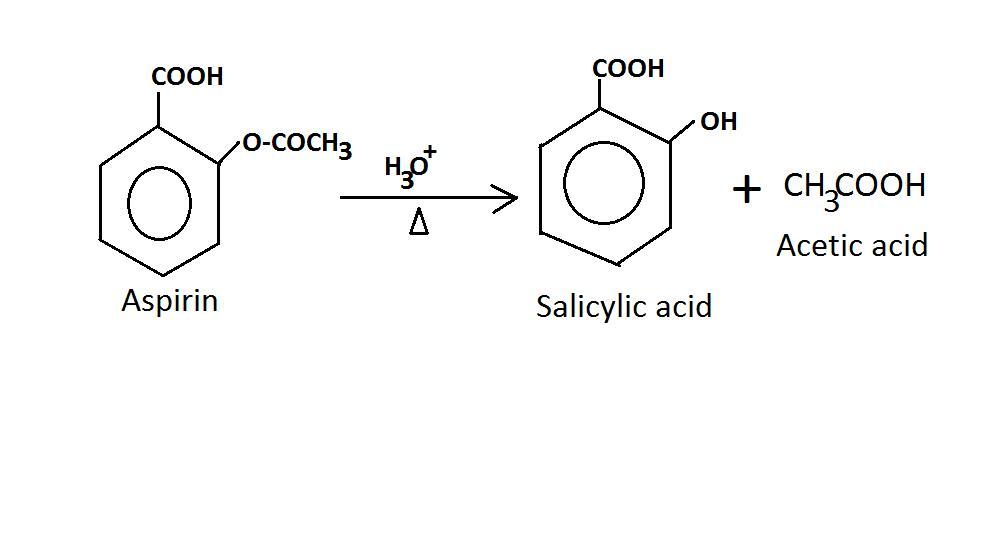
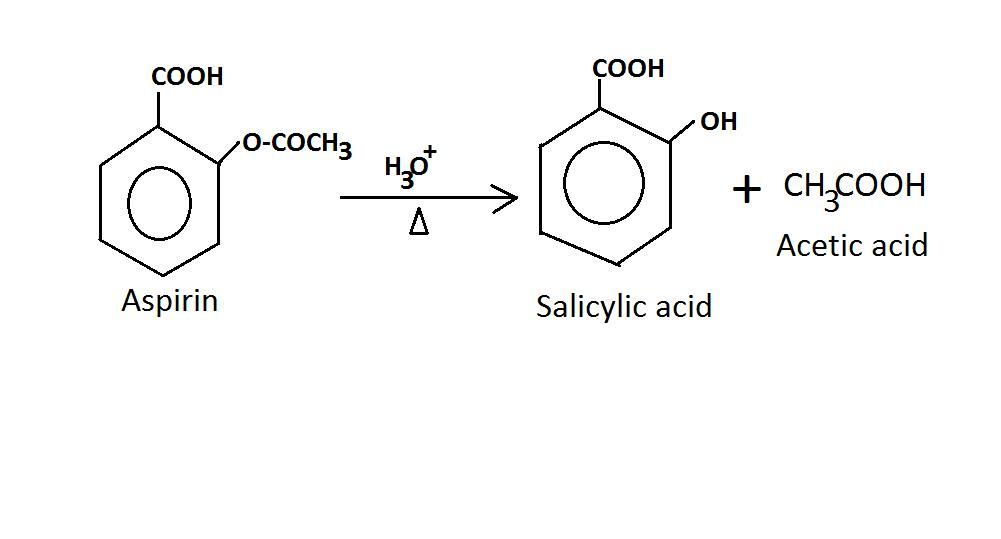
Old aspirin exposed to moisture often smells like acetic acid (vinegar). When aspirin is heated in boiling water, it decomposes

and gives off a vinegar smell. The resulting solution gives a positive FeCl3 test. Why is this test positive? (Please explain in detail!)
Write the chemical equation for the reaction of aspirin and water at high temperature.

Chemistry
1 answer:
Anit [1.1K]2 years ago
6 0

Explanation:

Vinegar like smell is given off by aspirin when we tend to heat it in boiling water. The main cause of this vinegar like smell is due to the formation of acetic acid and a phenolic acid upon heating of aspirin.

As a result, it gives a positive test when treated with ferric chloride, that is, FeCl_{3}.

You might be interested in
In the equilibrium system described by: PO43-(aq) + H2O(1) = HPO42-(aq) + OH-(aq) Brønsted-Lowry theory would designate: A) PO43
Kamila [148]

Answer:

The correct option is:  B) H₂0 and OH⁻ as a conjugate pair

Explanation:

According to Brønsted-Lowry theory, the<u> </u><u>acids</u><u> are the chemical substances that form a conjugate base by donating a proton</u> and <u>bases</u><u> are the chemical substances that form conjugate acid by accepting a proton.</u>

In the given chemical reaction: PO₄³⁻(aq) + H₂O(l) ⇄ HPO₄²⁻(aq) + OH⁻(aq)

<u>According to Brønsted-Lowry theory, PO₄³⁻ and OH⁻ are bases. Whereas, H₂O and HPO₄²⁻ are acids.</u>

<u>Also, PO₄³⁻ and HPO₄²⁻ are the conjugate acid-base pair; and H₂O and OH⁻ are the conjugate acid-base pair.</u>

6 0
2 years ago
Consider the following chemical reaction: CO (g) + 2H2(g) ↔ CH3OH(g) At equilibrium in a particular experiment, the concentratio
AlexFokin [52]

Answer:

The equilibrium concentration of CH₃OH is 0.28 M

Explanation:

For the reaction: CO (g) + 2H₂(g) ↔ CH₃OH(g)

The equilibrium constant (Keq) is given for the following expresion:

Keq= \frac{(CH3OH)}{(CO) x (H2)^{2}} =14.5

Where (CH3OH), (CO) and (H2) are the molar concentrations of each product or reactant.

We have:

(CH3OH)= ?

(CO)= 0.15 M

(H2)= 0.36 M

So, we only have to replace the concentrations in the equilibrium constant expression to obtain the missing concentration we need:

14.5= \frac{(CH_{3}OH) }{(0.15 M) x (0.36 M) ^{2} }

14.5 x (0.15 M) x (0.36)^{2} = (CH₃OH)

0.2818 M = (CH₃OH)

6 0
2 years ago
The burning of 80.3 g of SiH4 at constant pressure gives off 3790 kJ of heat. Calculate △H for this reaction. SiH4(g) + 2O2(g) ⟶
Trava [24]

Answer  : The value of ΔH for this reaction is, -1516 kJ/mol

Explanation :

First we have to calculate the moles of SiH_4

\text{Moles of }SiH_4=\frac{\text{Mass of }SiH_4}{\text{Molar mass of }SiH_4}

\text{Moles of }SiH_4=\frac{80.3g}{32.12g/mol}

\text{Moles of }SiH_4=2.5mol

Now we have to calculate the ΔH for this reaction.

As, 2.5 mole of SiH_4 react to gives heat = -3790 kJ

So, 1 mole of SiH_4 react to gives heat = -\frac{3790kJ}{2.5mol}

                                                                                = -1516 kJ/mol

Therefore, the value of ΔH for this reaction is, -1516 kJ/mol

7 0
2 years ago
A cylinder at left with balls evenly spaced throughout the cylinder has an arrow leading to a cylinder at right cylinder with ba
Lelechka [254]

gas to liquid

Explanation:

The change of state indicated by this analogy is from gas to liquid.

Cylinder to the left is filled with gases

Cylinder to the right is made up of liquid.

  • Gases occupy the volumes of containers they are introduced into.
  • They are random and possess a high kinetic energy.
  • Liquids have definite volume and flow with one another.
  • The gases in A are dispersed and in random motion.
  • This phase change is called condensation

learn more:

Phase change brainly.com/question/1875234

#learnwithBrainly

7 0
2 years ago
Read 2 more answers
The element carbon (C) is most likely to form covalent bonds with the element beryllium (Be). krypton (Kr). selenium (Se). sodiu
noname [10]

 The element  that is most  likely  to form covalent  bonds  with  carbon (C)  is

Selenium  (Se)

<em><u>Explanation</u></em>

<em><u> </u></em> Covalent  bond is  formed   when  there is sharing of electrons among  two   or more non metals.

Both carbon  and selenium are non metals  therefore they  react to form  a covalent  bond  by sharing electron.

 Despite  krypton been a non metal  it does  not form a covalent  bond with carbon since krypton is  inert ( non reactive).

Beryllium (Be)  and  sodium (Na) are  metals therefore  they form  ionic bond with  carbon instead  of covalent  bond.
5 0
2 years ago
Read 2 more answers
Other questions:
  • When sodium reacts with chlorine, sodium chloride is produced. Andrew represented this reaction with this equation: Na + Cl2 → 2
    6·2 answers
  • A solution contains cr3+ ions. the addition of 0.063 l of 1.50 m naf solution was needed to completely precipitate the chromium
    14·1 answer
  • The percent composition by mass of a compound is 76.0% c, 12.8% h, and 11.2% o. the molar mass of this compound is 284.5 g/mol.
    14·1 answer
  • let 4 moles of methanol (liquid) combust in 3 moles of gaseous oxygen to form gaseous carbon dioxide and water vapor. Suppose th
    12·1 answer
  • Select the correct set of quantum numbers (n, l, ml, ms) for the first electron removed in the formation of a cation for stronti
    7·1 answer
  • Which of the following species is not formed through a termination reaction in the chlorination of methane? Which of the followi
    10·1 answer
  • PLS HELP! 50 PTS!
    14·1 answer
  • How much energy is required to vaporize 1.5 KG of aluminum
    8·1 answer
  • Q 11.20: What is the product of the reaction between t-BuCl and MeOH? A : t-BuOH B : MeOCl C : t-BuOMe D : (CH3)2CCH2
    8·1 answer
  • A big bully is having a tug-of-war with a small child. There is a ball attached to the middle of the rope.
    11·1 answer
Add answer
Login
Not registered? Fast signup
Signup
Login Signup
Ask question!