answer.
Ask question
Login Signup
Ask question
All categories
  • English
  • Mathematics
  • Social Studies
  • Business
  • History
  • Health
  • Geography
  • Biology
  • Physics
  • Chemistry
  • Computers and Technology
  • Arts
  • World Languages
  • Spanish
  • French
  • German
  • Advanced Placement (AP)
  • SAT
  • Medicine
  • Law
  • Engineering
myrzilka [38]
2 years ago
5

(a) The bonding with electrostatic attraction between oppositely charged ions is called . The bonding with electron sharing betw

een two adjacent atoms such that each atom assumes a stable electron configuration is called . The bonding where the positively charged ion cores are shielded from one another, and also "glued" together by the sea of valence electrons is called . (b) Please select statements that satisfy the Pauli exclusion principle. Electrons with the same state must have opposite spins. Electron state can hold no more than four electrons. Electron state can hold no more than two electrons. Electrons with the same state must have the same spins.
Chemistry
1 answer:
AVprozaik [17]2 years ago
7 0

Answer:

a) Ionic bonding

   Covalent bonding

   Metallic bonding

b)  Electrons with the same state must have opposite spins.

    Electron state can hold no more than two electrons.

Explanation:

a) When an atom loses electrons it became a cation, with a positive charge, and when an atom gain electrons it became an anion, with a negative charge. Because of the attraction of the opposite charges, the ions form a bond, which is called ionic bonding.

When atoms share electrons to complete the octet rule, they form a molecule by covalent bonding.

When a metal loses its valence electrons, they form a "sea of electrons" and the cations are "glued" by them, which is called metallic bonding.

b) The Pauli exclusion principle determinants that two electrons can not occupy the same state at the same time, it means that two electrons can't have the same four quantic number equal. If they are at the same shell, they must have different spins. The electron can have only two spin (-1/2 or +1/2) so the electron state can hold no more than two electrons, and they have to have opposite spins.

You might be interested in
Increased motion in the particles in a liquid allows the particles to
makkiz [27]
Particles in a liquid are more loosely packed there for they have more room to move and can flow around eachother . Hope this helps XD
8 0
2 years ago
Read 2 more answers
Select the correct answer. A student places a sample of white sodium bicarbonate powder in a test tube and heats it. The student
inessss [21]

Answer is: D. It is not sodium bicarbonate.

Balanced chemical reaction of heating sodium bicarbonate:                    2NaHCO₃ → Na₂CO₃ + CO₂ + H₂O.

This is chemical change (chemical reaction), because new substances are formed (sodium carbonate, carbon(IV) oxide and water), the atoms are rearranged, so there is no sodium bicarbonate (NaHCO₃) in the test tube.

8 0
2 years ago
a gas that exerts a pressure of 215 torr in a container with a volume of 51.0 mL will exert a pressure of ? torr when transferre
zhannawk [14.2K]
To calculate the new pressure, we can use Boyle’s law to relate these two scenarios (Boyle’s law is used because the temperature is assumed to remain constant). Boyle’s law is:

P1V1 = P2V2,

Where “P” is pressure and “V” is volume. The pressure and volume of the first scenario is 215 torr and 51 mL, respectively, and the second scenario has a volume of 18.5 L (18,500 mL) and the unknown pressure - let’s call that “x”. Plugging these into the equation:

(215 torr)(51 mL) =(“x” torr)(18,500 mL)
x = 0.593 torr

The final pressure exerted by the gas would be 0.593 torr.

Hope this helps!
3 0
2 years ago
his is the chemical formula for chromium(III) nitrate: . Calculate the mass percent of oxygen in chromium(III) nitrate. Round yo
Alinara [238K]

Answer:

\%\ Composition\ of\ iron=69.92\ \%

Explanation:

Percent composition is percentage by the mass of element present in the compound.

The formula for chromium(III) nitrate is Cr(NO_3)_3

Molar mass of chromium(III) nitrate = 238.011 g/mol

1 mole of chromium(III) nitrate contains 9 moles of oxygen

Molar mass of oxygen = 16 g/mol

So, Mass= Molar mass*Moles = 16*9 g = 144 g

\%\ Composition\ of\ iron=\frac{Mass_{iron}}{Total\ mass}\times 100

\%\ Composition\ of\ iron=\frac{144}{238.011}\times 100

\%\ Composition\ of\ iron=69.92\ \%

5 0
2 years ago
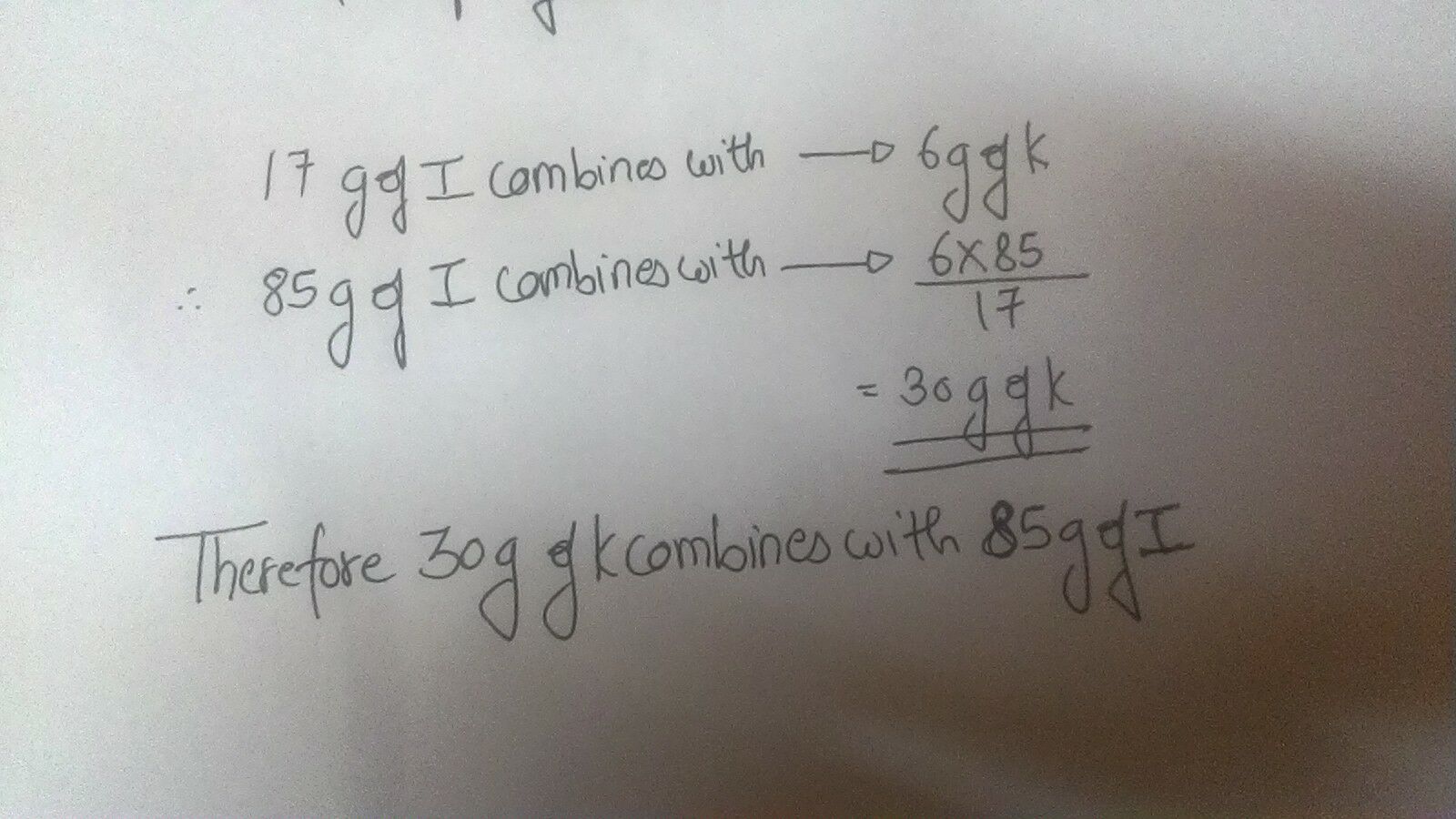
If 6 g of element k combine with 17 g of element l, how many grams of element k combine with 85 g of element l?
Ede4ka [16]
Hope this helps you.

5 0
2 years ago
Other questions:
  • Why does increasing the number of trials increase confidence in the results of the experiment?
    6·2 answers
  • Na+ and Cl- are ions formed from _____.
    11·1 answer
  • In what situation do we use a volumetric flask, conical flask, pipette and graduated cylinder? Explain your answer from accuracy
    9·1 answer
  • Magnesium oxide decomposes into magnesium and oxygen. if 12.09 g of magnesium oxide decomposes to form 7.29 g of magnesium, what
    14·1 answer
  • In part 2 of the experiment, you will be analyzing a sample of household bleach. A 0.0854 g sample of household bleach is comple
    7·1 answer
  • Ethylene (C2H4) is the starting material for the preparation of polyethylene. Although typically made during the processing of p
    11·1 answer
  • Energy may not be created or destroyed, but it may be converted into different types. Categorize the examples below as either Po
    7·1 answer
  • 6.
    6·1 answer
  • Describe how the Rube Goldberg device design that you created follows the law of conservation of energy. Be sure to include both
    15·1 answer
  • The molar mass of an imaginary molecule is is 93.89 g/mol. Determine its density at STP.
    14·1 answer
Add answer
Login
Not registered? Fast signup
Signup
Login Signup
Ask question!