answer.
Ask question
Login Signup
Ask question
All categories
  • English
  • Mathematics
  • Social Studies
  • Business
  • History
  • Health
  • Geography
  • Biology
  • Physics
  • Chemistry
  • Computers and Technology
  • Arts
  • World Languages
  • Spanish
  • French
  • German
  • Advanced Placement (AP)
  • SAT
  • Medicine
  • Law
  • Engineering
tatyana61 [14]
2 years ago
15

Air enters a horizontal, constant-diameter heating duct operating at steady state at 290 K, 1 bar, with a volumetric flow rate o

f 0.25 m3/s, and exits at 325 K, 0.95 bar. The flow area is 0.04 m2. Assuming the ideal gas model with k 5 1.4 for the air, determine:
(a) the mass flow rate, in kg/s,
(b) the velocity at the inlet and exit, each in m/s, and
(c) the rate of heat transfer, in kW.
Engineering
2 answers:
Taya2010 [7]2 years ago
6 0

Answer:

a) m = 0.3003 kg/s

b) Vel1 = 6.25 m/s, Vel2 = 7.3725 m/s

c) 12.845 KW

Explanation:

a)

using ideal gas law:

PV = nRT

since, n = no. of moles = m/M

therefore,

PV = (m/M)RT

P1 v1 = RT1/M

where,

P1 = inlet pressure = 1 bar = 100000 Pa

v1 = specific volume at inlet = ?

R = universal gas constant = 8.314 KJ/Kmol.k

T1 = inlet temperature = 290 K

M = Molecular mass of air = 28.9628 Kg/kmol

Therefore,

v1 = (8.314 KJ/Kmol.k)(290 k)/(28.9628 kg/kmol)(100 KPa)

v1 = 0.83246 m³/kg

Now, the mass flow rate can be given as:

Mass Flow Rate = (Volume Flow Rate)/(v1)

Mass Flow Rate = (0.25 m³/s)/(0.83246 m³/kg)

<u>Mass Flow Rate = 0.3003 kg/s</u>

b)

using general gas equation to find the specific volume at the exit first, we get:

P1v1/T1 = P2v2/T2

v2 = P1 v1 T2/T1 P2

where,

P1 = inlet pressure = 1 bar

P2 = exit pressure = 0.95 bar

T1 = inlet temperature = 290 k

T2 = exit temperature = 325 k

v1 = specific volume at inlet = 0.83246 m³/kg

v2 = specific volume at exit = ?

Therefore,

v2 = (1 bar)(0.83246 m³/kg)(325 k)/(290 k)(0.95 bar)

v2 = 0.98203 m³/kg

Now, for velocity, we use formula:

Vel = v/A

where,

A = Area = 0.04 m²

For inlet:

Vel1 = Inlet Volume flow Rate/A = (0.25 m³/s)/(0.04 m²)

<u>Vel1 = 6.25 m/s</u>

For exit:

Vel2 = Exit Volume flow Rate/A = (Mass Flow Rate)(v2)/(0.04 m²)

Vel2 = (0.98203 m³/kg)(0.3003 kg/s)/0.04 m²

<u>Vel2 = 7.3725 m/s</u>

c)

using first law of thermodynamics, with no work done, we can derive the formula given below:

Q = m(h2 - h1) + (m/2)(Vel2² - Vel1²)

where,

Q = rate of heat transfer

m = mass flow rate = 0.3003 kg/s

m(h2 - h1) = change in enthalpy = mCpΔT   , for ideal gas

Vel1 = 6.25 m/s

Vel2 = 7.3725 m/s

Also,

Cp in this case will be function of temperature and given as:

Cp = KR/(K-1)

where,

K = 1.4

R = Gas constant per molecular mass of air = 0.28699 KJ/kg.k

Therefore,

Cp = 1.0045 KJ/kg.k

Now, using the values in the expression of first law of thermodynamics, we get:

Q = (0.3003 kg/s)(1.0045 KJ/kg.k)(35 K) + [(0.3003 kg/s)/2][(7.3725 m/s)² - (6.25 m/s)²]

Q = 10.55 KW + 2.29 KW

<u>Q = 12.845 KW</u>

Sliva [168]2 years ago
5 0

Answer:

A) Mass flow rate = 0.3004 Kg/s

B) Velocity at Inlet = 6.25 m/s

Velocity at exit = 7.3725 m/s

C) Rate of heat transfer = 12.858 Kw

Explanation:

T1 = 290K ;P1 = 1 bar = 100 KPa

T2= 325K ; P2 = 0.95 bar = 95 KPa

A = 0.04 m² ; k = 1.4

Molar mass of air = 28.97 Kg/Kmol

R = 8.314 J/molK

A) Since we are dealing with a steady state mass flow rate through an open system, we will treat this as an ideal gas. Thus ;

PV = nRT

n=m/M where m =1

Thus; V1 = RT1/MP1 = (8.314 X 290)/(28.97 x 100) = 0.8323 m³/Kg

Now, mass flow rate is given by;

Mass flow rate(m') = Volumetric flow rate(V')/Volume(v)

Thus; Mass flow rate(m') = 0.25/0.8323 = 0.3004 Kg/s

From Gay lussacs law; P1V1/T1 = P2V2/T2

So to find the volume at the exit which is V2, let's make V2 the subject of the formula;

(P1V1T2)/(P2T1) = V2

So; V2 = (100 x 0.8323 x 325)/(95 x 290) = 0.9818 m³/kg

B) we know that velocity = volumetric flow rate/area

Thus;

At inlet; Velocity (Vi) = 0.25/0.04 = 6.25m/s

At exit; Velocity (Ve) = Volumetric flow rate at exit/ Area.

We don't know the volumetric flow at exit so let's look for it. from earlier, we saw that;

volumetric flow rate/Volume = mass flow rate

And rearranging, volumetric flow rate(V') = mass flow rate(m) x volume(v)

So V' = 0.3004 x 0.9818 = 0.2949 Kg/s

So, Ve = 0.2949/0.04 = 7.3725 m/s

C) The steady state equation when potential energy is neglected is given by the formula;

Q'= m'Cp(T2 - T1) + (m'/2){(Ve)² - (Vi)²}

Where Q' is the rate of heat transfer.

Cp is unknown. The formula to find Cp is given as ;

Cp = KR/(K-1)

Since we are dealing with change in enthalpy here, the gas constant R will be expressed per molecular mass of the air and so R = 0.287 KJ/kg.k

Cp = (1.4 x 0.287)/(1.4 - 1) = 1.0045 Kj/KgK

And so, Q' = (0.3004 x 1.0045)(325 - 290) + (0.3004/2){(7.3725)² - (6.25)²} = 10.5613 + 2.2967 = 12.858 Kw

You might be interested in
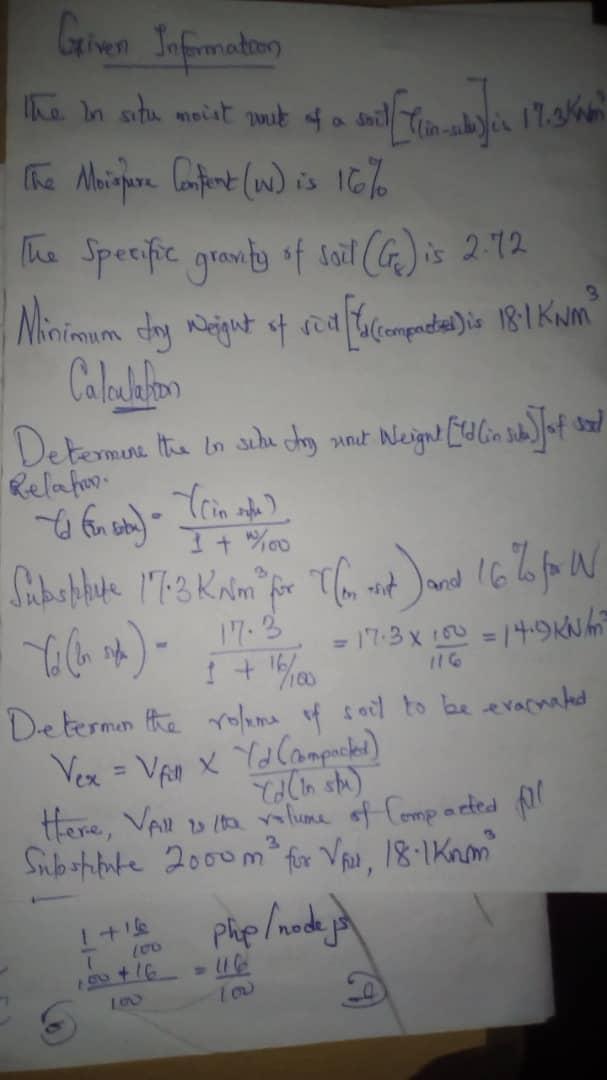
The in situ moist unit weight of a soil is 17.3 kN/m^3 and the moisture content is 16%. The specific gravity of soil solids is 2
hammer [34]

Answer:

Explanation:

The solution to given problem is attached below

7 0
2 years ago
Theorems of Pappus and Guldinus are used to find: a. The surface area and volume of a body of rotation b. The surface area and v
s2008m [1.1K]

Answer:

option (a). The surface area and volume of a body of rotation

is the correct option

Explanation:

Theorems of Pappus and Guldinus are used to find the surface area and volume of a revolving body. It is neither applicable for surface areas and volumes of a symmetric body nor it helps to find the overall mass of any body. Thus, it can help to calculate the surface area and volume of any body rotated in 2-D frame(or any 2-D curve).

It is given or calculated as the product of area, perpendicular distance from the axis and length of the 2-D curve.

6 0
2 years ago
Steam enters a turbine operating at steady state at 1 MPa, 200 °C and exits at 40 °C with a quality of 83%. Stray heat transfer
Andrei [34K]

Answer:

(a) Work out put=692.83\frac{KJ}{Kg}

(b) Change in specific entropy=0.0044\frac{KJ}{Kg-K}

Explanation:

Properties of steam at 1 MPa and 200°C

        h_1=2827.4\frac{KJ}{Kg},s_1=6.69\frac{KJ}{Kg-K}

We know that if we know only one property in side the dome then we will find the other property by using steam property table.

Given that dryness or quality of steam at the exit of turbine is 0.83 and temperature T=40°C.So from steam table we can find pressure corresponding to saturation temperature 40°C.

Properties of saturated steam at 40°C

      h_f= 167.5\frac{KJ}{Kg} ,h_g= 2537.4\frac{KJ}{Kg}

 s_f= 0.57\frac{KJ}{Kg-K} ,s_g= 8.25\frac{KJ}{Kg-K}

So the enthalpy of steam at the exit of turbine  

h_2=h_f+x(h_g-h_f)\frac{KJ}{Kg}

h_2=167.5+0.83(2537.4-167.5)\frac{KJ}{Kg}

h_2=2134.57\frac{KJ}{Kg}

s_2=s_f+x(s_g-s_f)\frac{KJ}{Kg-K}

s_2=0.57+0.83(8.25-0.57)\frac{KJ}{Kg-K}

s_2=6.6944\frac{KJ}{Kg-K}

(a)

Work out put =h_1-h_2

                      =2827.4-2134.57 \frac{KJ}{Kg}

Work out put =692.83 \frac{KJ}{Kg}

(b) Change in specific entropy

     s_2-s_1=6.6944-6.69\frac{KJ}{Kg-K}

Change in specific entropy =0.0044\frac{KJ}{Kg-K}

3 0
2 years ago
A railcar with an overall mass of 78,000 kg traveling with a speed vi is approaching a barrier equipped with a bumper consisting
sergij07 [2.7K]

Answer:

v₀ = 2,562 m / s  = 9.2 km/h

Explanation:

To solve this problem let's use Newton's second law

              F = m a = m dv / dt = m dv / dx dx / dt = m dv / dx v

              F dx = m v dv

We replace and integrate

            -β ∫ x³ dx = m ∫ v dv

            β x⁴/ 4 = m v² / 2

We evaluate between the lower (initial) integration limits v = v₀, x = 0 and upper limit v = 0 x = x_max

        -β (0- x_max⁴) / 4 = ½ m (v₀²2 - 0)

         x_max⁴ = 2 m /β   v₀²


Let's look for the speed that the train can have for maximum compression

         x_max = 20 cm = 0.20 m


         v₀ =√(β/2m)   x_max²

Let's calculate

          v₀ = √(640 106/2 7.8 104)    0.20²

          v₀ = 64.05  0.04

          v₀ = 2,562 m / s

          v₀ = 2,562 m / s (1lm / 1000m) (3600s / 1h)

          v₀ = 9.2 km / h

5 0
2 years ago
The emissivity of galvanized steel sheet, a common roofing material, is ε = 0.13 at temperatures around 300 K, while its absorpt
Step2247 [10]

Answer:

759.99W/m²

Explanation:

Question: If the temperature of the sheet is 77C,what is the incident solar radiation on aday with Tinf= Tsurr= 16°C?

Given

Energy Equation of the Gas

αs * Gs * A + h * A * (T inf - Tg) + εσA (Tsurr⁴- Tg⁴) = 0

Where σ= 5.67 *10^-8 W/m²K⁴ (Stefan-Boltzmann constant)

ε = 0.13 (Emisivity)

αs = 0.65 (Absorptivity for solar radiation)

h = 7W/m²K⁴

Tg = 77 + 273.15K = 350.15K

T inf = 16 + 273.15 = 288.15K

T surr= T inf = 288.15

Substitute the above values in the Gas Equation, we have

0.65 * Gs * A + 7 * A * (288.15 - 350.15) + 0.13 * 5.67 * 10^-8 * A * (288.15⁴ - 350.15⁴) = 0

0.65 * Gs * A = - 7 * A * (288.15 - 350.15) - 0.13 * 5.67 * 10^-8 * A * (288.15⁴ - 350.15⁴)

A cancels out, so we are left with

0.65 * Gs = - 7 * (288.15 - 350.15) - 0.13 * 5.67 * 10^-8 * (288.15⁴ - 350.15⁴)

0.65Gs = 434 - 0.7372 * 10^-8(−8,137,940,481.697)

0.65Gs = 434 + 0.7372 * 81.37940481697

0.65Gs = 493.992897231070284

Gs = 493.992897231070284/0.65

Gs = 759.9890726631850

Gs = 759.99W/m² ------- Approximated

3 0
2 years ago
Other questions:
  • A gas metal arc welder is also known as a _____ welder.
    5·1 answer
  • Define a) Principal Plane b) Principal Stress c) anelasticity d) yield point e) ultimate tensile stress f) hardness g) toughness
    5·1 answer
  • Which of the following is correct regarding the principal stresses and maximum in-plane shear stresses? a. Principal stresses ca
    14·1 answer
  • A flexural member is fabricated from two flange plates 7-1/2 x ½ and a web plate 17 x 3/8. The yield stress of steel is 50 ksi.
    8·1 answer
  • A pipe is insulated such that the outer radius of the insulation is less than the critical radius. Now the insulation is taken o
    11·1 answer
  • Technician A says that the most efficient method of EVAP system leak detection is introducing smoke under low pressure from a ma
    7·1 answer
  • Five Kilograms of continuous boron fibers are introduced in a unidirectional orientation into of an 8kg aluminum matrix. Calcula
    9·1 answer
  • A commercial refrigerator with refrigerant-134a as the working fluid is used to keep the refrigerated space at -30C by rejecting
    13·1 answer
  • 11 Notează, în caiet, trăsăturile personajelor ce se pot
    13·1 answer
  • Dalton needs to prepare a close-out report for his project. Which part of the close-out report would describe
    6·1 answer
Add answer
Login
Not registered? Fast signup
Signup
Login Signup
Ask question!