answer.
Ask question
Login Signup
Ask question
All categories
  • English
  • Mathematics
  • Social Studies
  • Business
  • History
  • Health
  • Geography
  • Biology
  • Physics
  • Chemistry
  • Computers and Technology
  • Arts
  • World Languages
  • Spanish
  • French
  • German
  • Advanced Placement (AP)
  • SAT
  • Medicine
  • Law
  • Engineering
Andrews [41]
2 years ago
10

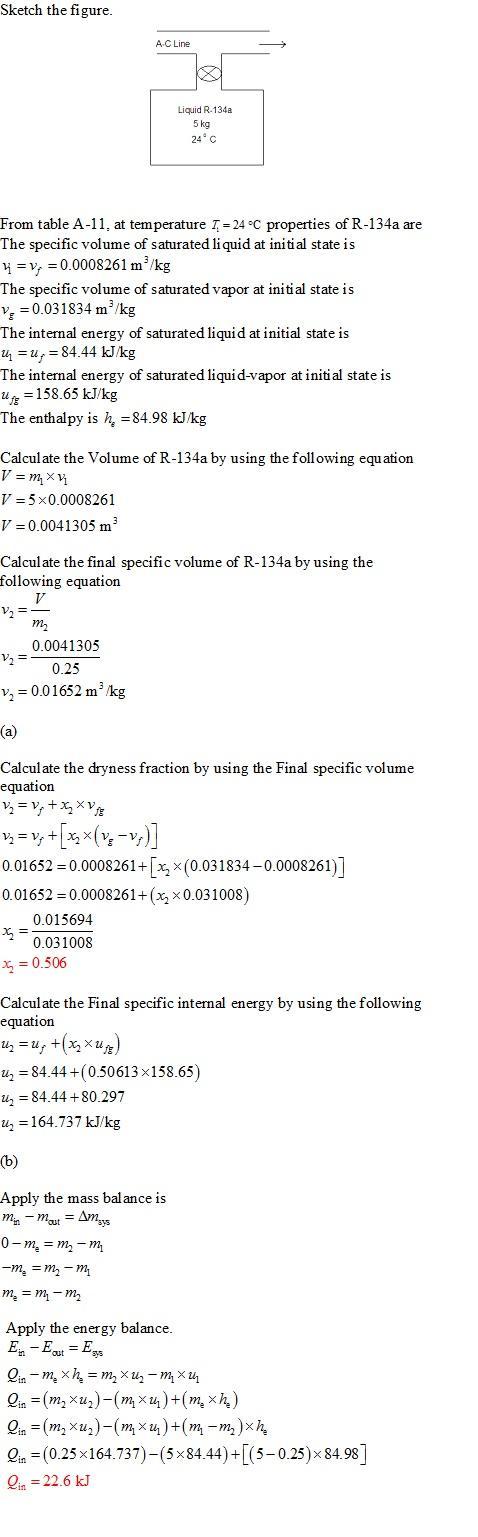
An air-conditioning system is to be filled from a rigid container that initially contains 5 kg of liquid R-134a at 24°C. The val

ve connecting this container to the air-conditioning system is now opened until the mass in the container is 0.24 kg, at which time the valve is closed. During this time, only liquid R-134a flows from the container. Presuming that the process is isothermal while the valve is open, determine the final quality of the R-134a in the container and the total heat transfer.

Engineering
1 answer:
Olin [163]2 years ago
6 0

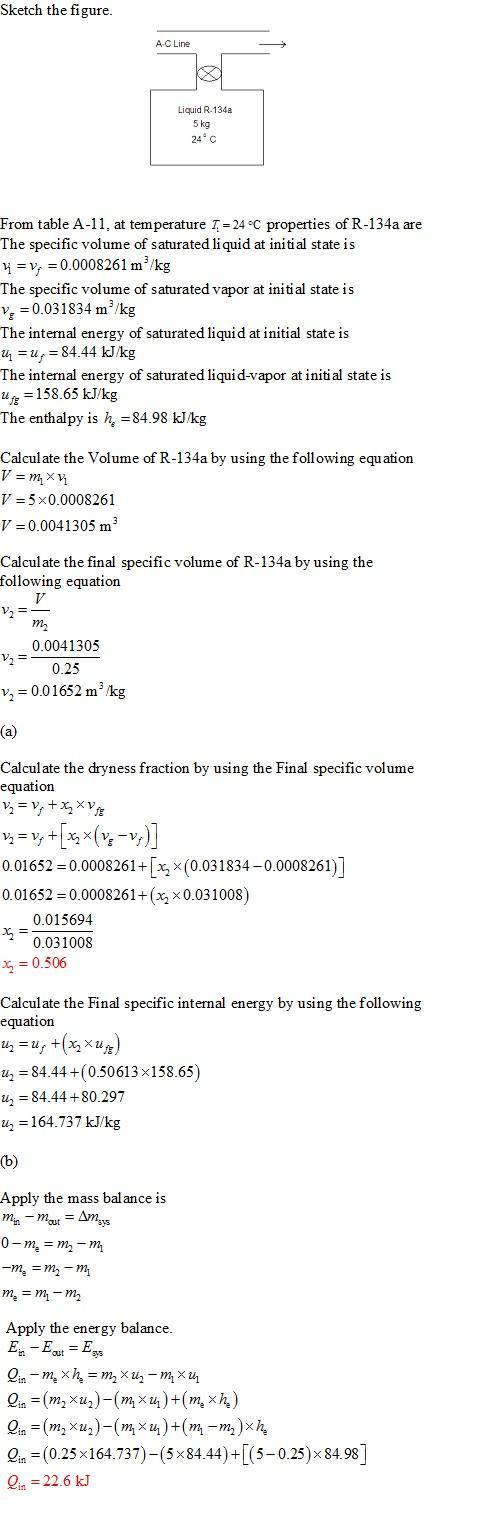
Answer: a) U2 = 164.737kJ/kg

b) Q2 = 22.6kJ

Explanation: see attachment below

You might be interested in
A thin-walled tube with a diameter of 12 mm and length of 25 m is used to carry exhaust gas from a smoke stack to the laboratory
nlexa [21]

Answer:

(a)  h₁   = 204.45 W/m²k

(b) h₀ = 46.80 W/m².k

(c) T = T = 15.50°C

Explanation:

Given Data;

Diameter = 12mm

Length = 25 m

Entry temperature = 200°C

Flow rate = 0.006 kg/s

velocity = 2.5 m/s.

Step 1: Calculating the mean temperature;

(200 + 15)/2

Mean temperature = 107.5°C = 380.5 K

The properties of air at mean temperature 380.5 K are given as:

v = 24.2689*10⁻⁶m²/s

a = 35.024*10⁻⁶m²/s

μ    = 221.6 *10⁻⁷Ns/m²

k = 0.0323 W/m.k

Cp = 1012 J/kg.k

Step 2: Calculating the prantl number using the formula;

Pr = v/a

   = 24.2689*10⁻⁶/ 35.024*10⁻⁶

   = 0.693

Step3: Calculating the reynolds number using the formula;

Re = 4m/πDμ

    = 4 *0.006/π*12*10⁻³ * 221.6 *10⁻⁷

    = 0.024/8.355*10⁻⁷

    = 28725

Since Re is greater than 2000, the flow is turbulent. Nu becomes;

Nu = 0.023Re^0.8 *Pr^0.3

Nu = 0.023 * 28725^0.8 * 0.693^0.3

     = 75.955

(a) calculating the heat transfer coefficient:

Nu = hD/k

h = Nu *k/D

  = (75.955 * 0.0323)/12*10^-3

h   = 204.45 W/m²k

(b)

Properties of air at 15°C

v = 14.82 *10⁻⁶m²/s

k = 0.0253 W/m.k

a = 20.873 *10⁻⁶m²/s

Pr(outside) = v/a

                  = 14.82 *10⁻⁶/20.873 *10⁻⁶

                 = 0.71

Re(outside) = VD/v

                   = 2.5 * 12*10⁻³/14.82*10⁻⁶

                    =2024.29

Using Zakauskus correlation,

Nu = 0.26Re^0.6 * Pr^0.37 * (Pr(outside)/Pr)^1/4

    = 0.26 * 2024.29^0.6 *  0.71^0.37 * (0.71/0.693)^1/4

    = 22.199

Nu = h₀D/k

h₀ = Nu*k/D

     = 22.199* 0.0253/12*10⁻³

h₀ = 46.80 W/m².k

 (c)

Calculating the overall heat transfer coefficient using the formula;

1/U =1/h₁ +1/h₀

1/U = 1/204.45 + 1/46.80

1/U = 0.026259

U = 1/0.026259

U = 38.08

Calculating the temperature of the exhaust using the formula;

T -T₀/T₁-T₀ = e^-[uπDL/Cpm]

T - 15/200-15 = e^-[38.08*π*12*10⁻³*25/1012*0.006]

T - 15/185 = e^-5.911

T -15 = 185 * 0.002709

T = 15+0.50

T = 15.50°C
6 0
2 years ago
Write multiple if statements: If carYear is before 1967, print "Probably has few safety features." (without quotes). If after 19
Free_Kalibri [48]

Answer:

The solution code is written in Python 3.

  1. carYear = 1995
  2. if(carYear < 1967):
  3.    print("Probably has few safety features.\n")
  4. if(carYear > 1970):
  5.    print("Probably has head rests. \n")
  6. if(carYear > 1991):
  7.    print("Probably has electronic stability control.\n")
  8. if(carYear > 2002):
  9.    print("Probably has airbags. \n")

Explanation:

Firstly, create a variable, <em>carYear</em> to hold the value of year of the car make. (Line 1)

Next, create multiple if statements as required by the question (Line 3-13). The operator "<" denotes "smaller" and therefore <em>carYear < 1967</em> means any year before 1967. On another hand, the operator ">" denotes "bigger" and therefore <em>carYear > 1970 </em>means any year after 1970.

The print statement in each of the if statements is done using the Python built-in function <em>print()</em>. The "\n" is an escape sequence that create a new line at the end of each printed phrase.

5 0
2 years ago
A thermal energy storage unit consists of a large rectangular channel, which is well insulated on its outer surface and encloses
yaroslaw [1]

Answer:

the temperature of the aluminum at this time is 456.25° C

Explanation:

Given that:

width w of the aluminium slab = 0.05 m

the initial temperature T_1 = 25° C

T{\infty} =600^0C

h = 100 W/m²

The properties of Aluminium at temperature of 600° C by considering the conditions for which the storage unit is charged; we have ;

density ρ = 2702 kg/m³

thermal conductivity k = 231 W/m.K

Specific heat c = 1033 J/Kg.K

Let's first find the Biot Number Bi which can be expressed by the equation:

Bi = \dfrac{hL_c}{k} \\ \\ Bi = \dfrac{h \dfrac{w}{2}}{k}

Bi = \dfrac{hL_c}{k} \\ \\ Bi = \dfrac{100 \times \dfrac{0.05}{2}}{231}

Bi = \dfrac{2.5}{231}

Bi = 0.0108

The time constant value \tau_t is :

\tau_t = \dfrac{pL_cc}{h} \\ \\ \tau_t = \dfrac{p \dfrac{w}{2}c}{h}

\tau_t = \dfrac{2702* \dfrac{0.05}{2}*1033}{100}

\tau_t = \dfrac{2702* 0.025*1033}{100}

\tau_t = 697.79

Considering Lumped capacitance analysis since value for Bi is less than 1

Then;

Q= (pVc)\theta_1 [1-e^{\dfrac {-t}{ \tau_1}}]

where;

Q = -\Delta E _{st} which correlates with the change in the internal energy of the solid.

So;

Q= (pVc)\theta_1 [1-e^{\dfrac {-t}{ \tau_1}}]= -\Delta E _{st}

The maximum value for the change in the internal energy of the solid  is :

(pVc)\theta_1 = -\Delta E _{st}max

By equating the two previous equation together ; we have:

\dfrac{-\Delta E _{st}}{\Delta E _{st}{max}}= \dfrac{  (pVc)\theta_1 [1-e^{\dfrac {-t}{ \tau_1}}]} { (pVc)\theta_1}

Similarly; we need to understand that the ratio of the energy storage to the maximum possible energy storage = 0.75

Thus;

0.75=  [1-e^{\dfrac {-t}{ \tau_1}}]}

So;

0.75=  [1-e^{\dfrac {-t}{ 697.79}}]}

1-0.75=  [e^{\dfrac {-t}{ 697.79}}]}

0.25 =  e^{\dfrac {-t}{ 697.79}}

In(0.25) =  {\dfrac {-t}{ 697.79}}

-1.386294361= \dfrac{-t}{697.79}

t = 1.386294361 × 697.79

t = 967.34 s

Finally; the temperature of Aluminium is determined as follows;

\dfrac{T - T _{\infty}}{T_1-T_{\infty}}= e ^ {\dfrac{-t}{\tau_t}}

\dfrac{T - 600}{25-600}= e ^ {\dfrac{-967.34}{697.79}

\dfrac{T - 600}{25-600}= 0.25

\dfrac{T - 600}{-575}= 0.25

T - 600 = -575 × 0.25

T - 600 = -143.75

T = -143.75 + 600

T = 456.25° C

Hence; the temperature of the aluminum at this time is 456.25° C

3 0
2 years ago
A 227 pound compressor is supported by four legs that contact the floor of a machine shop. At the bottom of each leg there is a
Ganezh [65]

Answer:

1.312 in

Explanation:

Data provided in the question:

Weight of the compressor, W = 227 pound

Number of legs = 4

Maximum pressure = 42 psi

Now,

Let F be the force taken by the legs

Therefore,

W = 4F

or

227 pound = 4F

or

F = 56.75 pounds

Also,

Force = Pressure × Area

or

56.75 pounds = 42 psi × πr²                      [ r is the diameter of one leg]

or

r² = 0.4301

or

r = 0.656

therefore,

diameter = 2r = 2 × 0.656

= 1.312 in

6 0
2 years ago
4. Two technicians are discussing the evaporative emission monitor. Technician A says that serious monitor faults cause a blinki
snow_lady [41]

Answer:

The correct option is;

Neither Technician A nor B

Explanation:

The evaporative emission monitor or Evaporaive Emission Control System EVAP System monitors enables the Power Control Module of the car to check fuel system leak integrity and the vapor consumption efficiency during engine combustion

It is a requirement of EPA on cars to check the emission of smug forming evaporates from cars

Serious monitor faults can cause the turning on of the check engine lights and the vehicle will not pass OBD II test, but it will not lead to engine shutdown

It runs when the engine is 15 to 85% full and the TP sensor is between 9% and 35%.

Therefore, the correct option is that neither Technician A nor B are correct.

3 0
2 years ago
Other questions:
  • A particle has an initial velocity of v0 = 14 ft/s to the right, at s0 = 0, and a = 2 ft/s2 to the left. determine its position
    5·1 answer
  • Pipe (2) is supported by a pin at bracket C and by tie rod (1). The structure supports a load P at pin B. Tie rod (1) has a diam
    15·1 answer
  • Consider a very long rectangular fin attached to a flat surface such that the temperature at the end of the fin is essentially t
    9·1 answer
  • Show that a chirped Gaussian pulse is compressed initially inside a single-mode fiber when ftC &lt; 0. Derive expressions for th
    12·1 answer
  • 2. A ¼ in. diameter rod must be machined on a lathe to a smaller diameter for use as a specimen in a tension test. The rod mater
    9·1 answer
  • A flexural member is fabricated from two flange plates 7-1/2 x ½ and a web plate 17 x 3/8. The yield stress of steel is 50 ksi.
    8·1 answer
  • Q5. A hypothetical metal alloy has a grain diameter of 2.4 x 10⁻² mm. After a heat treatment at 575°C for 500 min, the grain dia
    7·1 answer
  • The atomic radii of a divalent cation and a monovalent anion are 0.77 nm and 0.136 nm, respectively.1- Calculate the force of at
    11·1 answer
  • Refrigerant-134a is compressed from 2 bar, saturated vapor, to 10 bar, 90o C in a compressor operating at steady state. The mass
    11·1 answer
  • Water enters a circular tube whose walls are maintained at constant temperature at specified flow rate and temperature. For full
    8·1 answer
Add answer
Login
Not registered? Fast signup
Signup
Login Signup
Ask question!