answer.
Ask question
Login Signup
Ask question
All categories
  • English
  • Mathematics
  • Social Studies
  • Business
  • History
  • Health
  • Geography
  • Biology
  • Physics
  • Chemistry
  • Computers and Technology
  • Arts
  • World Languages
  • Spanish
  • French
  • German
  • Advanced Placement (AP)
  • SAT
  • Medicine
  • Law
  • Engineering
olga2289 [7]
2 years ago
15

A four-lane northbound section of interstate has rigid pavement and was designed with an 8-inch slab, 90% reliability, a 700 lb/

in2 concrete modulus of rupture, a 5 million lb/in2 modulus of elasticity, a 3.0 load transfer coefficient, and an overall standard deviation of 0.3. The initial PSI is 4.6 and the TSI is 2.5. The pavement was conservatively designed (assuming the upper limit of the W18 design lane load) to last 20 years, and the CBR is 25 with a drainage coefficient of 1.0. A design mistake was made that ignored 1000 total northbound (daily) passes of trucks with 22-kip single and 30-kip tandem axles. What slab thickness should have been used?

Engineering
1 answer:
CaHeK987 [17]2 years ago
6 0

Answer:

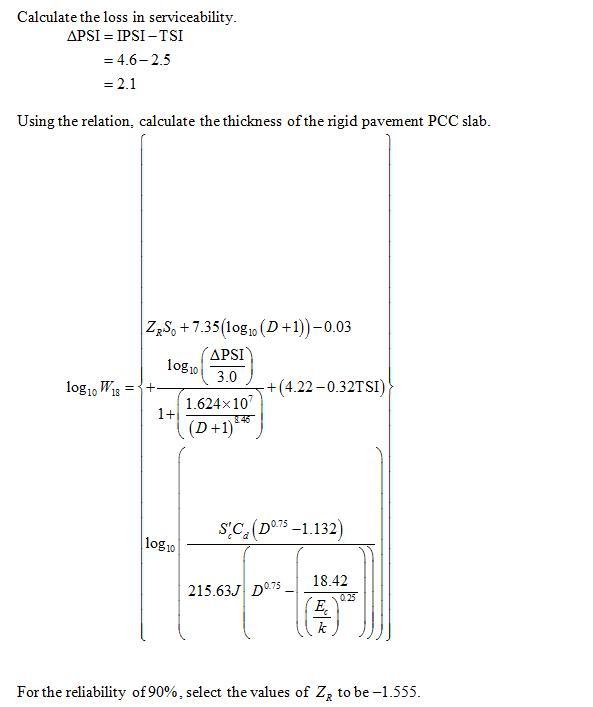
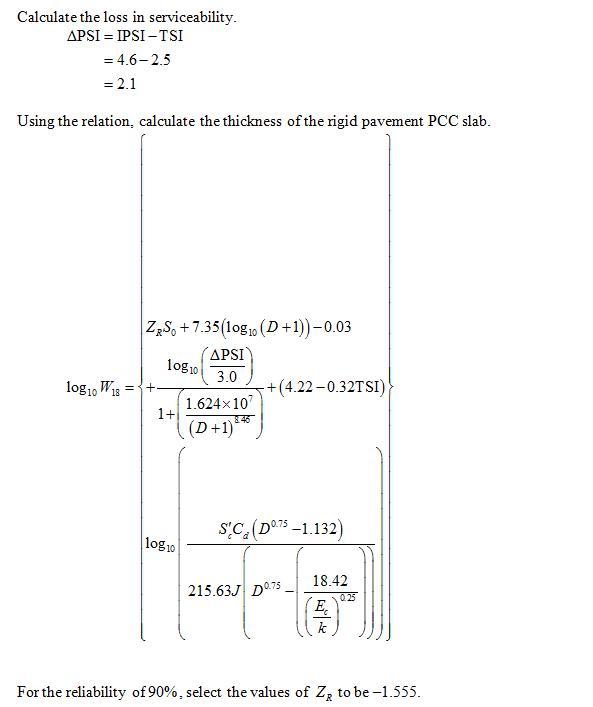
Detailed solution is given below:

You might be interested in
An optical mouse originally cost $31.85. Before it was removed from the store, it underwent the following changes in price. 27%
saul85 [17]

Answer:

b.

$43.21

Explanation:

8 0
2 years ago
Read 2 more answers
In a parallel one-dimensional flow in the positive x direction, the velocity varies linearly from zero at y = 0 to 32 m/s at y =
monitta

Answer:

Ψ = 10(y^2) + c

<em><u>y = 1.067m</u></em>

Explanation:

since the flow is one dimensional in positive X direction, the only velocity component is in X, which is denoted by u

while u is a function of y

we find the u in terms of y; u varies linearly wih y

we use similiraty to find the relation

32/1.6 =<em>u/y</em>

<em><u>u = 20y</u></em>

<em><u>Ψ = ∫20ydy</u></em>

<em><u>Ψ = 10(y^2) + c</u></em>

<em><u>(b)</u></em>

<em><u>the flow is half below y = 1.6*(2/3)=1.067 m</u></em>

<em><u>this is because at two third of the height of a triangle lies the centroid of triangle. since the velocity profile forms a right angled triangle , its height is 1.6 m . the flow is halved at y = 1.067m</u></em>

3 0
2 years ago
Suppose we store a relation R (x,y) in a grid file. Both attributes have a range of values from 0 to 1000. The partitions of thi
leva [86]

Answer:

For (a) The total number of buckets from the given query for the relation is 25 buckets (b) the nearest neighboring query is (80, 200) (80, 150), (100, 150), (120,150) and (120, 200)

Explanation:

From the question stated, we need to define what a Grid file is

Grid File it is a structure of data that are used to divide the total space into a grid non-periodic, where set of point (small) are defined by more than one cells of the grid.

(a)Finding buckets for the query

The relation is divided into two parts which ranges from 0 to 1000, the first part is partitioned in every 20 units, at 20, 40, 60 etc; a second part is partitioned into every 50 units at 50, 100, 150 etc.

The total number of buckets from the given query for the relation is 25 buckets

(b)Finding the closest point or nearest point

The closest point discovered in the distance is little above 15

These points are are the points closer to the point target (110, 205) which can be found in five neighboring rectangles with left corners lower is stated as follows:

(80, 200) (80, 150), (100, 150), (120,150) and (120, 200)
3 0
2 years ago
Water is flowing in a metal pipe. The pipe OD (outside diameter) is 61 cm. The pipe length is 120 m. The pipe wall thickness is
Yuki888 [10]

Answer:

1113kN

Explanation:

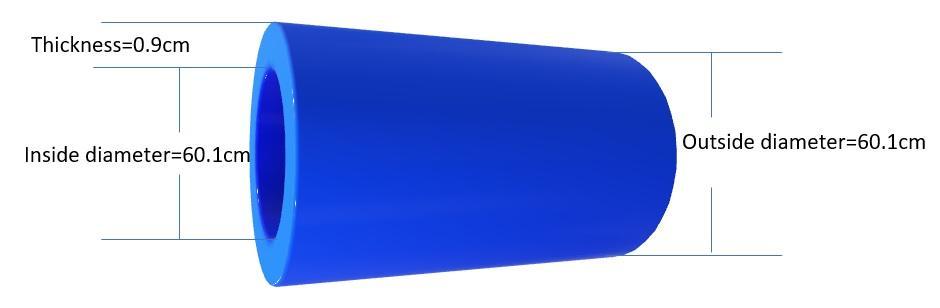
The ouside diameter OD of the pipe is 61cm and the thickness T is 0.9cm, so the inside diameter ID will be:

Inside Diameter = Outside Diameter - Thickness

Inside Diameter = 61cm - 0.9cm = 60.1cm

Converting this diameter to meters, we have:

60.1cm*\frac{1m}{100cm}=0.601m

This inside diameter is useful to calculate the volume V of water inside the pipe, that is the volume of a cylinder:

V_{water}=\pi  r^{2}h

V_{water}=\pi (\frac{0.601m}{2})^{2}*120m

V_{water}=113.28m^{3}

The problem gives you the water density d as 1.0kg/L, but we need to convert it to proper units, so:

d_{water}=1.0\frac{Kg}{L}*\frac{1L}{1000cm^{3}}*(\frac{100cm}{1m})^{3}

d_{water}=1000\frac{Kg}{m^{3}}

Now, water density is given by the equation d=\frac{m}{V}, where m is the water mass and V is the water volume. Solving the equation for water mass and replacing the values we have:

m_{water}=d_{water}.V_{water}

m_{water}=1000\frac{Kg}{mx^{3}}*113.28m^{3}

m_{water}=113280Kg

With the water mass we can find the weight of water:

w_{water}=m_{water} *g

w_{water}=113280kg*9.8\frac{m}{s^{2}}

w_{water}=1110144N

Finally we find the total weight add up the weight of the water and the weight of the pipe,so:

w_{total}=w_{water}+w_{pipe}

w_{total}=1110144N+2500N

w_{total}=1112644N

Converting this total weight to kN, we have:

1112644N*\frac{0.001kN}{1N}=1113kN

7 0
2 years ago
An 80-L vessel contains 4 kg of refrigerant-134a at a pressure of 160kPa. Determine (a) the temperature, (b) the quality, (c) th
makvit [3.9K]

Answer:

temperature -15.6 C, quality x=0.646, enthalpy h=667.20 KJ, volume of vapor phase Vg= 79.8 L

Explanation:

property table for R-134a

https://www.ohio.edu/mechanical/thermo/property_tables/R134a/R134a_PresSat.html

at 160 KPa , temperature = -15.66 C

quality x=mass of vapour/ total mass of liq-vap mixture

alternaternately: x=(v-vf)/(vg-vf)    

v=total volume i.e. volume of container"80L"   80L=0.08 cubic meter

vf=vol of liquid phase  vg=vol of vapor phase vf, vg values at 160Kpa

x=(0.08-0.0007437)/(0.1235-0.0007437)=0.646

enthalpy

h=hf+xhfg          hf, hfg values at 160Kpa

h=hf+xhfg=31.2+0.646(209.9)=166.80 KJ/Kg

for 4Kg R-134a h=m(166.80 KJ/Kg )=667.20 KJ

volume of vapor phase

vg at 160Kpa=0.1235 cubic meter for quality=1.

in this case quality=0.646 , so it will occupy 64.6% space of the vapor phase at quality=1.

vol. of vapor phase=0.646*0.1235=0.0798 cubic meter=79.8 L

7 0
2 years ago
Other questions:
  • You are working in a lab where RC circuits are used to delay the initiation of a process. One particular experiment involves an
    13·1 answer
  • How much extra water does a 21.5 ft, 175-lb concrete canoe displace compared to an ultra-lightweight 38-lb Kevlar canoe of the s
    8·1 answer
  • A particle has an initial velocity of v0 = 14 ft/s to the right, at s0 = 0, and a = 2 ft/s2 to the left. determine its position
    5·1 answer
  • A subway car leaves station A; it gains speed at the rate of 4 ft/s^2 for of until it has reached and then at the rate 6 then th
    8·1 answer
  • Two physical properties that have a major influence on the cracking of workpieces, tools, or dies during thermal cycling are the
    13·1 answer
  • When a man returns to his well-sealed house on a summer day, he finds that the house is at 35°C. He turns on the air conditioner
    13·1 answer
  • One mole of iron (6 1023 atoms) has a mass of 56 grams, and its density is 7.87 grams per cubic centimeter, so thecenter-to-cent
    15·1 answer
  • A desktop computer is to be cooled by a fan whose flow rate is 0.34 m3/min. Determine the mass flow rate of air through the fan
    12·1 answer
  • A thin-walled tube with a diameter of 6 mm and length of 20 m is used to carry exhaust gas from a smoke stack to the laboratory
    7·1 answer
  • Milton has been tracking the migrating patterns of whales in the northwest Atlantic Ocean for five years. He knows where and whe
    5·2 answers
Add answer
Login
Not registered? Fast signup
Signup
Login Signup
Ask question!