answer.
Ask question
Login Signup
Ask question
All categories
  • English
  • Mathematics
  • Social Studies
  • Business
  • History
  • Health
  • Geography
  • Biology
  • Physics
  • Chemistry
  • Computers and Technology
  • Arts
  • World Languages
  • Spanish
  • French
  • German
  • Advanced Placement (AP)
  • SAT
  • Medicine
  • Law
  • Engineering
oksano4ka [1.4K]
2 years ago
13

List the number of each type of atom on the left side of the equation C5H12(g)+8O2(g)→5CO2(g)+6H2O(g)

Chemistry
1 answer:
n200080 [17]2 years ago
7 0

Answer:

The combustion of pentane, C5H12, occurs via the reaction C5H12(g)+8O2(g)→5CO2(g)+6H2O(g) with heat of formation values given by the following table: Substance ΔH∘f (kJ/mol) C5H12 (g) -119.9 CO2(g) −393.5 H2O(g) −241.8 Calculate the enthalpy for the combustion of pentane.

You might be interested in
What are the intermolecular forces between molecules in a liquid sample of sulfur trioxide,SO3?a. hydrogen bonding b. dipole-dip
fgiga [73]

Answer:

dispersion forces

Explanation:

SO3 is a trigonal planar molecule. All the dipoles of the S-O bonds cancel out making the molecule to be a nonpolar molecule.

The primary intermolecular force in nonpolar molecules is the London dispersion forces. As expected, the London dispersion forces is the intermolecular force present in SO3.

Hence SO3 is a symmetrical molecule having only weak dispersion forces acting between its molecules.

8 0
2 years ago
Nickel can be plated from aqueous solution according to the following half reaction. How long would it take (in min) to plate 29
andrey2020 [161]

Answer:

It take 3.5 *10² min

Explanation:

Step 1: Data given

Mass of the nickel = 29.6 grams

4.7A

Step 2: The balanced equation

Ni2+ (aq- +2e- → Ni(s)

Step 3: Calculate time

W = (ItA)/(n*F)

  ⇒ W = weight of plated metal in grams = 29.6

 ⇒ I = current in coulombs per second. = 4.7

 ⇒ t = time in seconds.

 ⇒ A = atomic weight of the metal in grams per mole. = 58.69

 ⇒ n = valence of dissolved metal in solution in equivalents per mole.  = 2

 ⇒ F = Faraday's constant in coulombs per equivalent. F = 96,485.309               coulombs/equivalent.

29.6 = (4.7 * t * 58.69)/(2*96485309)

t = 20707 seconds

t =345 minutes = 3.5 * 10² min

It take 3.5 *10² min

7 0
2 years ago
Which letter indicates a subatomic particle with a mass of 5.489 x 10⁻⁴ amu
Ludmilka [50]

Answer:

electron

Explanation:

The electron is subatomic particle that revolve around outside the nucleus and has negligible mass. It has a negative charge.

Symbol = e⁻

Mass = 9.10938356×10⁻³¹ Kg

Mass in amu = 1/1838 = 5.4 × 10⁻⁴amu

It was discovered by j. j. Thomson in 1897 during the study of cathode ray properties.

While neutron and proton are present inside the nucleus. Proton has positive charge while neutron is electrically neutral. Proton is discovered by Rutherford while neutron is discovered by James Chadwick in 1932.

Symbol of proton= P⁺

Symbol of neutron= n⁰  

Mass of proton=1.672623×10⁻²⁷ Kg

Mass of neutron=1.674929×10⁻²⁷Kg

An atom consist of electron, protons and neutrons. Protons and neutrons are present with in nucleus while the electrons are present out side the nucleus.

All these three subatomic particles construct an atom

4 0
2 years ago
Read 2 more answers
 A reaction container holds 5.77 g of P4 and 5.77 g of O2.
Dvinal [7]

Answer:

a) O2 is the limiting reactant

b) 5.75 grams P4O10

c) 5.79 grams P4O6

Explanation:

Step 1: Data given

Mass of P4 = 5.77 grams

Mass of O2 = 5.77 grams

Molar mass of P4 = 123.90 g/mol

Molar mass O2 = 32.0 g/mol

Step 2: The balanced equation

P4 + 3O2 → P4O6

Step 3: Calculate moles of P4

Moles P4 = mass P4 / molar mass P4

Moles P4 = 5.77 grams / 123.90 g/mol

Moles P4 = 0.0466 moles

Step 4: Calculate moles O2

Moles O2 = mass O2 / molar mass O2

Moles O2 = 5.77 grams / 32.0 g/mol

Moles O2 = 0.1803 moles

Step 5: Calculate limiting reactant

P4 is the limiting reactant in this reaction. It will completely be consumed (0.0466 moles). O2 is in excess, there will react 3*0.0466 = 0.1398 moles

There will remain 0.1803 - 0.1398 = 0.0405 moles O2

Step 6: Calculate the amount of P4O6

For 1 mol P4 we'll have 1 mol P4O6

For 0.0466 moles P4 we'll have 0.0466 moles P4O6

Step 7: The balanced equatio

P4O6 + 2O2 → P4O10

We have 0.0466 moles P4O6 and 0.0405 moles O2

Step 8: Calculate the limiting reactant

For 1 mol P4O6 we need 2 moles O2 to produce 1 mol P4O10

O2 is the limiting reactant. It will completely be consumed (0.0405 moles)

P4O6 is in excess. There will react 0.0405/2 = 0.02025 moles

There will remain 0.0466 - 0.02025 = 0.02635 moles P4O6

This is 0.02635 * 219.88 g/mol = 5.79 grams P4O6

Step 9: Calculate moles and mass of P4O10

For 1 mol P4O6 we need 2 moles O2 to produce 1 mol P4O10

For 0.0405 moles O2 we'll have 0.02025 moles P4O10

This is 0.02025 * 283.89 g/mol = 5.75 grams P4O10

3 0
2 years ago
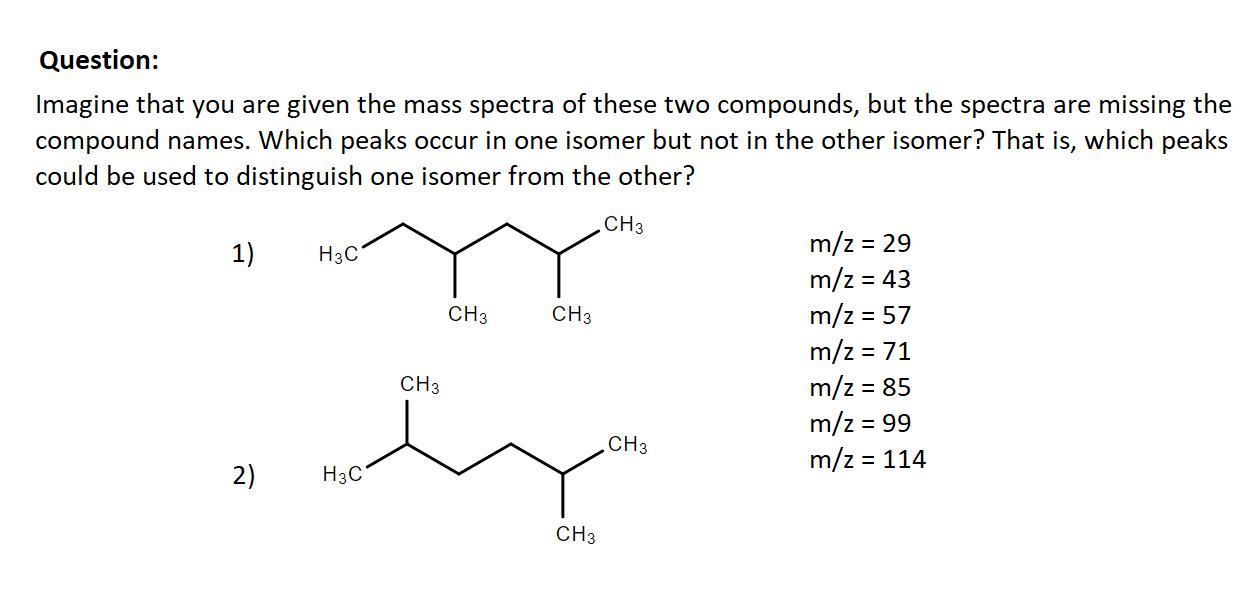
Imagine that you are given the mass spectra of these two compounds, but the spectra are missing the compound names.
12345 [234]

The structures of the isomers and the m/z values of their peaks are not given in the question. The complete question is provided in the attachment

Answer:

Compound 2 (2,5-dimethylhexane) will not have the peaks at 29 and 85 m/z

Explanation:

The fragmentation of molecules by electron ionization of mass spectrometer occurs according to Stevenson's Rule, which states that "The most probable fragmentation is the one that leaves the positive charge on the fragment with the lowest ionization energy". This is much like the Markovnikov's Rule in organic chemistry which has predicted the formation of most stable carbocation and the addition of hydrogen halide to it.

The mass spectra of compound 1 (2,4-dimethylhexane) will contain all the m/z values mentioned in the question. Each peak indicate towards homologous series of fragmentation product of the compound 1. The first peak can be attributed to ethyl carbocation (m/z = 29), with the increase of 14 units the next peak indicates towards propyl carbocation (m/z = 43) and onwards until molecular ion peak of 114 m/z.

Compound 2 (2,5-dimethylhexane) structure shows that the cleavage  of C-C bond will not yield a stable ethyl and hexyl carbocation. Hence, no peaks will be observed at 29 and 85 m/z. The absence of these two peaks can be used to distinguish one isomer from the other.

5 0
2 years ago
Other questions:
  • What scientific knowledge was necessary for Kroto, Smalley, and Curl to discover buckyballs? Check all that apply. All matter is
    7·2 answers
  • A sample of a gas occupies a volume of 752 ml at 25°c. what volume will the gas occupies if the temperature increases to 50°c, i
    5·1 answer
  • A standard solution of 0.243 m naoh was used to determine the concentration of a hydrochloric acid solution. if 46.33 ml of naoh
    8·1 answer
  • Examine the sets of bonds given in the choices. which one arranges the bonds in order of increasing (shortest to longest) bond l
    11·1 answer
  • How many molecules of CBr4 are in 250 grams of CBr4
    7·1 answer
  • A chemist requires 5.00 liters of 0.420 M H2SO4 solution. How many grams of H2SO4 should the chemist dissolve in water? 129 gram
    8·1 answer
  • What is the minimum pressure in kPa that must be applied at 25 °C to obtain pure water by reverse osmosis from water that is 0.1
    10·1 answer
  • Using the van der Waals equation, the pressure in a 22.4 L vessel containing 1.00 mol of neon gas at 100 °C is ________ atm. (a
    14·1 answer
  • Which equation represents the total ionic equation for the reaction of HNO3 and NaOH? Upper H superscript plus, plus upper O upp
    13·2 answers
  • The table shows the densities of four samples, each of the same volume.
    15·2 answers
Add answer
Login
Not registered? Fast signup
Signup
Login Signup
Ask question!