answer.
Ask question
Login Signup
Ask question
All categories
  • English
  • Mathematics
  • Social Studies
  • Business
  • History
  • Health
  • Geography
  • Biology
  • Physics
  • Chemistry
  • Computers and Technology
  • Arts
  • World Languages
  • Spanish
  • French
  • German
  • Advanced Placement (AP)
  • SAT
  • Medicine
  • Law
  • Engineering
xxMikexx [17]
2 years ago
14

Using the van der Waals equation, the pressure in a 22.4 L vessel containing 1.00 mol of neon gas at 100 °C is ________ atm. (a

= 0.211 L2-atm/mol2, b = 0.0171 L/mol)
Chemistry
1 answer:
svetoff [14.1K]2 years ago
7 0

Answer:

The answer to your question is        P = 1.357 atm

Explanation:

Data

Volume = 22.4 L

1 mol

temperature = 100°C

a = 0.211 L² atm

b = 0.0171 L/mol

R = 0.082 atmL/mol°K

Convert temperature to °K

Temperature = 100 + 273

                      = 373°K

Formula

               (P + \frac{a}{v^{2}} )(v - b) = RT

Substitution

               (P + \frac{0.211}{22.4})(22.4 - 0.0171) = (0.082)(373)

Simplify

               (P + 0.0094)(22.3829) = 30.586

Solve for P

                           P + 0.0094 = \frac{30.586}{22.3829}

                           P + 0.0094 = 1.366

                                 P = 1.336 - 0.0094

                                P = 1.357 atm

You might be interested in
Paintball is a popular recreational activity that uses a metal tank of compressed carbon
Dovator [93]

Answer:

Explanation:

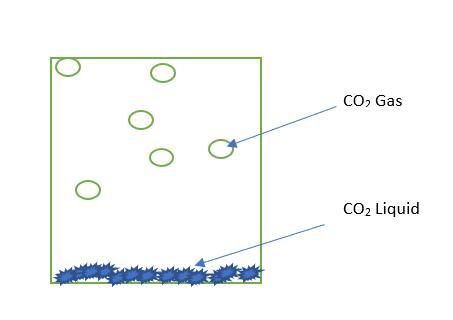
Here we have the mass of CO₂ added = 340 g

From

Number \, of \, moles = \frac{Mass}{Molar \, mass}

We have, where the molar mass of CO₂ is 44.01 g/mol

Therefore,

Number \, of \, moles = \frac{340}{44.01} = 7.73 \, \, \, moles

71. Included drawing attached

72. Here we have the pressure of the gas given by Charles law which can be resented as follows;

\frac{P_1}{P_2} =\frac{T_1}{T_2}

Where:

P₁ = Initial pressure = 6.1 atmospheres

P₂ = Final pressure

T₁ = Initial Temperature = 293 K

T₂ = Initial Temperature = 313 K

Therefore,

P_2= T_2 \times \frac{P_1}{T_1} = 313 \times \frac{6.1}{293} = 3.312 \, \, \, atmospheres


5 0
2 years ago
1. Which class of compounds contains at least one element from Group 17 of the Periodic Table ? A) aldehyde B ) amine C) ester D
blondinia [14]

Halide

hope it helps

4 0
2 years ago
What kind of decoration did artists use on Tutankhamen's throne?
Temka [501]

If there are options, they are b, c, and d. I've done this question in class before :)

5 0
2 years ago
Read 2 more answers
A 1.00 g sample of a hydrogen peroxide (H2O2) solution is placed in an Erlenmeyer flask and diluted with 20 mL of 1 M aqueous su
Minchanka [31]
Following reaction is involved in present system:

2KMnO4  +  5H2O2 +  3H2SO4 →  2MnSO4    +     K2SO4  + 5O2  +   8H2O

From the above balance reaction, it can be seen that 2 moles of KMnO4 is consumed for every 5 moles of H2O2.

 Now, percent by mass of hydrogen peroxide in the original solution can be estimated as follows:
percent by mass = \frac{\text{mass of H2O2(g)}}{\text(volume of H2SO4(ml))}X 100
∴percent by mass = \frac{\text{1}}{\text(25)}X 100
                             = 4 % 
5 0
2 years ago
Cacodyl, which has an intolerable garlicky odor and is used in the manufacture of cacodylic acid, a cotton herbicide, has a mass
Papessa [141]

Answer:

The molecular formula of cacodyl is C₄H₁₂As₂.

Explanation:

<u>Let's assume we have 1 mol of cacodyl</u>, in that case we'd have 209.96 g of cacodyl and the<u> following masses of its components</u>:

  • 209.96 g * 22.88/100 = 48.04 g C
  • 209.96 g * 5.76/100 = 12.09 g H
  • 209.96 g * 71.36/100 = 149.83 g As

Now we convert those masses into moles:

  • 48.04 g C ÷ 12 g/mol = 4.00 mol C
  • 12.09 g H ÷ 1 g/mol = 12.09 mol H
  • 149.83 g As ÷ 74.92 g/mol = 2.00 mol As

Those amounts of moles represent the amount of each component in 1 mol of cacodyl, thus, the molecular formula of cacodyl is C₄H₁₂As₂.


3 0
2 years ago
Other questions:
  • One atom of silicon can properly combined in a compound with
    5·1 answer
  • Phosphine, ph3(g), combusts in oxygen gas to form water vapor and solid tetraphosphorus decaoxide. express your answer as a bala
    10·1 answer
  • 28 ml of 0.10 m hcl is added to 60 ml of 0.10 m sr(oh)2. determine the concentration of oh− in the resulting solution.
    6·2 answers
  • In an experiment, 16.8 g of k2so4 was dissolved in 1.00 kg of water to make a solution. the freezing point of the solution was m
    11·1 answer
  • A common reaction is the formation of butyric acid from butyl alcohol. butyric acid is what causes the odor of rancid butter. ba
    14·2 answers
  • Two containers hold the same radioactive isotope. Container A contains 1000 atoms, and container B contains 500 atoms. Which of
    5·2 answers
  • (a) The bonding with electrostatic attraction between oppositely charged ions is called . The bonding with electron sharing betw
    5·1 answer
  • Enter the correct answer for each unit conversion.
    8·2 answers
  • Given that Kw for water is 2.4×10⁻¹⁴ M2 at 37 °C, calculate the pH of a neutral aqueous solution at 37 °C, which is the normal h
    10·1 answer
  • The isotope 64Cu has t1/2 of 12.7 hours. If the initial concentration of this isotope in an aqueous solution is 845 ppm, what wi
    5·1 answer
Add answer
Login
Not registered? Fast signup
Signup
Login Signup
Ask question!