answer.
Ask question
Login Signup
Ask question
All categories
  • English
  • Mathematics
  • Social Studies
  • Business
  • History
  • Health
  • Geography
  • Biology
  • Physics
  • Chemistry
  • Computers and Technology
  • Arts
  • World Languages
  • Spanish
  • French
  • German
  • Advanced Placement (AP)
  • SAT
  • Medicine
  • Law
  • Engineering
Illusion [34]
2 years ago
9

Thiamine hydrochloride (C12H18ON4SCl2) is a water-soluble form of thiamine (vitamin B1; Ka = 3.37×10⁻⁷). How many grams of the h

ydrochloride must be dissolved in 10.00 mL of water to give a pH of 3.50?
Chemistry
1 answer:
Elan Coil [88]2 years ago
6 0

Answer:

m_{HA}=0.784g

Explanation:

Hello,

In this case, considering the dissociation of thiamine hydrochloride:

C_{12}H_{18}ON_4SCl_2 \rightleftharpoons H^++C_{12}H_{17}ON_4SCl_2^-

It is convenient to write it as:C_{12}H_{18}ON_4SCl_2+H_2O \rightleftharpoons H_3O^++C_{12}H_{17}ON_4SCl_2^-

Or:

HA+H_2O\rightleftharpoons H_3O^++A^-

With which the Henderson-Hasselbalch equation is applied:

pH=pKa+log(\frac{[A^-]}{[HA]} )

Therefore:

log(\frac{[A^-]}{[HA]} )=3.50-[-log(3.37x 10^{-7})]=3.50-6.47=-2.97}\\\\\frac{[A^-]}{[HA]} =10^{-2.97}=1.07x10^{-3}

[A^-]=1.07x10^{-3}}[HA]

Thus, as the pH equals the concentration of hydrogen which also equals the concentration of the conjugate base, one obtains:

[H]^+=[A^-]=10^{-pH}=10^{-3.50}=3.16x10^{-4}M

Now, solving for the concentration of acid ([HA]):

[HA]=\frac{3.16x10^{-4}M}{1.07x10^{-3}} =0.296M

Finally, the mass turns out:

m_{HA}=0.01000L*0.296\frac{mol}{L}*\frac{265.35g}{1mol}\\  m_{HA}=0.784g

Best regards.

You might be interested in
The concentration of hydrogen peroxide in a hair bleach is 0.050 mol dm–3. Use your answer from (b) to calculate the dilution fa
stellarik [79]

Answer:

0.03

Explanation:0.050 -

8 0
2 years ago
Panuto: Sumulat ng isang halimbawa ng adyenda. Ipagpalagay mo na ikaw ay isang tagapayo. Ikaw
Degger [83]

Answer:

Sumulat lamang ng mga random na pangalan at sabihin ang "Appointment with (name)"

School Counselor ba ito?

8 0
2 years ago
A student wants to draw a model of an atom. Which statement describes how to find the number of neutrons to include in the model
san4es73 [151]

c is the correct answer

4 0
2 years ago
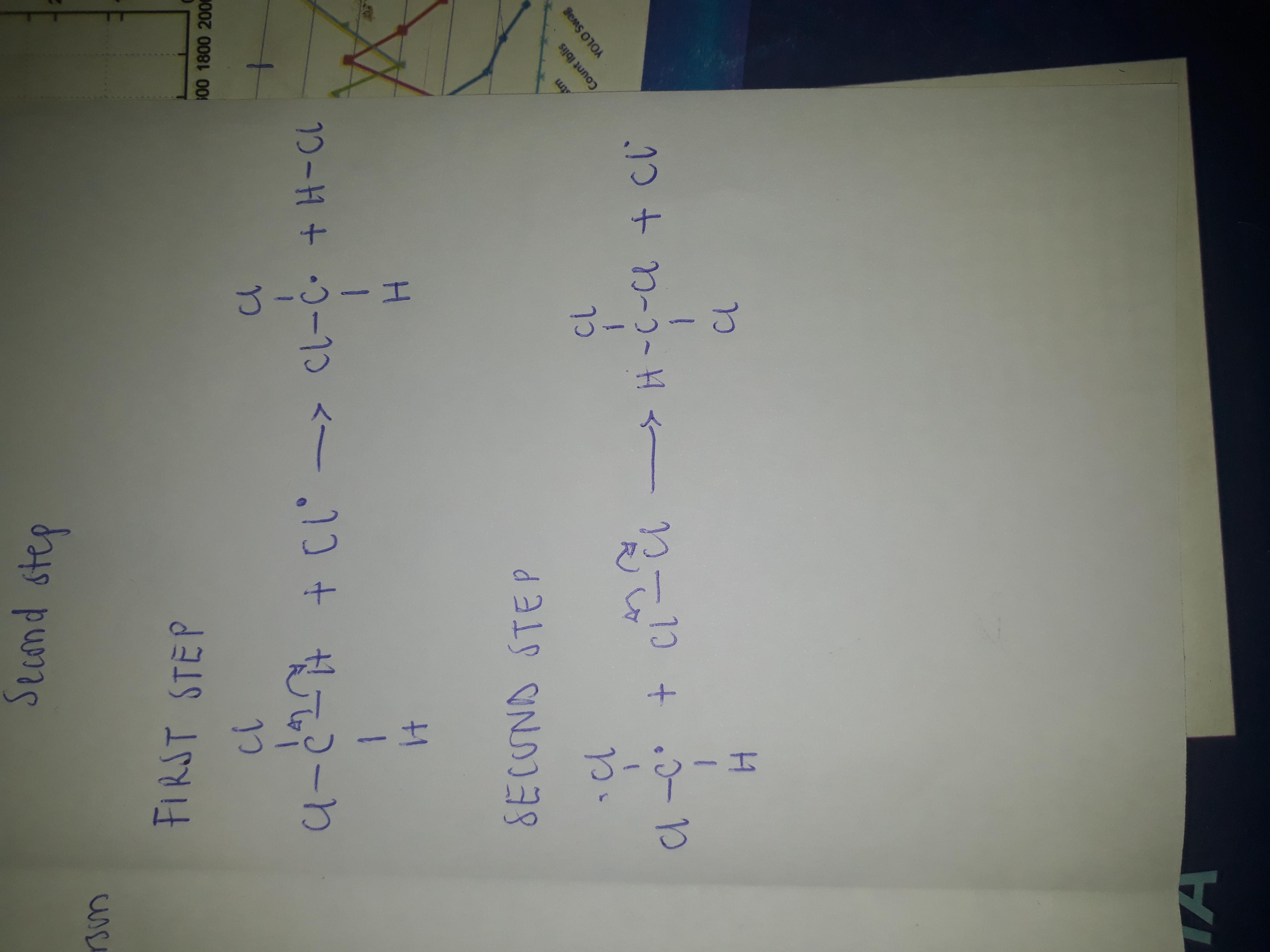
Which of the following represents a propagation step in the monochlorination of methylene chloride (CH2Cl2)?a. CHCl3 + Cl. Right
svetlana [45]

Answer:

B = CHCl2 + Cl2 --> CHCl3 + Cl

Explanation:

Free radical halogenation is a chlorination reaction on Alkane hydrocarbons. This involves the splitting of molecules into radicals/ unstable molecules in the presence of sunlight/ U.V light which ensures bonding of the molecules.

Free radical chlorination is divided into 3 steps which are:

The initiation step

The propagation step

The termination step

So in reference to the question, propagation step involves two steps.

The first step is where the molecule in this case the methylene chloride(CH2Cl2) loses a hydrogen atom and then bond with a chlorine atom radical to give a nethylwnw chloride radical and HCl.

The second step involves the reaction of this methylene chloride got in the first step with chlorine molecule to form trichloride methane and a chlorine radical.

You would find in the attachment the 2 step mechanism.

3 0
2 years ago
Determine the empirical formula for compounds that have the following analyses: a. 66.0% barium and 34.0% chlorine b. 80.38% bis
almond37 [142]

Answer: a) BaCl_2

b)  BiO_3H_3

Explanation:

If percentage are given then we are taking total mass is 100 grams.

So, the mass of each element is equal to the percentage given.

a) Mass of Ba= 66.06 g

Mass of Cl = 34.0 g

Step 1 : convert given masses into moles.

Moles of Ba =\frac{\text{ given mass of ba}}{\text{ molar mass of Ba}}= \frac{66.06g}{137g/mole}=0.48moles

Moles of Cl = \frac{\text{ given mass of Cl}}{\text{ molar mass of Cl}}= \frac{34g}{35.5g/mole}=0.96moles[/tex]

Step 2 : For the mole ratio, divide each value of moles by the smallest number of moles calculated.

For Ba = \frac{0.48}{0.48}=1

For O =\frac{0.96}{0.48}=2

The ratio of Ba: Cl= 1:2

Hence the empirical formula is BaCl_2

b) Mass of Bi= 80.38 g

Mass of O= 18.46 g

Mass of H = 1.16 g

Step 1 : convert given masses into moles.

Moles of Bi =\frac{\text{ given mass of ba}}{\text{ molar mass of Ba}}= \frac{80.38g}{209g/mole}=0.38moles

Moles of O= \frac{\text{ given mass of O}}{\text{ molar mass of O}}= \frac{18.46g}{16g/mole}=1.15moles

Moles of H=\frac{\text{ given mass of H}}{\text{ molar mass of H}}= \frac{1.16g}{1g/mole}=1.16moles

Step 2 : For the mole ratio, divide each value of moles by the smallest number of moles calculated.

For Bi= \frac{0.38}{0.38}=1

For O =\frac{1.15}{0.38}=3

For H=\frac{1.16}{0.38}=3

The ratio of Bi: O: H= 1:3: 3

Hence the empirical formula is BiO_3H_3

6 0
2 years ago
Other questions:
  • When you open a bottle of a soft drink and leave it open, the drink eventually goes flat. this happens because the equilibrium b
    6·1 answer
  • How many molecules are in 13.5g of sulfur dioxide, SO2?
    6·2 answers
  • Two liquids are known to be miscible. They are placed in a beaker and shaken. Which of the following describes what will happen?
    5·2 answers
  • The accepted value is 1.43. Which correctly describes this student’s experimental data?
    14·2 answers
  • The solubility of acetanilide is 12.8 g in 100 mL of ethanol at 0 ∘C, and 46.4 g in 100 mL of ethanol at 60 ∘C. What is the maxi
    8·1 answer
  • Industrial production of nitric acid, which is used in many products including fertilizers and explosives, approaches 10 billion
    9·1 answer
  • A beaker contains a dilute sodium chloride solution at 1 atmosphere. What happens to the number of solute particles in the solut
    10·1 answer
  • The ph of an aqueous solution at 25.0°c is 10.66. what is the molarity of h+ in this solution? the ph of an aqueous solution at
    8·1 answer
  • A blacksmith making a tool heats 525 grams of steel to 1230°C. After hammering the steel, she places it into a bucket of water t
    5·1 answer
  • You are about to watch a video about a scientist who studies jellies like the one shown in this image. One thing she investigate
    13·1 answer
Add answer
Login
Not registered? Fast signup
Signup
Login Signup
Ask question!