answer.
Ask question
Login Signup
Ask question
All categories
  • English
  • Mathematics
  • Social Studies
  • Business
  • History
  • Health
  • Geography
  • Biology
  • Physics
  • Chemistry
  • Computers and Technology
  • Arts
  • World Languages
  • Spanish
  • French
  • German
  • Advanced Placement (AP)
  • SAT
  • Medicine
  • Law
  • Engineering
denpristay [2]
2 years ago
10

A beaker contains a dilute sodium chloride solution at 1 atmosphere. What happens to the number of solute particles in the solut

ion and the boiling point of the solution, as more sodium chloride is dissolved?
Chemistry
1 answer:
nadezda [96]2 years ago
3 0

Answer:

As more sodium chloride is dissolved, higher is the boiling point of the solution

Explanation:

The boiling point- the temperature at which the solution boils- will increase as more solute is added. That is a colligative property called <em>boiling point elevation</em>. Colligative propeties are those that depend on the number of particles of solute in a solution. As more solute is added (sodium chloride or NaCl), more particles of solute will be present in the solution and the boiling point of the solution will be higher. The mathematical expression for the boiling point elevation (ΔTb) is the following:

ΔTb= Kb x m

Where Kb is a molal constant and m is the molality of the solution. That expression shows that the elevation of boiling point depends on the concentration of the solute expressed in terms of moles per mass of solution.

You might be interested in
A person throws a ball up into the air, and the ball falls back toward Earth. At which point would the kinetic energy be the low
dybincka [34]
It would be d bc when it’s at its lowest point it means not that much energy and that would be its lowest point which is D
6 0
2 years ago
Read 2 more answers
A mysterious white powder could be powdered sugar (C12H22O11), cocaine (C17H21NO4), codeine (C18H21NO3), norfenefrine (C8H11NO2)
rodikova [14]

Norfenefrine (C₈H₁₁NO₂).

<h3>Further explanation</h3>

We will solve a case related to one of the colligative properties, namely freezing point depression.

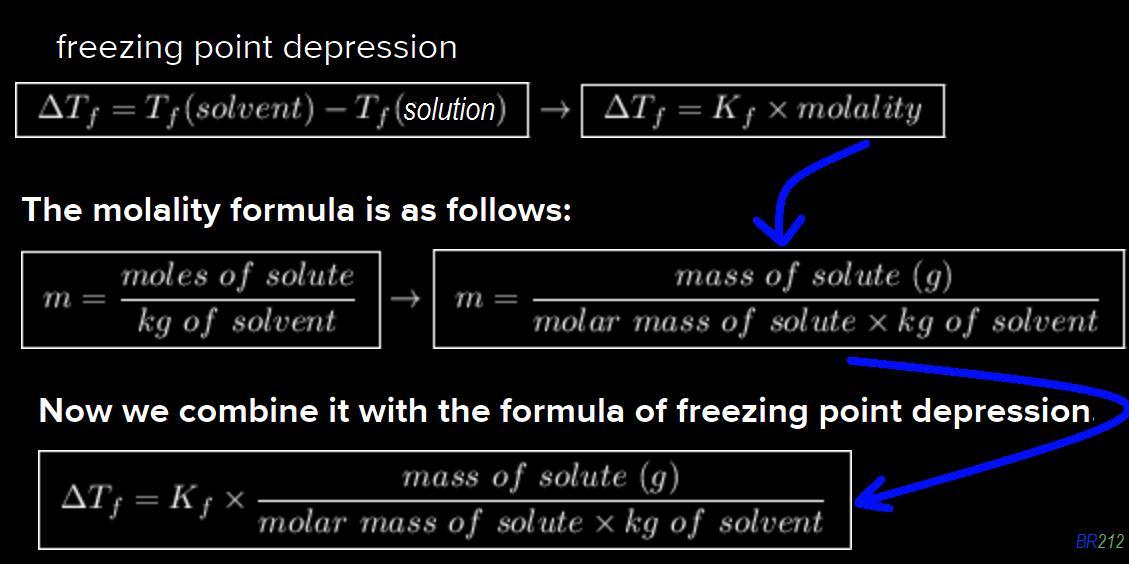
The freezing point of the solution is the temperature at which the solution begins to freeze. The difference between the freezing point of the solvent and the freezing point of the solution is called freezing point depression.

\boxed{ \ \Delta T_f = T_f(solvent) - T_f(solution) \ } \rightarrow \boxed{ \ \Delta T_f = K_f \times molality \ }

<u>Given:</u>

A mysterious white powder could be,

  • powdered sugar (C₁₂H₂₂O₁₁) with a molar mass of 342.30 g/moles,
  • cocaine (C₁₇H₂₁NO₄) with a molar mass of 303.35 g/moles,
  • codeine (C₁₈H₂₁NO₃) with a molar mass of 299.36 g/moles,
  • norfenefrine (C₈H₁₁NO₂) with a molar mass of 153.18 g/moles, or
  • fructose (C₆H₁₂O₆) with a molar mass of 180.16 g/moles.

When 82 mg of the powder is dissolved in 1.50 mL of ethanol (density = 0.789 g/cm³, normal freezing point −114.6°C, Kf = 1.99°C/m), the freezing point is lowered to −115.5°C.

<u>Question: </u>What is the identity of the white powder?

<u>The Process:</u>

Let us identify the solute, the solvent, initial, and final temperatures.

  • The solute = the powder
  • The solvent = ethanol
  • The freezing point of the solvent = −114.6°C
  • The freezing point of the solution = −115.5°C

Prepare masses of solutes and solvents.

  • Mass of solute = 82 mg = 0.082 g
  • Mass of solvent = density x volume, i.e., \boxed{ \ 0.789 \ \frac{g}{cm^3} \times 1.50 \ cm^3 = 1.1835 \ g = 0.00118 \ kg  \ }

We must prepare the solvent mass unit in kg because the unit of molality is the mole of the solute divided by the mass of the solvent in kg.

The molality formula is as follows:

\boxed{ \ m = \frac{moles \ of \ solute}{kg \ of \ solvent} \ } \rightarrow \boxed{ \ m = \frac{mass \ of \ solute \ (g)}{molar \ mass \ of \ solute \times kg \ of \ solvent} \ }

Now we combine it with the formula of freezing point depression.

\boxed{ \ \Delta T_f =  K_f \times \frac{mass \ of \ solute \ (g)}{molar \ mass \ of \ solute \times kg \ of \ solvent} \ }

It is clear that we will determine the molar mass of the solute (denoted by Mr).

We enter all data into the formula.

\boxed{ \ -114.6^0C - (-115.5^0C) = 1.99 \frac{^0C}{m} \times \frac{0.082 \ g}{Mr \times 0.00118 \ kg} \ }

\boxed{ \ 0.9 = \frac{1.99 \times 0.082}{Mr \times 0.00118} \ }

\boxed{ \ Mr = \frac{0.16318}{0.9 \times 0.00118} \ }

We get \boxed{ \ Mr = 153.65 \ }

These results are very close to the molar mass of norfenefrine which is 153.18 g/mol. Thus the white powder is norfenefrine.

<h3>Learn more</h3>
  1. The molality and mole fraction of water brainly.com/question/10861444
  2. About the mass and density of ethylene glycol as an  antifreeze brainly.com/question/4053884
  3. About the solution as a homogeneous mixture  brainly.com/question/637791

Keywords: a mysterious white powder, sugar, cocaine, codeine, norfenefrine, fructose, the solute, the solvent, dissolved, ethanol, normal freezing point, the freezing point depression, the identity


7 0
2 years ago
Read 2 more answers
choose the reaction that illustrates delta H *f for Ca(NO3)2.(A) Ca (s) + N2 (g) + 3O2 ---&gt; Ca(NO3)2 (s)(B) Ca2 (aq) + 2 NO3-
kompoz [17]

<u>Answer:</u> The correct answer is Option A.

<u>Explanation:</u>

Standard enthalpy of formation is the change in enthalpy of  one mole of a substance present at the standard state that is 1 atm of pressure and 298 K of temperature. The substance is formed from its pure elements under the same conditions.

We are given a chemical compound having chemical formula Ca(NO_3)_2

This compound is formed by the combination of calcium, nitrogen and oxygen elements.

The chemical equation for the formation of Ca(NO_3)_2 from the components in their standard states follows:

Ca+N_2+3O_2\rightarrow Ca(NO_3)_3

Hence, the correct answer is Option A.

3 0
2 years ago
You wish to make a buffer with pH 7.0. You combine 0.060 grams of acetic acid and 14.59 grams of sodium acetate and add water to
aleksandr82 [10.1K]

Answer:

The pH of the buffer is 7.0 and this pH is not useful to pH 7.0

Explanation:

The pH of a buffer is obtained by using H-H equation:

pH = pKa + log [A⁻] / [HA]

<em>Where pH is the pH of the buffer</em>

<em>The pKa of acetic acid is 4.74.</em>

<em>[A⁻] could be taken as moles of sodium acetate (14.59g * (1mol / 82g) = 0.1779 moles</em>

<em>[HA] are the moles of acetic acid (0.060g * (1mol / 60g) = 0.001moles</em>

<em />

Replacing:

pH = 4.74 + log [0.1779mol] / [0.001mol]

<em>pH = 6.99 ≈ 7.0</em>

<em />

The pH of the buffer is 7.0

But the buffer is not useful to pH = 7.0 because a buffer works between pKa±1 (For acetic acid: 3.74 - 5.74). As pH 7.0 is out of this interval,

this pH is not useful to pH 7.0

<em />

7 0
2 years ago
What is the percent CdSO4 by mass in a 1.00 m aqueous CdSO4 solution?
Svet_ta [14]
I don't know but I'm wasting 5 seconds of your time you can't take back sorry
3 0
2 years ago
Other questions:
  • If 350.0 grams of Cr2O3 are reacted with 235.0 grams of elemental silicon, 213.2 grams of chromium metal are recovered. What is
    5·1 answer
  • In an experiment, 0.42 mol of co and 0.42 mol of h2 were placed in a 1.00-l reaction vessel. at equilibrium, there were 0.29 mol
    6·1 answer
  • HELP!!!!!!! How many moles of AgNO3 must react to form 0.854 mol Ag?<br> mol AgNO3
    12·2 answers
  • What is the empirical formula? A compound is used to treat iron deficiency in people. It contains 36.76% iron, 21.11% sulfur, an
    9·2 answers
  • Bella wants to know which mode of transportation is the fastest for getting from her home to the grocery store. She cans drive h
    6·1 answer
  • What is the empirical formula of a compound containing 90 grams carbon, 11 grams hydrogen, and 35 grams nitrogen? A. C3H4N B. C2
    6·1 answer
  • Partitioning of toxic chemicals in the environment refers to:
    11·1 answer
  • The mole fraction of oxygen molecules in dry air is 0.2095. What volume of dry air at 1.00 atm and 25°C is required for burning
    9·1 answer
  • If Co(NH3)63+ has a λmax at 440 nm, calculate ΔE for the complex. A) 2.72 x 10⁻⁴ kJ/mol B) 4.52 x 10⁻² kJ/mol C) 2.72 x 10 2 kJ/
    5·1 answer
  • In a voltaic cell made of a Ag strip and an Al strip immersed in 1.0 M aqueous AgNO_3 and Al(NO_3)_3 solutions, respectively, wi
    6·1 answer
Add answer
Login
Not registered? Fast signup
Signup
Login Signup
Ask question!