answer.
Ask question
Login Signup
Ask question
All categories
  • English
  • Mathematics
  • Social Studies
  • Business
  • History
  • Health
  • Geography
  • Biology
  • Physics
  • Chemistry
  • Computers and Technology
  • Arts
  • World Languages
  • Spanish
  • French
  • German
  • Advanced Placement (AP)
  • SAT
  • Medicine
  • Law
  • Engineering
Alexus [3.1K]
2 years ago
8

You wish to make a buffer with pH 7.0. You combine 0.060 grams of acetic acid and 14.59 grams of sodium acetate and add water to

yield a total volume of 1 liter . What is the pH? Will this be the useful pH 7.0 buffer you seek?
Chemistry
1 answer:
aleksandr82 [10.1K]2 years ago
7 0

Answer:

The pH of the buffer is 7.0 and this pH is not useful to pH 7.0

Explanation:

The pH of a buffer is obtained by using H-H equation:

pH = pKa + log [A⁻] / [HA]

<em>Where pH is the pH of the buffer</em>

<em>The pKa of acetic acid is 4.74.</em>

<em>[A⁻] could be taken as moles of sodium acetate (14.59g * (1mol / 82g) = 0.1779 moles</em>

<em>[HA] are the moles of acetic acid (0.060g * (1mol / 60g) = 0.001moles</em>

<em />

Replacing:

pH = 4.74 + log [0.1779mol] / [0.001mol]

<em>pH = 6.99 ≈ 7.0</em>

<em />

The pH of the buffer is 7.0

But the buffer is not useful to pH = 7.0 because a buffer works between pKa±1 (For acetic acid: 3.74 - 5.74). As pH 7.0 is out of this interval,

this pH is not useful to pH 7.0

<em />

You might be interested in
Hector claims that a single sodium ion and a single oxygen ion do not bond together to form a stable binary ionic compound. Is h
levacccp [35]

Answer:

C

Explanation:

Looking at the periodic table, we can see that sodium is in group 1, so a sodium ion would be Na⁺, with a charge of +1. Oxygen is in group 16, so an oxygen ion would be O²⁻, with a charge of -2.

A compound formed only by a single sodium ion and a single oxygen ion would thus have a charge of -1, and in order to have a stable ionic compound its charge must be zero.

8 0
2 years ago
Read 2 more answers
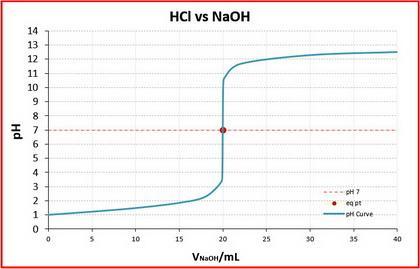
(g) On the graph in part (d) , carefully draw a curve that shows the results of the second titration, in which the student titra
atroni [7]

Answer:

Here's what I get  

Explanation:

(g) Titration curves

I can't draw two curves on the same graph, but I can draw two separate curves for you.  

The graph in part (d) had an equivalence point at 20 mL.

In the second titration, the NaOH was twice as concentrated, so the volume to equivalence point would be half as much — 10 mL.

The two titration curves are below.

(h) Evidence of reaction

HCl and NaOH are both colourless.

They don't  evolve a gas or form a precipitate when they react.

The student probably noticed that the Erlenmeyer flask warmed up — a sign of a chemical change.

4 0
2 years ago
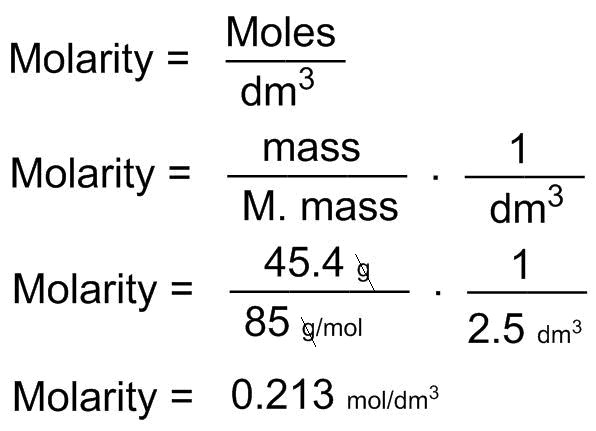
Calculate the molarity of a solution made by adding 45.4 g of nano3 to a flask and dissolving it with water to create a total vo
aleksandr82 [10.1K]
Solutions are made up of two non reacting species called solute and solvent. The amount of solute in solvent is known as concentration of that solute. Concentration is often measured in Molarity. Molarity is the amount of solute dissolved in 1 dm3 of solution. Answer to your question is as follow;

3 0
2 years ago
Read 2 more answers
How much heat is required to raise the temperature of 670g of water from 25.7"C to 66,0°C? The specific heat
inna [77]

Answer:

Explanation:

q= mc theta

where,

Q = heat gained

m = mass of the substance = 670g

c = heat capacity of water= 4.1 J/g°C    

theta =Change in temperature=( 66-25.7)

Now put all the given values in the above formula, we get the amount of heat needed.

q= mctheta

q=670*4.1*(66-25.7)

  =670*4.1*40.3

=110704.1

8 0
2 years ago
what is the new pressure acting on a 2.5 l balloon if its original volume was 5.8 l at 3.7 ATM of pressure
Ivan

Answer : The new pressure acting on a 2.5 L balloon is, 8.6 atm.

Explanation :

Boyle's Law : It is defined as the pressure of the gas is inversely proportional to the volume of the gas at constant temperature and number of moles.

P\propto \frac{1}{V}

or,

P_1V_1=P_2V_2

where,

P_1 = initial pressure = 3.7 atm

P_2 = final pressure = ?

V_1 = initial volume = 5.8 L

V_2 = final volume = 2.5 L

Now put all the given values in the above equation, we get:

3.7atm\times 5.8L=P_2\times 2.5L

P_2=8.6atm

Thus, the new pressure acting on a 2.5 L balloon is, 8.6 atm.

8 0
2 years ago
Other questions:
  • A container of hydrogen gas has a volume of 1.46 liters, a pressure of 2.18 atm, and a temperature of 185 Kelvin. How many moles
    9·1 answer
  • You are on a field trip to a nearby lake for biology class and want to perform a quick analysis of the water’s approximate pH le
    6·2 answers
  • Concentration of 10.00 mL of HBr if it takes 5 mL of a 0.253 M LiOH solution to<br> neutralize it?
    6·1 answer
  • A beaker holds 962 g of a brine solution that is 6.20 percent salt. If 123g of water are evaporated from the beaker, how much sa
    15·1 answer
  • Freon-12, CF2Cl2, which has been widely used in air conditioning systems, is considered a threat to the ozone layer in the strat
    8·2 answers
  • Calculate the internal energy of 2 moles of argon gas (assuming ideal behavior) at 298 K. Suggest two ways to increase its inter
    13·1 answer
  • A student places 1.38g of unknown metal at 99.6C into 60.50g of water at 22.1C. The entire system reaches a uniform temperature
    14·1 answer
  • Why is the atomic mass of iron, 55.845 amu, most similar to the mass of iron-56, yet less than 56 amu? The atomic mass is the si
    5·1 answer
  • Choose two different particles found in the air. Explain how they are different and how they are the same
    5·1 answer
  • What is the compound name for PCl8
    5·2 answers
Add answer
Login
Not registered? Fast signup
Signup
Login Signup
Ask question!