answer.
Ask question
Login Signup
Ask question
All categories
  • English
  • Mathematics
  • Social Studies
  • Business
  • History
  • Health
  • Geography
  • Biology
  • Physics
  • Chemistry
  • Computers and Technology
  • Arts
  • World Languages
  • Spanish
  • French
  • German
  • Advanced Placement (AP)
  • SAT
  • Medicine
  • Law
  • Engineering
Novosadov [1.4K]
2 years ago
14

Which of the following offspring genotypes could result from the fertilization of an egg that had undergone nondisjunction in me

iosis II with a normal haploid sperm? (Because a nondisjunction event in meiosis II could involve the chromosome containing gene A or the chromosome containing gene a, be sure to consider both possibilities in your final answer .)
Biology
2 answers:
ElenaW [278]2 years ago
8 0

Answer:

 AAa, aaa, Aa, aa or a.

Explanation:

The phenomenon where homologous chromosome failed to separate into new daughter cells , but remained joined together  so that one daughter cell  has extra number of chromosomes while the other daughter cell has empty chromosome in nucleus is called non dis junction.

In this present scenario   in the mother with heterozygous  gene (Aa) , during oogenesis at anaphase of meiosis 1. each of the gene  separate, and move to the different  oocytes -daughter cells .

However, at meiosis 2, instead of the each chromosomes to undergo centromere separation at metaphase  ii ,either of A  or a -genes, may failed to do this and rather migrates into  same  oocyte -daughter cells. Because this is a random events, the oocyte may have;

 <u>AA/aa,-</u><u>assuming one A or  a failed to separate and joined with another</u>,

or

<u> A  /a.</u><u> assuming no  extra to pair  because of  extra copies in some oocytes</u>

or  

<u>(0)-</u><u>nothing.-assuming extra copies has prevented equal distribution in non-dijuction oocytes.</u>

if  either of these cells above  is fertilized by  haploid sperm of father with homozygote recessive gene a  in random fertilisation; the haploid  sperm with  gene a  after fertilization produce either of offspring  of the following chromosomes combinations;

as a result   of non-dis-joined zygotes  AAa, aaa, Aa, aa or a.

Lorico [155]2 years ago
5 0

Answer:

See explanation below

Explanation:

<em>Non-disjunction occur as a result of lack of separation of homologous chromosomes during meiosis. </em>

As a result, the gametes (the daughter cells formed) produced end up having extra or lesser chromosomes as compared to a normal gamete.

When a gamete with extra chromosome fertilizes a normal gamete, the resulting offspring will have an extra chromosome (trisomy condition).

On the other hand, when a gamete with one less chromosome than normal fertilizes a normal gamete, the resulting offspring will have one less chromosome than normal offspring (monosomy condition).

Assuming a chromosome with Aa gene undergoes non disjunction during meiosis, the resulting gametes either contain both A and a chromosome or contain no chromosome at all.

If Aa gamete is fertilized by a normal haploid sperm (a), the resulting zygote will have the genotype Aaa.

If a gamete with no chromosome at all fertilizes a normal haploid sperm, the resulting offspring will have the genotype a.

You might be interested in
Which statement describes the reaction for cellular respiration? The equation is carbon dioxide + water Right-arrow glucose + ox
ziro4ka [17]

Answer:

glucose + oxygen Right-arrow carbon dioxide + water and energy is produced in the form of ATP. This is the correct equation.

Explanation:

In cellular respiration -

If oxygen is present glucose molecules breakdown release energy in the form of ATP.

Here 1 glucose molecule in the presence of 6 oxygen molecules gives 6 carbon dioxide and 6 water molecules And 36 ATP as energy.

aerobic cellular respiration is very efficient in energy production as it gives high energy.

8 0
2 years ago
Read 2 more answers
Tom wants to incorporate more organic practices on his farm. He wants to enrich the nitrogen content of his soil through biologi
leonid [27]

legumes, such as beans, peanuts, and alfalfa

6 0
2 years ago
Read 2 more answers
G protein‑coupled receptors (GPCRs) and receptor tyrosine kinases (RTKs) are two basic receptor types by which cells transduce s
elena-s [515]
<h2>GPCRs,RTKs</h2>

Explanation:

G Protein Coupled Receptors(GPCRs) are more common and found in almost all eukaryotes whereas Receptor Tyrosine Kinases(RTKs) are second largest family of receptors that relay signal from cell surface to the interior

  1. G protein coupled receptors(GPCRs) interacts with the ligand activated GPCR and phosphorylates its intracellular domain.This process of phosphorylation can terminate signal or desensitize receptor
  2. Autophosphorylation of receptor can initiate signal in case of Receptor Tyrosine Kinases(RTKs);Autophosphorylation is a feature of RTKs in which receptor dimerization activates intrinsic tyrosine kinase activity by which they phosphorylate its own tyrosine residue on cytosolic phase
  3. Seven transmembrane helices can be seen in case of G protein-coupled receptors(GPCRs);transmembrane protein of it consists of single polypeptide and spans the membrane 7 times
  4. Insulin receptor is a part of Insulin Signalling which comes under RTKs;Insulin receptor always exist in case of dimeric form
  5. Epinephrine receptor is an example of GPCRs;Epinephrine is an endocrine hormones produced in stress condition
  6. Transmembrane protein of GPCR activates G protein,activated G protein binds with effector enzyme and activate it;effector enzyme further can produce or destroy secondary messenger
5 0
2 years ago
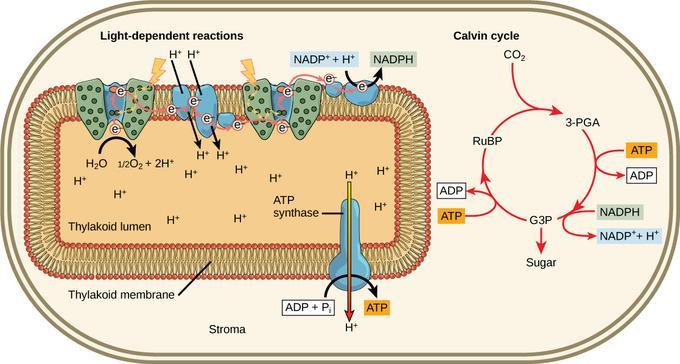
In one to three sentences, describe what happens during the reduction stage of the Calvin cycle
Marizza181 [45]

Answer:

  1. ATP and NADPH facilitate the reduction of 6 molecules of 3-PGA  (formed in carbon fixation)to six molecules of the simple sugar glyceraldehyde 3-phosphate (G3P).
  2. In the reduction process ADP and NADPH+ are made, when ATP releases energy and loses its terminal phosphate,  and NADPH loses energy and a hydrogen atom.
  3. ADP and NADPH+ return to the light-dependent reactions for re-use.

Explanation:

Sugar biosynthesis in plants, called photosynthesis produces glucose from the reactants;  it uses energy from sunlight, along with carbon dioxide and water. In chloroplasts, this occurs in the light-dependent and dark reactions. In the light- dependent reaction, solar energy stimulates photosystems, formed from pigments like chlorophylls.

In the light-independent reaction, products of the light reaction are used to make sugars. Here, in the Calvin cycle, the enzyme, RuBisCO, catalyzes the fixation of CO2 with Ribulose 1,5-bisphosphate (RuBP).  Organic molecules are reduced and RuBP is regenerated.

3 0
1 year ago
Read 2 more answers
Which of the following best explains why larger grapes have a different rate of water absorption per gram of mass than smaller g
tresset_1 [31]
B because it’s more accurate then others
5 0
2 years ago
Other questions:
  • Thiobacillus denitrificans is a species of bacteria that obtains its energy from carbon dioxide and inorganic compounds such as
    13·2 answers
  • When text is longer than the width of a column, Excel displays the overflow characters in adjacent cells to the right as long as
    13·1 answer
  • After my broken arm healed and my cast was removed, I found that my muscles had atrophied and it was difficult to use them in th
    14·2 answers
  • Select the correct answer.
    5·1 answer
  • In Illinois, the two most common crops grown are corn and soybeans. Corn is a that depletes the soil of nitrogen. Soybeans are a
    8·1 answer
  • Arsenate is a toxic ion that can interfere with both glycolysis and oxidative phosphorylation. Arsenate resembles inorganic phos
    15·1 answer
  • Drag and drop the appropriate labels into position to explain how this defect might cause mr. g's other problems.
    11·1 answer
  • Unlike humans that draw air in with the aid of a muscular __, frog lungs need air to be pumped into them like balloons. This is
    14·1 answer
  • Q6.5. What does the carrying capacity for moose on the island primarily depend on?
    7·1 answer
  • The cactus has a specialized fleshy stem that is specialized to store water for long periods of time. Which plant tissue most li
    6·2 answers
Add answer
Login
Not registered? Fast signup
Signup
Login Signup
Ask question!