answer.
Ask question
Login Signup
Ask question
All categories
  • English
  • Mathematics
  • Social Studies
  • Business
  • History
  • Health
  • Geography
  • Biology
  • Physics
  • Chemistry
  • Computers and Technology
  • Arts
  • World Languages
  • Spanish
  • French
  • German
  • Advanced Placement (AP)
  • SAT
  • Medicine
  • Law
  • Engineering
Annette [7]
2 years ago
5

Elemental S reacts with O2 gas to form SO3 gas according to the reaction depicted here.Before a chemical equation can be used to

conduct stoichiometric analysis, it must balanced. Type the balanced chemical equation for this reaction between solid sulfur and oxygen gas.Express your answer as a chemical equation including phases.
Chemistry
1 answer:
Oxana [17]2 years ago
5 0

Answer:

The balanced chemical equation for this reaction between solid sulfur and oxygen gas:

2S(s)+3O_2(g)\rightarrow 2SO_3(g)

Explanation:

The unbalanced chemical equation :

S(s)+O_2(g)\rightarrow SO_3(g)

Step 1:When balancing a chemical equation first balance out the atoms of all the elements beside oxygen .

S(s)+O_2(g)\rightarrow SO_3(g)

Step 2: balance oxygen atom by writing 3 in front of oxygen molecule and 2 in front of sulfur trioxide.

S(s)+3O_2(g)\rightarrow 2SO_3(g)

Step 3 : And finally write 2 in front of Sulfur.

2S(s)+3O_2(g)\rightarrow 2SO_3(g)

The balanced chemical equation for this reaction between solid sulfur and oxygen gas:

2S(s)+3O_2(g)\rightarrow 2SO_3(g)

You might be interested in
Consider a process in which the entropy of a system increases by 125 J K−1 and the entropy of the surroundings decreases by 125
expeople1 [14]

Answer : The process is not spontaneous.

Explanation :

As, we know that:

Change in entropy = Change in entropy of system + Change in entropy of surrounding

As we are given in question, the entropy of surroundings decrease by the same amount as the entropy of the system increases.

For the given reaction to be spontaneous, the total change in entropy should be positive.

Given :

Entropy change of system = +125J/K

Entropy change of surroundings = -125J/K

Total change in entropy = Entropy change of system + Entropy change of surroundings

Total change in entropy = 125 J/K + (-125 J/K)

Total change in entropy = 0

The process is at equilibrium because the entropy change is equal to zero. So, the process is not spontaneous.

4 0
2 years ago
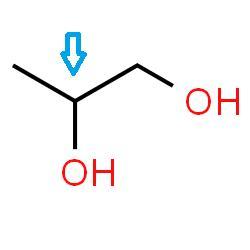
How many possible stereoisomers are there of propylene glycol, an organic compound found in clearasil acne cream, caladryl, colg
vova2212 [387]

Answer:

2

Explanation:

Isomers are molecules with the same molecular formula, but with some difference. If that difference is in the manner the atoms are distributed in the molecule, they are called structural isomers; if the difference is the way the molecule is in space, they're called space isomers (cis/trans); and there are the stereoisomers, which the molecules are images that can be overlapping.

The stereoisomers have the property to deviate the polarized light, and, when a molecule has a chiral carbon, it means that it has stereoisomers. The number of stereoisomers is 2ⁿ, where n is the number of chiral carbons.

Chiral carbon is a carbon that bonds with four different structures. So, below is represented the molecule of propylene glycol, and it has only one chiral carbon (see the blue arrow), so, it has only 2 stereoisomers.

6 0
2 years ago
Before landing, the brakes and the tires of an airliner have a temperature of 15.0∘C. Upon landing, the 90.7 kg carbon fiber bra
Goryan [66]

Answer:

0.921 J/g degrees C

Explanation:

Recall that the First Law of Thermodynamics demands that the total internal energy of an isolated system must remain constant. Any amount of energy lost by the brakes must be gained by the tires (in the form of heat in this situation).  Therefore, heat given off by the brakes = −heat taken in by tires, or:

−qbrakes=qtires

The equation used to calculate the quantity of heat energy exchanged in this process is:

−qbrakes=−cbrakes mbrakes ΔTbrakes=ctires mtires ΔTtires=qtires

First we must convert the mass of the tires and the brakes from  kg to  g.

massbrakes=90.7 kg×1,000. g1 kg=9.07×10⁴ g

masstires=123 kg×1,000. g1 kg=1.23×10⁵ g

Next, substitute in known values and rearrange to solve for ctires. Note that the final temperature for both the tires and the brakes is 172∘C, the initial temperature of the brakes is 312∘C and the initial temperature of the tires is 15∘C.

−(1.400Jg∘C)(9.07×10⁴ g)(172∘C−312∘C)=(ctires)(1.23×10⁵ g)(172∘C−15∘C)

ctires=−(1.400 Jg∘C)(9.07×10⁴ g)(−140∘C)(1.23×10⁵ g)(157∘C)=17,777,200 J19311000 g∘C=0.9206Jg∘C

The answer should have three significant figures, so round to 0.921Jg∘C.

6 0
2 years ago
A certain element has a melting point over 700 ∘C and a density less than 2.00 g/cm3. What is one possible identity for this ele
Tom [10]
<span>  The element is Beryllium</span>
6 0
2 years ago
Read 2 more answers
A mixture of CH4 and H2O is passed over a nickel catalyst at 1000 K. The emerging gas is collected in a 5.00L flask and is found
Harman [31]

Answer:

Kc =<u> 3.74*10⁻³ </u>

Kp = 25.21

Explanation:

Step 1: Data given

Temperature = 1000 K

Volume = 5.00 L

Mass of CO = 8.62 grams

Mass of H2 = 2.60 grams

Mass of CH4 = 43.0 grams

Mass of H2O = 48.4 grams

Kc = [CO]*[H₂]³ / ([CH₄]∙*H₂O])

Kp = p(CO)*p(H₂)³ / (p(CH₄)*p(H₂O) )

Step 2: The balanced equation

CH₄ + H₂O ⇄ CO + 3 H₂

Step 3: Calculate number of moles

The number of moles of each compund in the equilibrium mixture are:

Moles = mass / molar mass

n(CH₄) = 43.0g / 16g/mol = 2.688mol

n(H₂O) = 48.4g / 18g/mol = 2.689mol

n(CO) = 8.62g/28g/mol = 0.308mol

n(H₂) = 2.60g / 2g/mol = 1.3mol

Step 4: Calculate concentrations at equilibrium

So the equilibrium concentrations are:

Concentration = moles / volume

[CH₄] = 2.688mol/5L = 0.5376 M

[H₂O] = 2.689mol/5L = 0.5378M

[CO] = 0.308mol/5L = 0.0616M

[H₂) =  1.3mol/5L = 0.26M

Step 5: Calculate Kc

Kc = 0.0616 ∙ (0.26)³ / (0.5376∙0.5378) = <u>3.74*10⁻³ </u>

Step 5: Calculate partial pressure

Partial pressures in equilibrium can be found from ideal gas law:

p(X) = n(X)∙R∙T/V = [X]∙R∙T

=>  p(CH₄) = [CH₄]∙R∙T = 0.5376mol/L * 0.082 06Latm/molK ∙ 1000K = 44.11 atm

p(H₂O) = [H₂O]∙R∙T = 0.5738mol/L * 0.082 06Latm/molK * 1000K = 44.13 atm

p(CO) = [CO]∙R∙T = 0.0616mol/L * 0.082 06Latm/molK * 1000K = 5.05atm

p(H₂) = [CO]∙R∙T = 0.26mol/L * 0.082 06Latm/molK * 1000K = 21.34atm

Step 5: Calculate Kp

Kp = p(CO)*p(H₂)³ / (p(CH₄)*p(H₂O) )  

Kp = 5.05*21.34³ / (44.11*44.13 ) = 25.21

8 0
2 years ago
Other questions:
  • Which of these is the lowest subgroup? kingdom, order, genus, or species.
    15·2 answers
  • How many grams of h2 gas can be produced by the reaction of 63.0 grams of al(s) with an excess of dilute hydrochloric acid in th
    12·2 answers
  • 50 POINTSSSSS PLZ HELPPPPPP NEED TO SHOW WORK!!!!
    5·1 answer
  • If 3.45 grams of Mg are burned how many grams of MgO are produced
    15·2 answers
  • Match each term to a correct example from the chemical equation: 2A + B2 → 2AB.
    6·1 answer
  • A 100.0 mL sample of 1.020 M HCl is mixed with a 50.0 mL sample of 2.040 M NaOH in a Styrofoam cup. If both solutions were initi
    13·1 answer
  • An object accelerates 3.0 m/s2 when a force of 6.0 Newton’s is applied to it. What is the mass of the object?
    13·1 answer
  • Select the correct answer from each drop-down menu.
    11·2 answers
  • A. Consider four different samples: aqueous LiI, molten LiI, aqueous AgI, and molten AgI. Current run through each sample produc
    9·1 answer
  • A big bully is having a tug-of-war with a small child. There is a ball attached to the middle of the rope.
    11·1 answer
Add answer
Login
Not registered? Fast signup
Signup
Login Signup
Ask question!