answer.
Ask question
Login Signup
Ask question
All categories
  • English
  • Mathematics
  • Social Studies
  • Business
  • History
  • Health
  • Geography
  • Biology
  • Physics
  • Chemistry
  • Computers and Technology
  • Arts
  • World Languages
  • Spanish
  • French
  • German
  • Advanced Placement (AP)
  • SAT
  • Medicine
  • Law
  • Engineering
Zina [86]
2 years ago
12

A certain element has a melting point over 700 ∘C and a density less than 2.00 g/cm3. What is one possible identity for this ele

ment?
Chemistry
2 answers:
ankoles [38]2 years ago
8 0
The only answer to an element that melts over 700 degrees Celcius and has a density of less than 2 g/cm3 is Beryllium. This element is rarely found anywhere in the entire universe. It's atomic number is 4 and it is created through stellar nucleosynthesis.
Tom [10]2 years ago
6 0
<span>  The element is Beryllium</span>
You might be interested in
Compound A, C6H12 reacts with HBr/ROOR to give compound B, C6H13Br. Compound C, C6H14, reacts with bromine and light to produce
Savatey [412]

Answer:

The question involves drawing of structures and showing mechanism in which brainly text editor did not support. I made sure I created a pdf file with both the anwsers and explanations in it. The pdf can be found in the attachment below.  

Explanation:

Download pdf
3 0
2 years ago
Exactly 1.0 mol N2O4 is placed in an empty 1.0-L container and allowed to reach equilibrium described by the equation N2O4(g) 2N
Amanda [17]

Answer : The correct option is, (a) 0.44

Explanation :

First we have to calculate the concentration of N_2O_4.

\text{Concentration of }N_2O_4=\frac{\text{Moles of }N_2O_4}{\text{Volume of solution}}

\text{Concentration of }N_2O_4=\frac{1.0moles}{1.0L}=1.0M

Now we have to calculate the dissociated concentration of N_2O_4.

The balanced equilibrium reaction is,

                             N_2O_4(g)\rightleftharpoons 2NO_2(aq)

Initial conc.           1.0 M          0

At eqm. conc.     (1.0-x) M    (2x) M

As we are given,

The percent of dissociation of N_2O_4 = \alpha = 28.0 %

So, the dissociate concentration of N_2O_4 = C\alpha=1.0M\times \frac{28.0}{100}=0.28M

The value of x = C\alpha = 0.28 M

Now we have to calculate the concentration of N_2O_4\text{ and }NO_2 at equilibrium.

Concentration of N_2O_4 = 1.0 - x  = 1.0 - 0.28 = 0.72 M

Concentration of NO_2 = 2x = 2 × 0.28 = 0.56 M

Now we have to calculate the equilibrium constant for the reaction.

The expression of equilibrium constant for the reaction will be:

K_c=\frac{[NO_2]^2}{[N_2O_4]}

Now put all the values in this expression, we get :

K_c=\frac{(0.56)^2}{0.72}=0.44

Therefore, the equilibrium constant K_c for the reaction is, 0.44

8 0
2 years ago
Find the enthalpy of neutralization of HCl and NaOH. 87 cm3 of 1.6 mol dm-3 hydrochloric acid was neutralized by 87 cm3 of 1.6 m
Vesna [10]

Answer : The correct option is, (A) -101.37 KJ

Explanation :

First we have to calculate the moles of HCl and NaOH.

\text{Moles of HCl}=\text{Concentration of HCl}\times \text{Volume of solution}=1.6mole/L\times 0.087L=0.1392mole

\text{Moles of NaOH}=\text{Concentration of NaOH}\times \text{Volume of solution}=1.6mole/L\times 0.087L=0.1392mole

The balanced chemical reaction will be,

HCl+NaOH\rightarrow NaCl+H_2O

From the balanced reaction we conclude that,

As, 1 mole of HCl neutralizes by 1 mole of NaOH

So, 0.1392 mole of HCl neutralizes by 0.1392 mole of NaOH

Thus, the number of neutralized moles = 0.1392 mole

Now we have to calculate the mass of water.

As we know that the density of water is 1 g/ml. So, the mass of water will be:

The volume of water = 87ml+87ml=174ml

\text{Mass of water}=\text{Density of water}\times \text{Volume of water}=1g/ml\times 174ml=174g

Now we have to calculate the heat absorbed during the reaction.

q=m\times c\times (T_{final}-T_{initial})

where,

q = heat absorbed = ?

c = specific heat of water = 4.18J/g^oC

m = mass of water = 174 g

T_{final} = final temperature of water = 317.4 K

T_{initial} = initial temperature of metal = 298 K

Now put all the given values in the above formula, we get:

q=174g\times 4.18J/g^oC\times (317.4-298)K

q=14110.008J=14.11KJ

Thus, the heat released during the neutralization = -14.11 KJ

Now we have to calculate the enthalpy of neutralization.

\Delta H=\frac{q}{n}

where,

\Delta H = enthalpy of neutralization = ?

q = heat released = -14.11 KJ

n = number of moles used in neutralization = 0.1392 mole

\Delta H=\frac{-14.11KJ}{0.1392mole}=-101.37KJ/mole

Therefore, the enthalpy of neutralization is, -101.37 KJ

3 0
2 years ago
Given: CaC2 + N2 → CaCN2 + C In this chemical reaction, how many grams of N2 must be consumed to produce 265 grams of CaCN2? Exp
weeeeeb [17]

Answer : The grams of N_2 consumed is, 89.6 grams.

Solution : Given,

Mass of CaCN_2 = 265 g

Molar mass of CaCN_2 = 80 g/mole

Molar mass of N_2 = 28 g/mole

First we have to calculate the moles of CaCN_2.

\text{Moles of }CaCN_2=\frac{\text{Mass of }CaCN_2}{\text{Molar mass of }CaCN_2}=\frac{265g}{80g/mole}=3.2moles

The given balanced reaction is,

CaC_2+N_2\rightarrow CaCN_2+C

from the reaction, we conclude that

As, 1 mole of CaCN_2 produces from 1 mole of N_2

So, 3.2 moles of CaCN_2 produces from 3.2 moles of N_2

Now we have to calculate the mass of N_2

\text{Mass of }N_2=\text{Moles of }N_2\times \text{Molar mass of }N_2

\text{Mass of }N_2=(3.2moles)\times (28g/mole)=89.6g

Therefore, the grams of N_2 consumed is, 89.6 grams.

5 0
2 years ago
Read 2 more answers
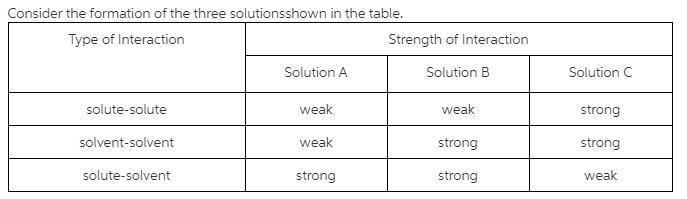
Rank the formation of the solutions A, B, and C from the most exothermic to the most endothermic. Rank the enthalpy of solution
Elodia [21]

This is an incomplete question, the table is attached below.

Answer : The correct ranking of the solution from most exothermic to most endothermic will be: A, B and C.

Explanation :

As we know that the intermolecular force of attraction play an important role in the interaction of solute-solute, solute-solvent and solvent solvent solution.

In the solution A, the solute-solute and solvent-solvent interactions are weak. So, their solute-solvent interaction will be strong. That means, the solution will be more exothermic.

In the solution C, the solute-solute and solvent-solvent interactions are strong. So, their solute-solvent interaction will be weak. That means, the solution will be more endothermic.

Thus, the correct ranking of the solution from most exothermic to most endothermic will be: A, B and C.

4 0
2 years ago
Other questions:
  • If a person burns 2171 Cal each day, how much energy (kJ) does she burn in 2 days??
    7·1 answer
  • Addition of 6 M HCl to which substance will NOT result
    10·2 answers
  • A pot of water is heated over a fire, and then frozen peas are added to the hot water. What happens to the energy in this situat
    9·2 answers
  • Question 2 The metal molybdenum becomes superconducting at temperatures below 0.90K. Calculate the temperature at which molybden
    10·1 answer
  • A chemist requires 5.00 liters of 0.420 M H2SO4 solution. How many grams of H2SO4 should the chemist dissolve in water? 129 gram
    8·1 answer
  • A student did not read the direction to the experiment properly and mixed up where to place the NaOH solution and the vinegar. H
    8·1 answer
  • In parallel flow heat exchangers...
    10·1 answer
  • A certain gas expands to fill a 3 L container. Its mass is measured to be 0.6 kg. What is its density?
    7·1 answer
  • What is the pressure of a 3.00 L gas vessel that has 18.0 grams of helium at 25°C? (R= 0.0821 L atm/ mol K)
    7·1 answer
  • The density of honey is 1.42 g/mL. If you poured honey into a glass of water, would it sink to the bottom or float on top? Expla
    11·1 answer
Add answer
Login
Not registered? Fast signup
Signup
Login Signup
Ask question!