answer.
Ask question
Login Signup
Ask question
All categories
  • English
  • Mathematics
  • Social Studies
  • Business
  • History
  • Health
  • Geography
  • Biology
  • Physics
  • Chemistry
  • Computers and Technology
  • Arts
  • World Languages
  • Spanish
  • French
  • German
  • Advanced Placement (AP)
  • SAT
  • Medicine
  • Law
  • Engineering
lozanna [386]
2 years ago
9

Find the enthalpy of neutralization of HCl and NaOH. 87 cm3 of 1.6 mol dm-3 hydrochloric acid was neutralized by 87 cm3 of 1.6 m

ol dm-3 NaOH. The temperature rose from 298 K to 317.4 K. The specific heat capacity is the same as water, 4.18 J/K g.
A. -101.37 kJ


B. -7.05 kJ


C. 7055 kJ


D. 10,1365 kJ
Chemistry
1 answer:
Vesna [10]2 years ago
3 0

Answer : The correct option is, (A) -101.37 KJ

Explanation :

First we have to calculate the moles of HCl and NaOH.

\text{Moles of HCl}=\text{Concentration of HCl}\times \text{Volume of solution}=1.6mole/L\times 0.087L=0.1392mole

\text{Moles of NaOH}=\text{Concentration of NaOH}\times \text{Volume of solution}=1.6mole/L\times 0.087L=0.1392mole

The balanced chemical reaction will be,

HCl+NaOH\rightarrow NaCl+H_2O

From the balanced reaction we conclude that,

As, 1 mole of HCl neutralizes by 1 mole of NaOH

So, 0.1392 mole of HCl neutralizes by 0.1392 mole of NaOH

Thus, the number of neutralized moles = 0.1392 mole

Now we have to calculate the mass of water.

As we know that the density of water is 1 g/ml. So, the mass of water will be:

The volume of water = 87ml+87ml=174ml

\text{Mass of water}=\text{Density of water}\times \text{Volume of water}=1g/ml\times 174ml=174g

Now we have to calculate the heat absorbed during the reaction.

q=m\times c\times (T_{final}-T_{initial})

where,

q = heat absorbed = ?

c = specific heat of water = 4.18J/g^oC

m = mass of water = 174 g

T_{final} = final temperature of water = 317.4 K

T_{initial} = initial temperature of metal = 298 K

Now put all the given values in the above formula, we get:

q=174g\times 4.18J/g^oC\times (317.4-298)K

q=14110.008J=14.11KJ

Thus, the heat released during the neutralization = -14.11 KJ

Now we have to calculate the enthalpy of neutralization.

\Delta H=\frac{q}{n}

where,

\Delta H = enthalpy of neutralization = ?

q = heat released = -14.11 KJ

n = number of moles used in neutralization = 0.1392 mole

\Delta H=\frac{-14.11KJ}{0.1392mole}=-101.37KJ/mole

Therefore, the enthalpy of neutralization is, -101.37 KJ

You might be interested in
Tamara is doing a scientific investigation to answer the question, "Do corn seeds germinate faster at warmer temperatures than t
sashaice [31]

Answer:

The tools/instruments, the type of seed, the soil or planting products, the amount of germination time/days, and where the seedling is placed.

Explanation:

If anything but the temperature is changed, it can result in false results. For instance, if Tamera uses red corn for one but yellow corn for the other, it can change the germination rate. So can the type of soil, water or the amount of time each plant has to grow. If she changes thermometers or any other tool she uses, it may give her a different result than the ones she used before. And finally, if she moves the warm plant from the windowsill to her bedroom, it can mess with the results she gets from the heated sample.

8 0
2 years ago
The electron dot structure for CI is
finlep [7]
The correct option is C.
A Lewis dot diagram is a representation of the valence electron of  an atom, which uses dot around the symbol of the atom. Chlorine has seven electrons in its outermost shell, these seven electrons are arranged in form of dot around the atom of chlorine. If you count the number of dot given in option C, you will notice that they are seven.
6 0
2 years ago
Read 2 more answers
How much maleic anhydride would you need to react 178 mg of anthracene? Assume 1:1 ratio from maleic anhydride to anthracene.
Licemer1 [7]

Answer:

(1) 0.10      (2) 17.8 g

Explanation:

Since the reaction ratio is 1:1 what we need is to convert the given masses to moles and you will have the answer:

MW anthracene = 178.23 g/mol

MW maleic anhydride = 98.06 g/mol

a) mass anthracene = 178 mg x 1 g/ 1000 mg = 0.178 g anthracene

Moles anthracene = 0.178 g anthracene/ 178.23 g/mol

= 0.001 mol anthracene

0.001 mol anthracene x 1 mol maleic acid/mol anthracene

= 0.001 mol maleic anhydride

mass maleic anhydride  = 0.001 mol x 98.06 g/mol =  0.10 g

b) moles maleic anhydride = 9.8 g/ 98.06 g/mol = 0.099 moles

0.099 moles maleic anhydride x 1 mol anthracene/mol  maleic anhydride =

0.099 mol anthracene

g anthracene = 0.10mol x 178 g/mol = 17.8 g

8 0
2 years ago
The four rows of data below show the boiling points for a solution with no solute, sucrose (C12H22O11), sodium chloride (NaCl),
skad [1K]
The following are the answers to the different questions: 
<span>The four rows of data below show the boiling points for a solution with no solute, sucrose (C12H22O11), sodium chloride (NaCl), and calcium chloride (CaCl2) (not in that order). Which boiling point corresponds to calcium chloride?

A. 101.53° C

Which of the following solutions will have the lowest freezing point?

D. 1.0 mol/kg magnesium fluoride (MgF2)


Which of the following compounds will be most effective in melting the ice on the roads when the air temperature is below zero?

A. sodium iodide (NaI)


Four different solutions have the following vapor pressures at 100°C. Which solution will have the greatest boiling point?

B. 96.3 kPa


Four different solutions have the following boiling points. Which boiling point corresponds to a solution with the lowest freezing point?

D. 108.1°C</span>
4 0
2 years ago
Read 2 more answers
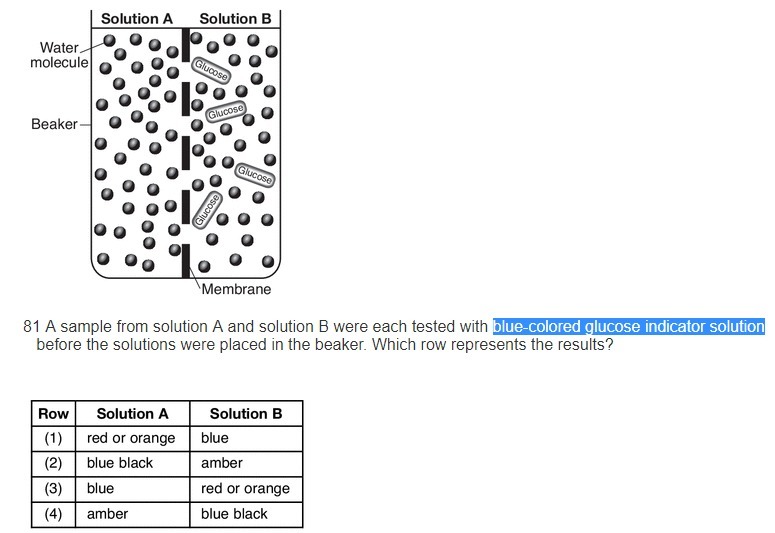
A sample from solution a and solution b were each tested with blue colored glucose indicator solution before the solutions were
vova2212 [387]
With the given problem you gave here, I can't answer the question because I need more details. Luckily, I found a similar problem that's provided with a diagram and a table shown in the attached picture.

This test is called the Benedict's test which is used as test for presence of sugars. If the solution contains sugar, like glucose, the solution would turn from blue to red. If not, it would stay blue. <em>Therefore, the correct results would be that in row 3.</em>

3 0
2 years ago
Other questions:
  • Acetone and sodium chloride both have similiar mass. Explain why their other properties differ.
    9·2 answers
  • Heptane (C7H16) and octane (C8H18) are constitutents of gasoline. At 80 degree celsius, the vapor pressure of heptane is 428mmHg
    5·2 answers
  • Which factors affect the flow of electric charge? Check all that apply.
    9·2 answers
  • Write a complete step-by-step plan for dealing with broken glassware on the floor or lab table. Write your plan in list form in
    14·2 answers
  • Magnesium has an atomic mass of 24.3. there are two isotopes of magnesium - one contains 12 neutrons and the other contains 13 n
    7·1 answer
  • A group of students is investigating how the addition of salt impacts the floatation of an egg in water. Four identical cups wer
    15·2 answers
  • Victoria has a crate of vegetables that weighs 100 newtons. She exerts a force of 100 newtons to lift the crate with a pulley. W
    9·2 answers
  • Mendeleev placed thallium (Tl) in the same group as lithium (Li), sodium (Na), potassium (K), rubidium (Rb), and cesium (Cs). Ho
    11·1 answer
  • A metal tank containing hydrogen gas has a pressure gauge that reads 575 psi. What is causing the pressure inside of the tank?
    13·1 answer
  • This unit discusses in detail the role of catalysts to lower the activation energy of reactions. The term catalyst appears in no
    12·1 answer
Add answer
Login
Not registered? Fast signup
Signup
Login Signup
Ask question!