answer.
Ask question
Login Signup
Ask question
All categories
  • English
  • Mathematics
  • Social Studies
  • Business
  • History
  • Health
  • Geography
  • Biology
  • Physics
  • Chemistry
  • Computers and Technology
  • Arts
  • World Languages
  • Spanish
  • French
  • German
  • Advanced Placement (AP)
  • SAT
  • Medicine
  • Law
  • Engineering
Liono4ka [1.6K]
2 years ago
11

Select the correct answer from each drop-down menu.

Chemistry
2 answers:
nataly862011 [7]2 years ago
8 0

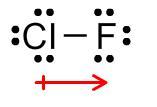
The arrow shows that the bond between the chlorine atom and the fluorine atom is nonpolar. The electrons in the bond are pulled more strongly by the fluorine atom, and the chlorine atom is slightly positive.
Explanation:

  • The bond between Chlorine and fluorine is nonpolar bonding because both of them are sharing an equal number of electrons in the bond. H2, F2, and CL2 are common examples of this.
  • Chlorine and fluorine are electronegative molecules but Fluorine is above chlorine in the periodic table. Since fluorine is above Chlorine, fluorine has slightly highest electronegative nature compare to fluorine. This is the reason why Fluorine molecules are attracting electrons more than chlorine atoms. This making chlorine atoms slightly positive in Cl and F bonding.

Olin [163]2 years ago
5 0

Answer:

The arrow shows that the bond between the chlorine atom and the fluorine atom is polar. The electrons in the bond are pulled more strongly by the fluorine atom, and the chlorine atom is slightly positive.

Explanation:

The covalent bond is the chemical bond between atoms where electrons are shared, forming a molecule. Covalent bonds are established between non-metallic elements, such as hydrogen H, oxygen O and chlorine Cl.

The covalent bond between two atoms can be polar or nonpolar. This depends on the type of atoms that make it up: if the atoms are equal, the bond will be nonpolar (since no atom attracts electrons more strongly). But, if the atoms are different, the bond will be polarized towards the most electronegative atom, because it will be the atom that attracts the electron pair with more force. Then it will be polar.

So in this case, being two non-metallic elements, it is a covalent bond, and, following the definition previously presented, it is a polar bond, indicated by the arrow shown in the image.

The arrow also indicates that the atoms shared between both elements are more strongly attracted by F, due to the fact that it has a higher electronegativity. And since the electrons are negatively charged, fluorine will have a slightly negative charge, while chlorine will have a slightly positive charge.

So, finally, the arrow shows that the bond between the chlorine atom and the fluorine atom is polar. The electrons in the bond are pulled more strongly by the fluorine atom, and the chlorine atom is slightly positive.
You might be interested in
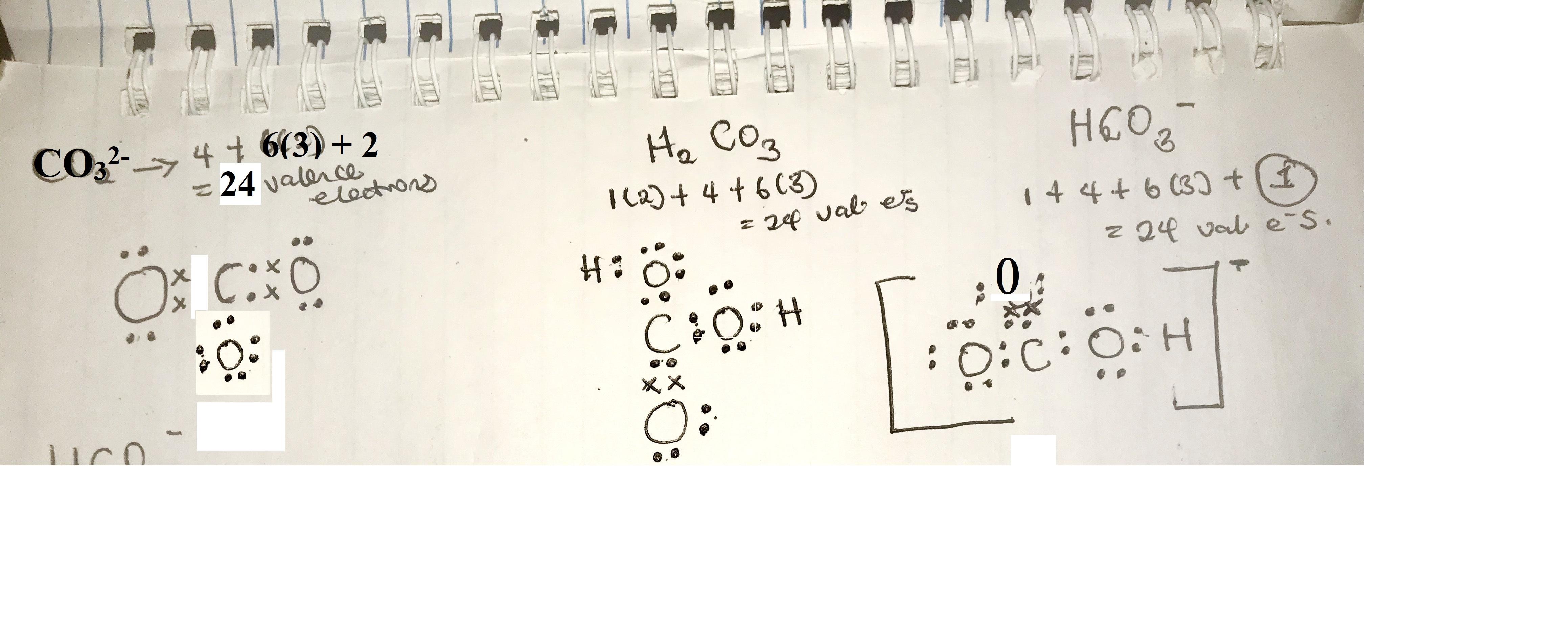
draw the lewis structure for CO2, H2CO3, HCO3-, and CO3 2-.Rank these in order of increasing attraction to water molecules. Expl
gavmur [86]

Answer:

The structures are attached in file.

Hydrogen bonding and intermolecular forces is the reason for ranks allotted.

Explanation:

In determining Lewis structure, we calculate the overall number of valence electrons available for bonding.  Making carbon (the least electronegative atom) the central atom in the structure, we allocate valence electrons until each atom has achieved stability.

In order of decreasing affinity to water molecules:

CO_{3}^{2-}  > HCO_{3} ^{2-} > H_{2} CO_{3}

This is due to the fact that the CO_{3}^{2-}will accept protons more readily than the bicarbonate ion, HCO_{3} ^{2-}. Carbonic acid, H_{2} CO_{3} will not accept any more protons, hence it is the least attractive to water molecule, even though soluble.

3 0
2 years ago
A biology student wants to conduct a study of how the amount of food affects weight gain for mice. He sets up four cages with a
drek231 [11]

The independent variable would be the variable in the research that is being manipulated by the researcher. In this case, it would be amount of food as it is what is being manipulated and changed in the research design. The dependent variable would be the variable that is being studied so, for this case, it would be the weight gain of the mice. The constants are the factors that might affect the dependent variable but is held constant or the same by the researcher throughout the experiment. These are the size of cage, amount of water, amount of sunlight, temperature and the exercise wheel.

5 0
2 years ago
A particular first-order reaction has a rate constant of 1.35 × 10² s-1 at 25.0°c. what is the magnitude of k at 75.0°c if ea =
IgorC [24]
According to this formula:
K= A*(e^(-Ea/RT) when we have K =1.35X10^2 & T= 25+273= 298K &R=0.0821
Ea= 85.6 KJ/mol So by subsitution we can get A:
1.35x10^2 = A*(e^(-85.6/0.0821*298))
1.35x10^2 = A * 0.03
A= 4333
by substitution with the new value of T(75+273) = 348K & A to get the new K
∴K= 4333*(e^(-85.6/0.0821*348)
  = 2.16 x10^2
8 0
2 years ago
Element X is a radioactive isotope such that every 82 years, its mass decreases by half. Given that the initial mass of a sample
lesantik [10]

Answer: 17 years

Explanation:

Expression for rate law for first order kinetics  for radioactive substance is given by:

t=\frac{2.303}{k}\log\frac{a}{a-x}

where,

k = rate constant

t = age of sample

a = let initial amount of the reactant

a - x = amount left after decay process  

a) for completion of half life:

Half life is the amount of time taken by a radioactive material to decay to half of its original value.

t_{\frac{1}{2}}=\frac{0.693}{k}

k=\frac{0.693}{82years}=8.4\times 10^{-3}years^{-1}

b) for 8900 g of the mass of the sample to reach  7700 grams

t=\frac{2.303}{8.4\times 10^{-3}}\log\frac{8900}{7700}

t=17years

Thus it will take 17 years

4 0
2 years ago
Jesse travels 3.0 meters east and then turns and travels 4.0 meters north. The trip requires 35 seconds. What is his velocity? 0
melisa1 [442]
Displacement = √(3² + 4²)
Displacement = 5 meters north east

Velocity = displacement / time
Velocity = 5 / 35
Velocity = 0.14 m/s northeast
6 0
2 years ago
Read 2 more answers
Other questions:
  • Which compound most likely contains polar covalent bonds?. The choices are the following: NaCl. AlF3. Br2. NF3
    13·2 answers
  • A flexible container is put in a deep freeze. Its original volume is 3.00 m3 at 25.0°C. After the container cools, it has shrunk
    12·1 answer
  • If your lungs were filled with air containing this level of lead, how many lead atoms would be in your lungs? (Assume a total lu
    5·2 answers
  • Small quantities of h2 gas can be collected by adding hcl to zn. a sample of 195 ml of h2 gas was collected over water at 25 c a
    5·2 answers
  • In the example above, imagine that the sunlight, solar cell, and fan form a closed system and no heat is generated. In this situ
    15·2 answers
  • An ordered list of chemical substances is shown.
    5·1 answer
  • Consider the following reaction: A(g)⇌2B(g). Find the equilibrium partial pressures of A and B for each of the following differe
    11·1 answer
  • Pb(OH)2 + _HCI → __ H2O + _<br>PbCl2​
    6·1 answer
  • Which of the following statements, if true, would support the claim that the NO3− ion, represented above, has three resonance st
    10·1 answer
  • 400 mL of hydrogen are collected over water at 18 C and a total pressure of 740 mm of mercury. (Vapor pressure of H2O at 18 C=15
    8·1 answer
Add answer
Login
Not registered? Fast signup
Signup
Login Signup
Ask question!