answer.
Ask question
Login Signup
Ask question
All categories
  • English
  • Mathematics
  • Social Studies
  • Business
  • History
  • Health
  • Geography
  • Biology
  • Physics
  • Chemistry
  • Computers and Technology
  • Arts
  • World Languages
  • Spanish
  • French
  • German
  • Advanced Placement (AP)
  • SAT
  • Medicine
  • Law
  • Engineering
jolli1 [7]
2 years ago
13

Which compound most likely contains polar covalent bonds?. The choices are the following: NaCl. AlF3. Br2. NF3

Chemistry
2 answers:
Serhud [2]2 years ago
8 0

The correct answer for above statement is:

d NF3

(+)NaCl(-) = 0 is linear and the charges cancel so its no polar 

(+3)AlF3(-3) = 0 the charges cancel so its non polar

Br2 is a diatomic element and elements don't have charges so its non polar 

NF3 the N has a lone pair of electrons (:) and so it will repel the fluorine's as fluorine is the most electronegative element there is an unbalance in the charges so NF3 is polar .

Explanation:

In a polar covalent attachment, the particles shared by the atoms absorb a larger amount of time, on the center, closer to the Oxygen nucleus than the Hydrogen nucleus. This is because of the geometry of the molecule and the numerous electronegativity difference between the Hydrogen atom and the Oxygen atom.

DerKrebs [107]2 years ago
6 0
Id guess its NF3 as...

(+)NaCl(-) = 0 is linear and the charges cancel so its no polar 

(+3)AlF3(-3) = 0 the charges cancel so its non polar

Br2 is a diatomic element and elements don't have charges so its non polar 

NF3 the N has a lone pair of electrons (:) and so it will repel the fluorine's as fluorine is the most electronegative element there is an unbalance in the charges so NF3 is polar 

hope that helps
You might be interested in
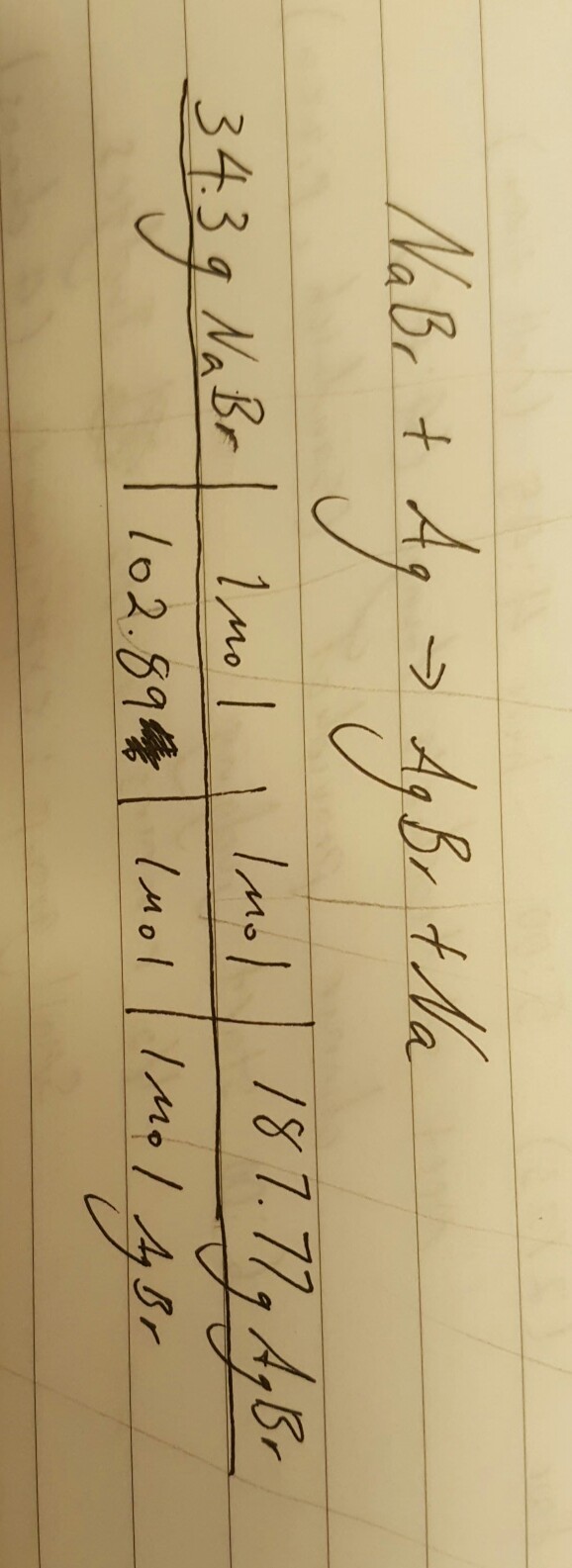
What mass of AgBr can be produced starting with 34.3G of NaBr? (Stoichiometry method)
olga nikolaevna [1]
The equation is already balanced so the mole ratio is just 1/1 and from the question you could conclude that the equation is a single displacement

5 0
2 years ago
A medical lab is testing a new anticancer drug on cancer cells. The drug stock solution concentration is 1.5×10⁻⁹m, and 1.00 ml
Elis [28]

The concentration of the drug stock solution is 1.5*10^-9 M i.e. 1.5 * 10^-9 moles of the drug per Liter of the solution

Therefore, the number of moles present in 1 ml i.e. 1*10^-3 L of the solution would be =  1 *10^-3 L * 1.5 * 10^-9 moles/1 L = 1.5 * 10^-12 moles

1 mole of the drug will contain 6.023*10^23 drug molecules

Therefore, 1.5*10^-12 moles of the drug will correspond to :

    1.5 * 10^-12 moles * 6.023*10^23 molecules/1 mole = 9.035 * 10^11 molecules

The number of cancer cells = 2.0 * 10^5

Hence the ratio = drug molecules/cancer cells

                          = 9.035 *10^11/2.0 *10^5

                          = 4.5 * 10^6

8 0
2 years ago
Read 2 more answers
When 5800 joules of energy are applied to a 15.2-kg piece of lead metal, how much does the temperature change by
Firdavs [7]

<span>Heat gained or absorbed in a system can be calculated by multiplying the given mass to the specific heat capacity of the substance and the temperature difference. The heat capacity of aluminum at 25 degrees celsius is 0.9 J/g-C. It is expressed as follows:</span><span>

Heat = mC(T2-T1)
5800 J = 152000(0.90)(</span>ΔT)

ΔT = 0.42 °C change in temperature

8 0
2 years ago
Read 2 more answers
The Thompson analogy titled "The Carpet-Seed Children Analogy" attempts to deal with the issue of failed ____________________(A)
vazorg [7]

Answer: (D) contraception

Explanation:

8 0
2 years ago
Room temperature is about 20 degrees Celsius. Explain how you could convert this temperature to kelvin. Use evidence from the fi
Taya2010 [7]

Answer:

293.15 K.

Explanation:

It is given that, the room temperature is 20 degrees Celsius.

We need to convert this temperature into kelvin.

The conversion from degrees Celsius to Kelvin is as follows :

T_k=T_c+273.15

We have, T_c=20^{\circ} C

So,

T_k=20+273.15\\\\T_k=293.15\ K

So, the room temperature is 293.15 kelvin.

8 0
2 years ago
Other questions:
  • The population of rabbits in a forest is decreasing. Foxes in that region are now competing with each other for the limited numb
    12·2 answers
  • Write a balanced half-reaction describing the oxidation of gaseous dihydrogen to aqueous hydrogen cations.
    12·2 answers
  • What crossed-aldol product results when butanal is heated in the presence of excess benzaldehyde and sodium hydroxide? draw the
    10·1 answer
  • Addition of 6 M HCl to which substance will NOT result
    10·2 answers
  • Calculate the internal energy and enthalpy changes resulting if air changes from an initial |state of 5°C and 10bar, where its m
    11·1 answer
  • A student wants to measure the heat of neutralization reaction. To do this they mixed in a coffer cup calorimeter 58.0 mL of 0.5
    7·1 answer
  • How much energy is transferred when 30.0<br> g of water is cooled from 25.0 °C to 12.7 °C.
    10·1 answer
  • A compound containing Na, C, and O is found to have 1.06 mol Na, 0.528 mol C, and 1.59 mol O. What is the empirical formula of t
    8·1 answer
  • This unit discusses in detail the role of catalysts to lower the activation energy of reactions. The term catalyst appears in no
    12·1 answer
  • A chunk of a metal alloy displaces 0.58 L of water and has a mass of 2.9 kg. What is the density of the alloy in g/cm3?
    8·1 answer
Add answer
Login
Not registered? Fast signup
Signup
Login Signup
Ask question!