answer.
Ask question
Login Signup
Ask question
All categories
  • English
  • Mathematics
  • Social Studies
  • Business
  • History
  • Health
  • Geography
  • Biology
  • Physics
  • Chemistry
  • Computers and Technology
  • Arts
  • World Languages
  • Spanish
  • French
  • German
  • Advanced Placement (AP)
  • SAT
  • Medicine
  • Law
  • Engineering
Anika [276]
2 years ago
9

A medical lab is testing a new anticancer drug on cancer cells. The drug stock solution concentration is 1.5×10⁻⁹m, and 1.00 ml

of this solution will be delivered to a dish containing 2.0×10⁵ cancer cells in 5.00 ml of aqueous fluid. What is the ratio of drug molecules to the number of cancer cells in the dish?
Chemistry
2 answers:
Elis [28]2 years ago
8 0

The concentration of the drug stock solution is 1.5*10^-9 M i.e. 1.5 * 10^-9 moles of the drug per Liter of the solution

Therefore, the number of moles present in 1 ml i.e. 1*10^-3 L of the solution would be =  1 *10^-3 L * 1.5 * 10^-9 moles/1 L = 1.5 * 10^-12 moles

1 mole of the drug will contain 6.023*10^23 drug molecules

Therefore, 1.5*10^-12 moles of the drug will correspond to :

    1.5 * 10^-12 moles * 6.023*10^23 molecules/1 mole = 9.035 * 10^11 molecules

The number of cancer cells = 2.0 * 10^5

Hence the ratio = drug molecules/cancer cells

                          = 9.035 *10^11/2.0 *10^5

                          = 4.5 * 10^6

galben [10]2 years ago
7 0

The ratio of drug molecules to the number of cancer cells in the dish is \boxed{4.5 \times {{10}^6}}.

Further Explanation:

Concentration of various solutions can be expressed by various concentration terms. Some of such concentration terms are listed below.

  • Molarity
  • Mole fraction
  • Molality
  • Parts per million
  • Mass percent
  • Volume percent
  • Parts per billion

Molarity is defined as moles of solute present in one litre of solution. It is represented by M and its unit is mol/L. The expression for molarity of solution is as follows:

{\text{Molarity of solution}} = \dfrac{{{\text{Moles }}\left( {{\text{mol}}} \right){\text{of solute}}}}{{{\text{Volume }}\left( {\text{L}} \right){\text{ of solution}}}}                 …… (1)

Rearrange equation (1) to calculate moles of solute.

{\text{Moles of solute}} = \left( {{\text{Molarity of solution}}} \right)\left( {{\text{Volume of solution}}} \right)                         …… (2)

Substitute 1.5 \times {10^{ - 9}}{\text{ M}} for molarity of solution and 1.00 mL for volume of solution in equation (2) to calculate moles of drug.

\begin{aligned}{\text{Moles of drug}} &= \left( {1.5 \times {{10}^{ - 9}}{\text{ M}}} \right)\left( {1.00{\text{ mL}}} \right)\left( {\frac{{{{10}^{ - 3}}{\text{ L}}}}{{1{\text{ mL}}}}} \right) \\ &= 1.5 \times {10^{ - 12}}{\text{ mol}} \\\end{aligned}  

According to Avogadro’s law, one mole of every substance has 6.022 \times {10^{23}}{\text{ units}}. These units can vary from question to question and can be atoms, molecules, or formula units. Since one mole of drug also contains   6.022 \times {10^{23}}{\text{ molecules}}, number of molecules of drug present in 1.5 \times {10^{ - 12}}{\text{ mol}} can be calculated as follows:

\begin{aligned}{\text{Molecules of drug}} &= \left( {1.5 \times {{10}^{ - 12}}{\text{ mol}}} \right)\left( {\frac{{6.022 \times {{10}^{23}}{\text{ molecules}}}}{{1{\text{ mol}}}}} \right) \\ &= 9.033 \times {10^{11}}{\text{ molecules}} \\ \end{aligned}  

The ratio of drug molecules to the number of cancer cells in the dish can be evaluated as follows:

\begin{aligned}{\text{Required ratio}} &= \frac{{9.033 \times {{10}^{11}}}}{{2.0 \times {{10}^5}}} \\ &= 4.5 \times {10^6} \\ \end{aligned}  

Learn more:

  1. Calculation of volume of gas: brainly.com/question/3636135
  2. Determine how many moles of water produce: brainly.com/question/1405182

Answer details:

Grade: Senior School

Subject: Chemistry

Chapter: Concentration

Keywords: concentration, concentration terms, solutions, molarity, Avogadro’s law, drug molecules, cancer cells, 4.5*10^6, one mole, atoms, molecules.

You might be interested in
What do a banana and a human have in common?
Dmitry [639]

Answer:

DNA between a human and a banana is 41 percent similar.

Explanation:

3 0
2 years ago
Read 2 more answers
What is the ph of a solution made by combining 157 ml of 0.35 m nac2h3o2 with 139 ml of 0.46 m hc2h3o2? the ka of acetic acid is
ExtremeBDS [4]
The first step is to calculate the molarity of each compound:
final volume of solution = 157 + 139 = 296 mL
molarity of <span>nac2h3o2 = (157 x 0.35) / 296 = 0.1856 molar
molarity of </span><span>hc2h3o2 = (139 x 0.46) / 296 = 0.216 molar

Then, we calculate the pH as follows:
pKa of acetic acid = -log(</span><span>1.75 × 10^-5) = 4.7569
pH = pKa + </span><span> log ([salt] / [acid]) 
     = </span>4.7569 + log(0.1856 / 0.216)
     = 4.691
6 0
2 years ago
11. A sample contains 25% water and weighs 201 grams. Determine the grams of water in the
77julia77 [94]

Answer:

m_{water}=50.25g

Explanation:

Hello,

In this case, considering that the by-mass percent of water is:

\% m/m=\frac{m_{water}}{m_{sample}}*100\%

Given such percent and the mass of the sample, we can find the mass of water in grams in the sample by solving for it as shown below:

m_{water}=\frac{\%m/m*m_{sample}}{100\%}\\ \\m_{water}=\frac{25\%*201g}{100\%}\\ \\m_{water}=50.25g

Best regards.

5 0
2 years ago
Titanium has five common isotopes: 46Ti (8.0%), 47Ti (7.8%), 48Ti (73.4%), 49Ti (5.5%), 50 Ti (5.3%). What is the average atomic
zhannawk [14.2K]
(46x8.0)+(47x7.8)+(48x73.4)+(49x5.5)+(50x5.3) = 4792.3

4792.3/100 = 47.923 this is the average atomic mass of Titanium
6 0
2 years ago
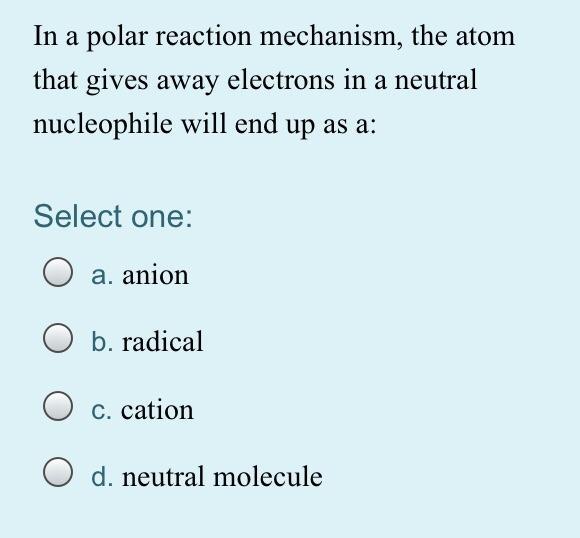
In a polar reaction mechanism, the atom that gives away electrons in a neutral nucleophile will end up as a(n):
Ray Of Light [21]

The question is incomplete, the complete question is shown in the image attached.

Answer:

Cation

Explanation:

In a polar reaction mechanism, a specie must give out electrons and another specie must accept those electrons.

The specie that gives out electrons becomes electron deficient and positively charged so we refer to such a specie as a cation.

Hence, the specie that looses electrons becomes a cation.

5 0
2 years ago
Other questions:
  • How many moles of libr are contained in 347 g of water in a 0.175 m libr solution?
    7·1 answer
  • compare and contrast melting 10 kg of ice freezing 1 kg of water. be sure to address temperature,heat flow, and thermal energy
    15·1 answer
  • How many moles of cacl2 are in 250 ml of a 3.0 m of cacl2 solution?
    12·2 answers
  • Match the element or group to the rule assigning its oxidation state.
    10·2 answers
  • How much heat is required to raise the temperature of 670g of water from 25.7"C to 66,0°C? The specific heat
    13·1 answer
  • If it takes 38.70cm³ of 1.90 M NaOH to neutralize 10.30cm³ of H2SO4 in a battery, What's the Molarity of the H2SO4 ?​
    15·2 answers
  • What sample size (grams) of Na3PO4 (FW 164.00) known to be 50.00% pure should be used to consume exactly 40.00 mL of 0.1000 M HC
    6·1 answer
  • 3. You measure a cube and determine that its sides are 0.65m. You place the cube on a mass scale and determine that this cube ha
    5·1 answer
  • A phosphorus atom with 4 bonds has a charge of ___.
    6·1 answer
  • An unopened, cold 2.00 L bottle of soda contains 46.0 mL of gas confined at a pressure of 1.30 atm at a temperature of 5.0oC. If
    10·1 answer
Add answer
Login
Not registered? Fast signup
Signup
Login Signup
Ask question!