answer.
Ask question
Login Signup
Ask question
All categories
  • English
  • Mathematics
  • Social Studies
  • Business
  • History
  • Health
  • Geography
  • Biology
  • Physics
  • Chemistry
  • Computers and Technology
  • Arts
  • World Languages
  • Spanish
  • French
  • German
  • Advanced Placement (AP)
  • SAT
  • Medicine
  • Law
  • Engineering
Burka [1]
2 years ago
12

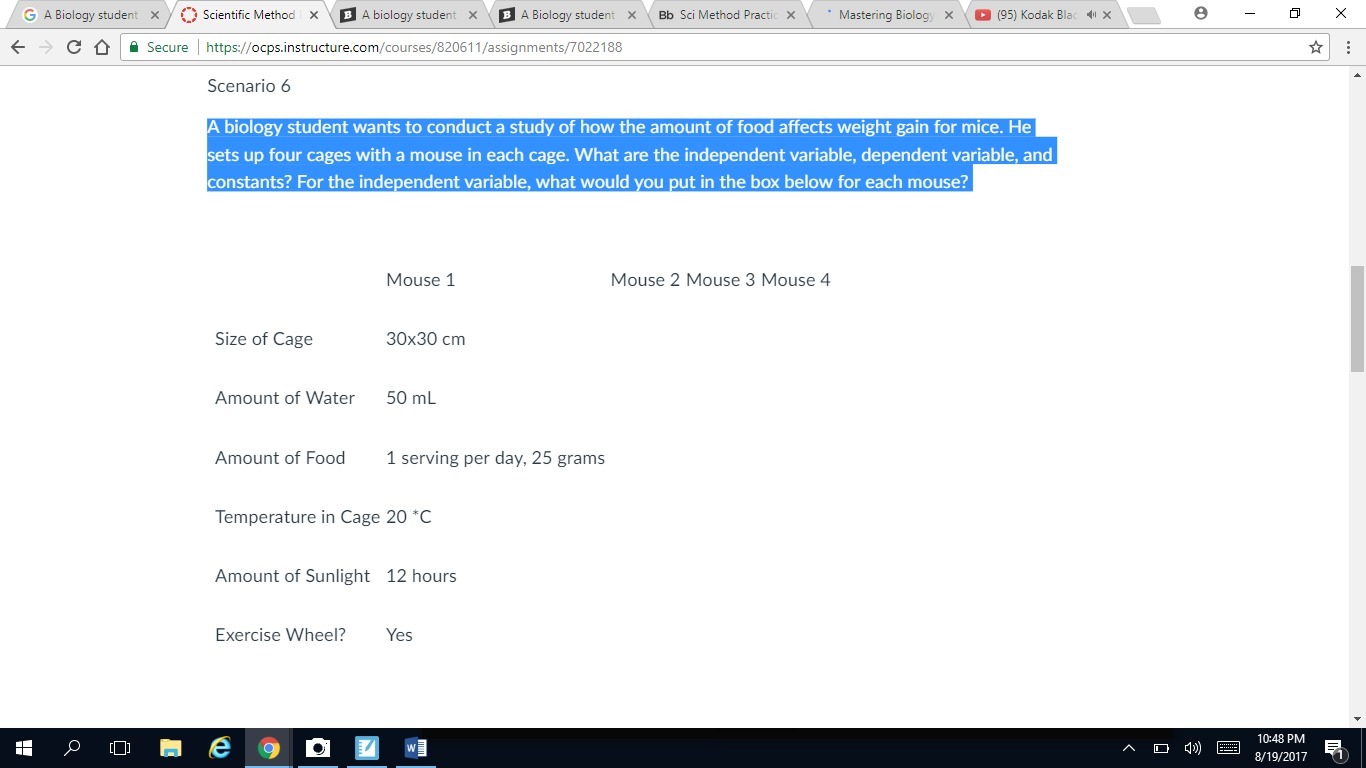
A biology student wants to conduct a study of how the amount of food affects weight gain for mice. He sets up four cages with a

mouse in each cage. What are the independent variable, dependent variable, and constants? For the independent variable, what would you put in the box below for each mouse?

Chemistry
1 answer:
drek231 [11]2 years ago
5 0

The independent variable would be the variable in the research that is being manipulated by the researcher. In this case, it would be amount of food as it is what is being manipulated and changed in the research design. The dependent variable would be the variable that is being studied so, for this case, it would be the weight gain of the mice. The constants are the factors that might affect the dependent variable but is held constant or the same by the researcher throughout the experiment. These are the size of cage, amount of water, amount of sunlight, temperature and the exercise wheel.

You might be interested in
50 kg of N2 gas and 10kg of H2 gas are mixed to produce NH3 gas calculate the NH3gas formed. Identify the limiting reagent in th
statuscvo [17]

Answer:

1. H2 is the limiting reactant.

2. 56666.67g ( i.e 56.67kg) of NH3 is produced.

Explanation:

Step 1:

The equation for the reaction. This is given below:

N2 + H2 —> NH3

Step 2:

Balancing the equation.

N2 + H2 —> NH3

The above equation can be balanced as follow :

There are 2 atoms of N on the left side and 1 atom on the right side. It can be balance by putting 2 in front of NH3 as shown below:

N2 + H2 —> 2NH3

There are 6 atoms of H on the right side and 2 atoms on the left side. It can be balance by putting 3 in front of H2 as shown below

N2 + 3H2 —> 2NH3

Now the equation is balanced.

Step 3:

Determination of the masses of N2 and H2 that reacted and the mass of NH3 produced from the balanced equation. This is illustrated below:

N2 + 3H2 —> 2NH3

Molar Mass of N2 = 2x14 = 28g/mol

Molar Mass of H2 = 2x1 = 2g/mol

Mass of H2 from the balanced equation = 3 x 2 = 6g

Molar Mass of NH3 = 14 + (3x1) = 14 + 3 = 17g/mol

Mass of NH3 from the balanced equation = 2 x 17 = 34g

From the balanced equation above,

28g of N2 reacted with 6g of H2 to produce 34g of NH3

Step 4:

Determination of the limiting reactant. This is illustrated below:

N2 + 3H2 —> 2NH3

Let us consider using all the 10kg (i.e 10000g) of H2 to see if there will be any left of for N2.

From the balanced equation above,

28g of N2 reacted with 6g of H2.

Therefore, Xg of N2 will react with 10000g of H2 i.e

Xg of N2 = (28 x 10000)/6

Xg of N2 = 46666.67g

We can see from the calculations above that there are leftover for N2 as only 46666.67g reacted out of 50kg ( i.e 50000g) that was given. Therefore, H2 is the limiting reactant.

Step 5:

Determination of the mass of NH3 produced during the reaction. This is illustrated below:

N2 + 3H2 —> 2NH3

From the balanced equation above,

6g of H2 reacted to produce 34g of NH3.

Therefore, 10000g of H2 will react to produce = ( 10000 x 34)/6 = 6g of 56666.67g of NH3.

Therefore, 56666.67g ( i.e 56.67kg) of NH3 is produced.
3 0
2 years ago
Read 2 more answers
Which one is balanced or unbalanced force 1. Change object motion 2. Push or pull 3. Have direction 4. Do not change objects mot
Margaret [11]

Answer:

Explanation:

1. Change object motion - unbalanced force

2. Push or pull - Balanced forces do not cause a change in motion. When balanced forces act on an object at rest, the object will not move. If you push against a wall, the wall pushes back with an equal but opposite force. Neither you nor the wall will move. Forces that cause a change in the motion of an object are unbalanced forces. So if object move it is unbalanced.

3. Have direction - unbalanced force

4. Do not change objects motion - balanced force

5. Net force does not =0 - unbalanced force

6.net force =0 - balanced force

3 0
2 years ago
How many moles NaOH are contained in 65.0 mL of a 2.20 M solution of NaOH in H2O?
saw5 [17]
The   number  of  moles  of  NaOh that  are    contained  in  65ml  of   2.20M  solution  NaOh  in H2o  is  calculated  using  the  below  formula


moles  =  molarity  x  volume  /1000

that  is     65 x2.20  /1000=  0.143  moles

0 0
2 years ago
Read 2 more answers
Convert 4.77x10^24 molecules of SO2 to grams
tensa zangetsu [6.8K]
Those are the correct steps, young chemist. Don't be discouraged by an insane answer. 
5 0
2 years ago
While looking at xenon (Xe) on the periodic table, a student needs to find an element with a smaller atomic mass in the same gro
zvonat [6]

Answer is: directly up.

Neon (Ne) is noble gas with atomic number 10 and atomic mass around 20.

1) directly up is noble gas helium (He) with atomic mass around 4.

2) directly down is noble gas argon (Ar) with atomic mass around 40.

3) directly to the left is florine (F), with smaller atomic mass, but also from different group.

4) directly to the right there no elements, because noble gases are far right in 18. group of Periodic table.

3 0
2 years ago
Read 2 more answers
Other questions:
  • What changes if the degree (amount) of intermolecular bonds of a substance are changed?
    7·2 answers
  • Rank the size of a change in temperature of one degree Fahrenheit, one degree Celsius, and one kelvin. In other words, if a ther
    6·1 answer
  • In a scientific experiment, the factor that may change in response to the manipulated variable is called the ______ variable.
    9·1 answer
  • Which species has the smaller bond angle, h3o+ or h2o?
    15·1 answer
  • From the options provided for each element below, choose the properties that it may have based on its location in the periodic t
    10·2 answers
  • 41Ca decays by electron capture. The product of this reaction undergoes alpha decay. What is the product of this second decay re
    11·1 answer
  • The following questions refer to the gas-phase decomposition of ethylene chloride. C2H5Cl ® products Experiment shows that the d
    12·1 answer
  • Please help me double-check my answer: Calculate the molarity of an aqueous solution that contains 36.5g KMnO4 and has a total v
    5·2 answers
  • How can a piece of wood floating on water illustrate the condition of lowest potential energy and maximum
    10·1 answer
  • A student buys a rope at the store. The label on the packaging says that the rope is 2.15 meters in length. The student measures
    14·1 answer
Add answer
Login
Not registered? Fast signup
Signup
Login Signup
Ask question!
