answer.
Ask question
Login Signup
Ask question
All categories
  • English
  • Mathematics
  • Social Studies
  • Business
  • History
  • Health
  • Geography
  • Biology
  • Physics
  • Chemistry
  • Computers and Technology
  • Arts
  • World Languages
  • Spanish
  • French
  • German
  • Advanced Placement (AP)
  • SAT
  • Medicine
  • Law
  • Engineering
ikadub [295]
2 years ago
14

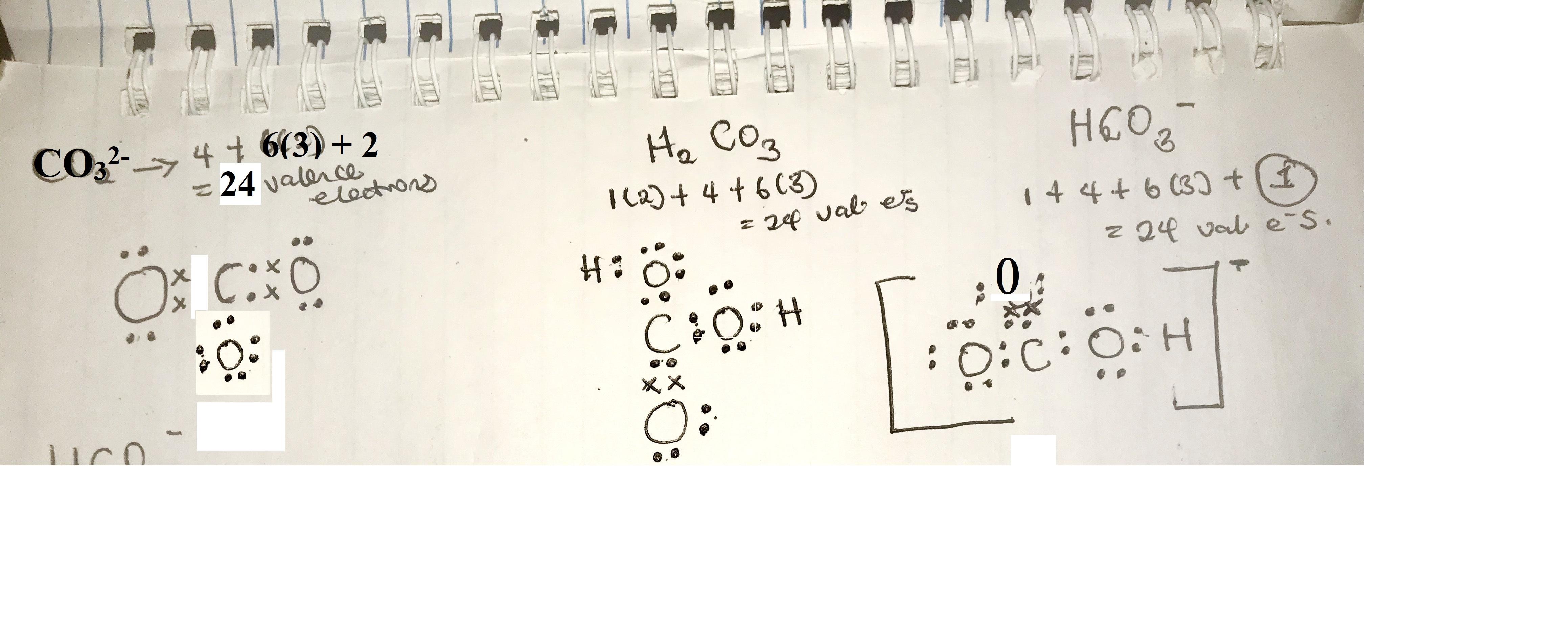
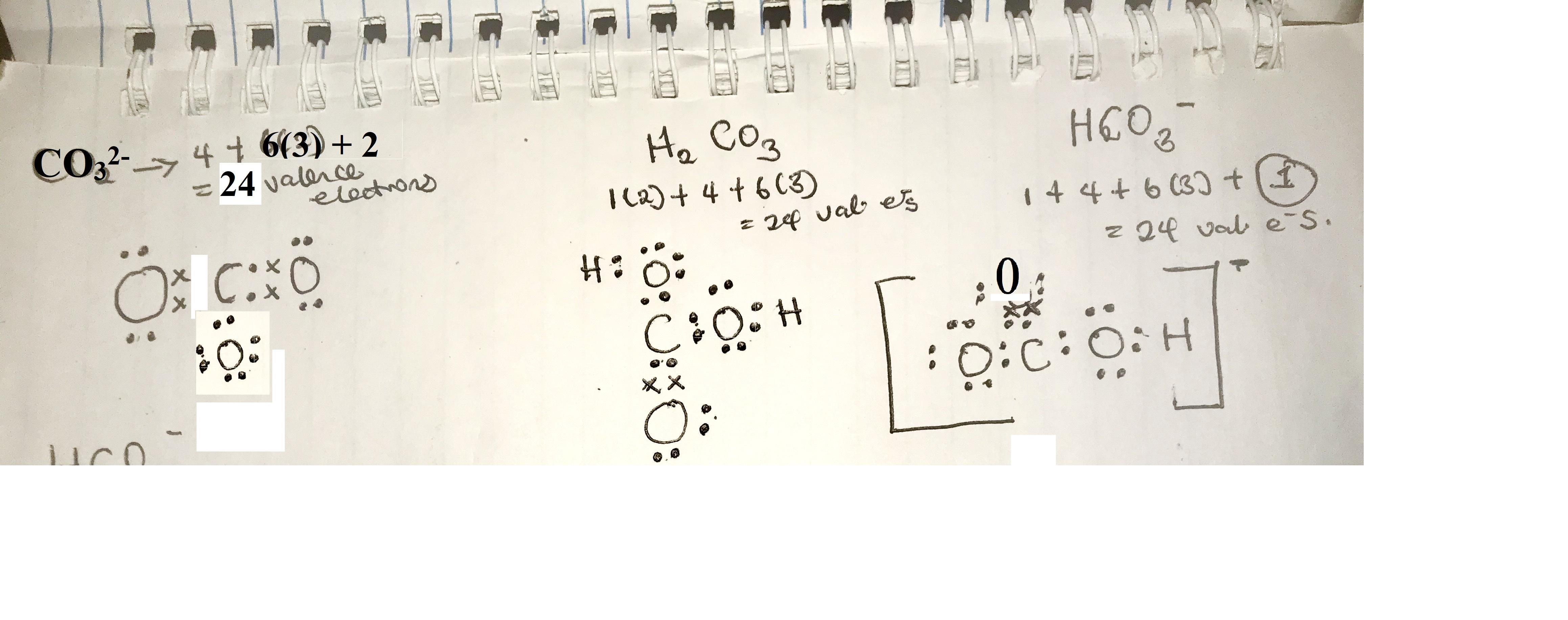
draw the lewis structure for CO2, H2CO3, HCO3-, and CO3 2-.Rank these in order of increasing attraction to water molecules. Expl

ain your choice. What evidence do you have that supports your predictions

Chemistry
1 answer:
gavmur [86]2 years ago
3 0

Answer:

The structures are attached in file.

Hydrogen bonding and intermolecular forces is the reason for ranks allotted.

Explanation:

In determining Lewis structure, we calculate the overall number of valence electrons available for bonding.  Making carbon (the least electronegative atom) the central atom in the structure, we allocate valence electrons until each atom has achieved stability.

In order of decreasing affinity to water molecules:

CO_{3}^{2-}  > HCO_{3} ^{2-} > H_{2} CO_{3}

This is due to the fact that the CO_{3}^{2-}will accept protons more readily than the bicarbonate ion, HCO_{3} ^{2-}. Carbonic acid, H_{2} CO_{3} will not accept any more protons, hence it is the least attractive to water molecule, even though soluble.

You might be interested in
at what temperature (inc) would the volume a gas be equal to 45.7L if the volume of gas was 33.9L at 12.4c
vesna_86 [32]

Answer:

The answer to your question is  T1 = 384.7 °K

Explanation:

Data

Volume 1 = V1 = 45.7 l

Temperature 1 = T1 = ?

Volume 2 = V2 = 33.9 l

Temperature 2 = T2 = 12.4°C

To solve this problem use Charles' law

              V1/T1 = V2/T2

                    T1 = V1T2/V2

-Convert temperature to °K

T2 = 12.4 + 273 = 285.4°K

-Substitution

                    T1 = (45.7 x 285.4) / 33.9

-Simplification

                    T1 = 13042.8 / 33.9

-Result

                    T1 = 384.7 °K

7 0
2 years ago
For which applications would you choose a liquid over a gas or solid?
DedPeter [7]

Answer:

Washing Clothes & Dissolving Sugar

Explanation:

Think about each application:

1) Washing clothes: You kind of need water to do this, or not much washing can be done.

2) Linking brake pedals to the brake pads: You don't need any liquids for this. You need solids.

3) Deodorizing a room: You would problem choose an aerosol, which is sprayed, thus a gas.

4) Carving a sculpture: You would use solid tool and a sold sculpture.

5) Dissolving sugar: You need a liquid to dissolve sugar!

6) Painting a wall: Perhaps, you COULD say that the paint is a liquid... but I'm not sure if that really counts. I believe this application would still be solids.

7) A gear for a machine is a solid!

5 0
2 years ago
Read 2 more answers
What must the melting point of the mold be compared to the temperature at which class get soft and why
stiv31 [10]

The answer is that the mold melting point must be higher then molten glass, otherwise the mold would melt when molten glass is poured into it .


I hope this helps :)

7 0
2 years ago
Complexes containing metals with d10 electron configurations are typically colorless because:
Lana71 [14]

Answer:

d

Explanation:

4 0
2 years ago
A balloon inflated with three breaths of air has a volume of 1.7 L. At the same temperature and pressure, what is the volume of
Karolina [17]

Ans: The final volume of the balloon is 4.5 L

<u>Given:</u>

Volume of balloon inflated with 3 breaths = 1.7 L

<u>To determine:</u>

Volume of balloon after a total of 3+5 = 8 breaths

<u>Explanation:</u>

Volume of the balloon per breath = 1.7 L * 1 breath/3 breaths = 0.567 L

Final volume of balloon after 8 breaths = 0.567 L * 8 breath/1 breath

= 4.536 L
7 0
2 years ago
Other questions:
  • Solids retain their shape and size, if kept constant temperature and pressure. At a constant temperature and pressure, liquids r
    7·2 answers
  • Using the solubility curve, what is the effect of increased temperature on the solubility of KBr in 100 grams of water? The solu
    12·2 answers
  • Given that 25.0 mL of mercury has a mass of 340.0 g, calculate (a) the density of mercury and (b) the mass of 120.0 mL of mercur
    6·1 answer
  • The dry adiabatic rate, characterized by rising unsaturated air, can be expressed as a temperature change of _____ Celsius for e
    10·1 answer
  • Draw the structures of two different compounds that have the composition CH3NO2. All three H atoms must remain bonded to the C a
    6·1 answer
  • Exactly 17.0 mL of a H2SO4 solution was required to neutralize 45.0 mL of 0.235 M NaOH. What was the concentration of the H2SO4
    6·1 answer
  • Answer the following questions regarding bond lengths and bond strengths. Choose all that apply. Choose all that apply. Single b
    11·1 answer
  • A blacksmith making a tool heats 525 grams of steel to 1230°C. After hammering the steel, she places it into a bucket of water t
    5·1 answer
  • From the graph of Density vs. Concentration, created in Graph 1, what was the relationship between the concentration of the suga
    9·1 answer
  • What amount of SeC16 is needed to produce 4.45 mol of chlorine gas in the
    14·1 answer
Add answer
Login
Not registered? Fast signup
Signup
Login Signup
Ask question!