answer.
Ask question
Login Signup
Ask question
All categories
  • English
  • Mathematics
  • Social Studies
  • Business
  • History
  • Health
  • Geography
  • Biology
  • Physics
  • Chemistry
  • Computers and Technology
  • Arts
  • World Languages
  • Spanish
  • French
  • German
  • Advanced Placement (AP)
  • SAT
  • Medicine
  • Law
  • Engineering
ycow [4]
2 years ago
15

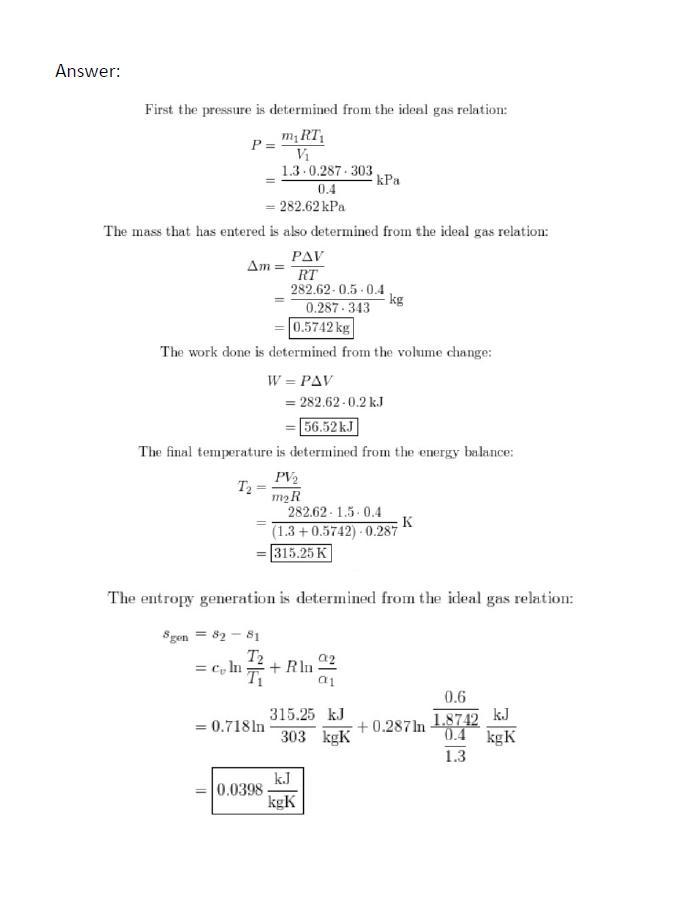
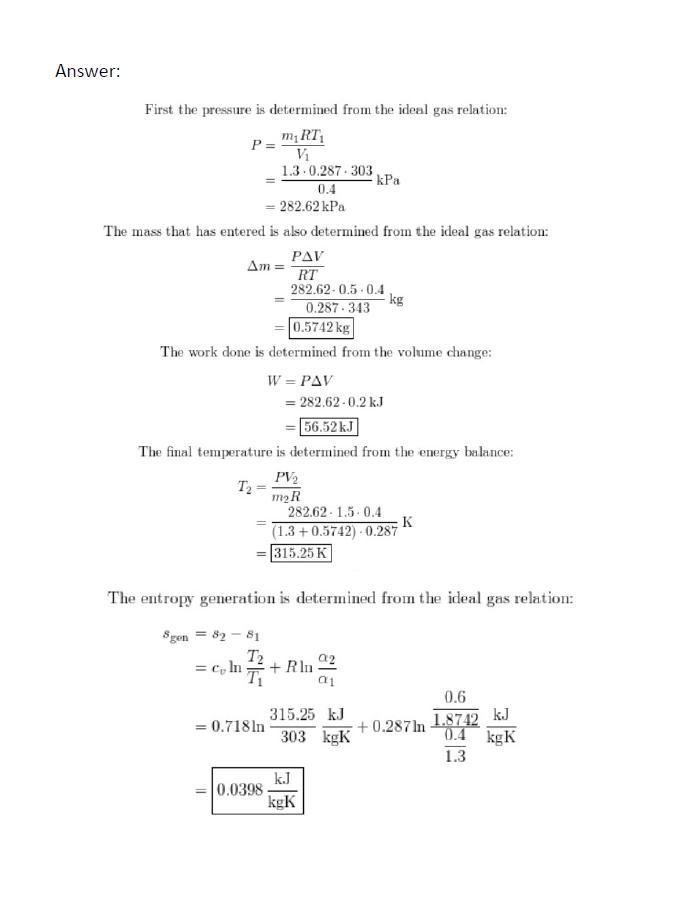
A 0.40-m3 insulated piston-cylinder device initially contains 1.3 kg of air at 30°C. At this state, the piston is free to move.

Now air at 500 kPa and 70°C is allowed to enter the cylinder from a supply line until the volume increases by 50%. Using constant specific heats at room temperature, determine (a) the final temperature, (b) the amount of mass that has entered, and (d) the work done; and (d) entropy generation

Engineering
1 answer:
Setler79 [48]2 years ago
6 0

Answer:

(a) The Final Temperature is 315.25 K.

(b) The amount of mass that has entered  0.5742 Kg.

(c) The work done is 56.52 kJ.

(d) The entrophy generation is 0.0398 kJ/kgK.

Explanation:

Explanation is in the following attachments.

You might be interested in
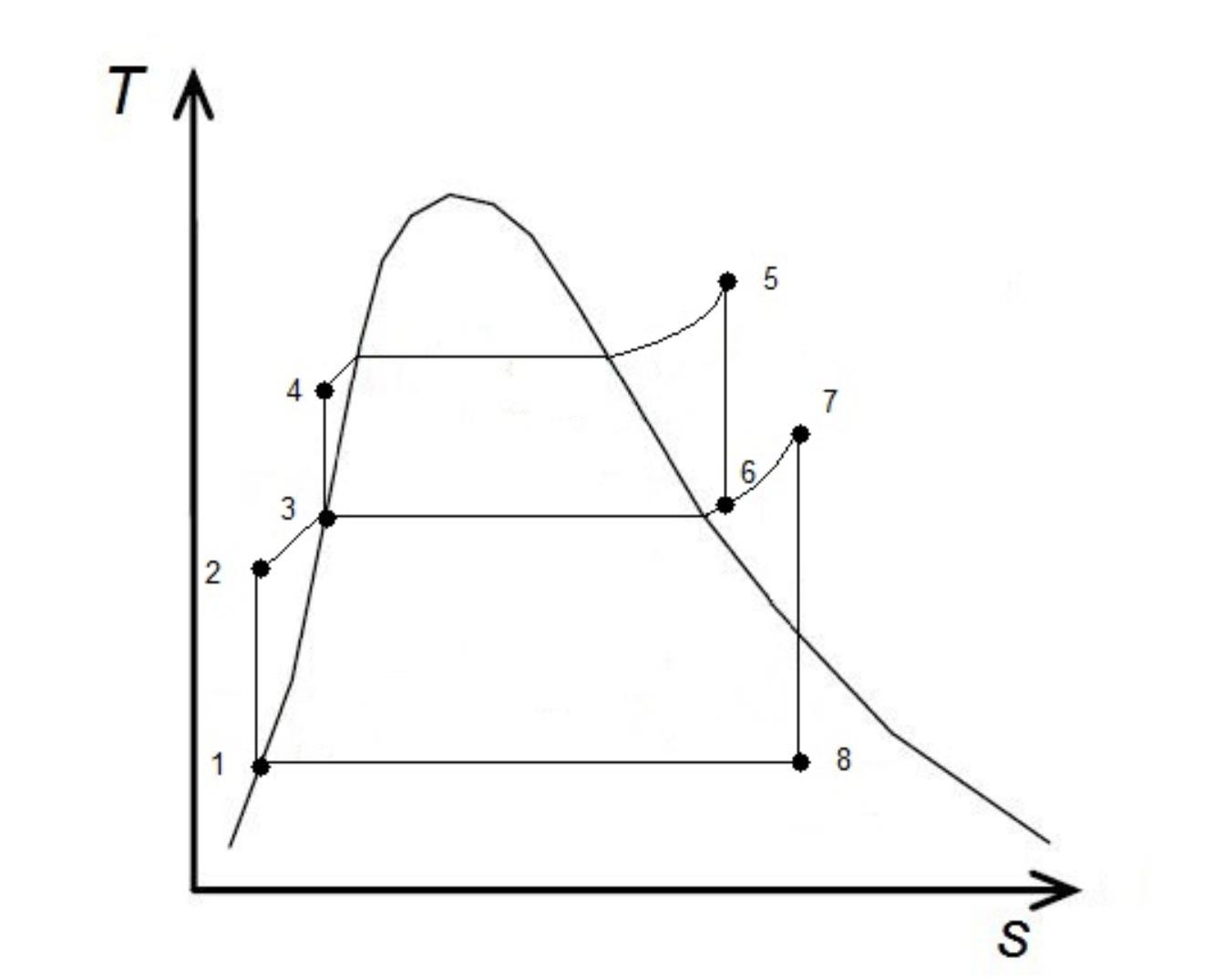
A steam power plant operates on an ideal reheat- regenerative Rankine cycle and has a net power output of 80 MW. Steam enters th
trasher [3.6K]

Answer:

flow(m) = 54.45 kg/s

thermal efficiency u = 44.48%

Explanation:

Given:

- P_1 = P_8 = 10 KPa

- P_2 = P_3 = P_6 = P_7 = 800 KPa

- P_4 = P_5 = 10,000 KPa

- T_5 = 550 C

- T_7 = 500 C

- Power Output P = 80 MW

Find:

-  The mass flow rate of steam through the boiler

-  The thermal efficiency of the cycle.

Solution:

State 1:

P_1 = 10 KPa , saturated liquid

h_1 = 192 KJ/kg

v_1 = 0.00101 m^3 / kg

State 2:

P_2 = 800 KPa , constant volume process work done:

h_2 = h_1 + v_1 * ( P_2 - P_1)

h_2 = 192 + 0.00101*(790) = 192.80 KJ/kg

State 3:

P_3 = 800 KPa , saturated liquid

h_3 = 721 KJ/kg

v_3 = 0.00111 m^3 / kg

State 4:

P_4 = 10,000 KPa , constant volume process work done:

h_4 = h_3 + v_3 * ( P_4 - P_3)

h_4 = 721 + 0.00111*(9200) = 731.21 KJ/kg

State 5:

P_5 = 10,000 KPa , T_5 = 550 C

h_5 = 3500 KJ/kg

s_5 = 6.760 KJ/kgK

State 6:

P_6 = 800 KPa , s_5 = s_6 = 6.760 KJ/kgK

h_6 = 2810 KJ/kg

State 7:

P_7 = 800 KPa , T_7 = 500 C

h_7 = 3480 KJ/kg

s_7 = 7.870 KJ/kgK

State 8:

P_8 = 10 KPa , s_8 = s_7 = 7.870 KJ/kgK

h_8 = 2490 KJ/kg

- Fraction of steam y = flow(m_6 / m_3).

- Use energy balance of steam bleed and cold feed-water:

                                        E_6 + E_2 = E_3

               flow(m_6)*h_6 + flow(m_2)*h_3 = flow(m_3)*h_3

                                    y*h_6 + (1-y)*h_3 = h_3

                                  y*2810 + (1-y)*192.8 = 721

Compute y:                          y = 0.2018

- Heat produced by the boiler q_b:

                             q_b = h_5 - h_4 +(1-y)*(h_7 - h_8)

                    q_b = 3500 -731.21 + ( 1 - 0.2018)*(3480 - 2810)

Compute q_b:               q_b = 3303.58 KJ/ kg

-Heat dissipated by the condenser q_c:

                                       q_c = (1-y)*(h_8 - h_1)

                                 q_c= ( 1 + 0.2018)*(2810 - 192)

Compute q_c:               q_c = 1834.26 KJ/ kg

- Net power output w_net:

                                     w_net = q_b - q_c

                                w_net = 3303.58 - 1834.26

                                    w_net = 1469.32 KJ/kg

- Given out put P = 80,000 KW

                                     flow(m) = P / w_net

compute flow(m)          flow(m) = 80,000 /1469.32 = 54.45 kg/s

- Thermal efficiency u:

                                     u = 1 - (q_c / q_b)

                                     u = 1 - (1834.26/3303.58)

                                     u = 44.48 %
5 0
2 years ago
49. A solenoid coil with a resistance of 30 ohms and an inductance of 200 milli-henrys, is connected to a 230VAC, 50Hz supply. D
Leya [2.2K]

Answer:

69.59 ohms

Explanation:

Given that

L=200\ mH

F=50\ hZ

R=30\ ohms

For inductance

X_L=2\times \pi\times f \times LX_L\\=2\times \pi \times 50\times 200\times 10^{-3}\\=62.8\ ohm

R=30\ ohmsImpedance\\Z=\sqrt{R^2+X_L^2}\\Z=\sqrt{30^2+62.8^2}\ ohms\\Z =69.59\ ohms

8 0
2 years ago
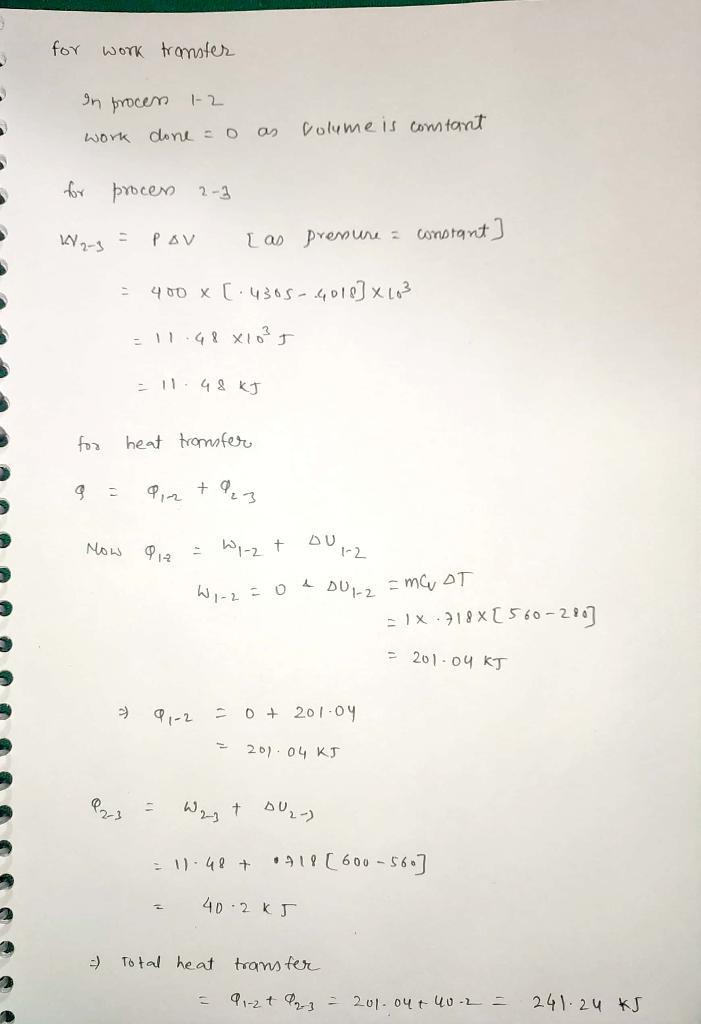
Air in tankBis at 200 kPa, 280 K and mass 1 kg. It is connected to an empty piston/cylinder with a float pressure of 400 kPa sim
Romashka [77]

Answer:

Explanation: see attachment

7 0
2 years ago
three balls each have a mass m if a has a speed v just before a direct collision with B determine the speed of C after collision
ratelena [41]

Answer:

Vc2= V(l+e) ^2/4

Vg2= V(l-e^2)/4

Explanation:

Conservation momentum, when ball A strikes Ball B

Where,

M= Mass

V= Velocity

Ma(VA)1+ Mg(Vg)2= Ma(Va)2+ Ma(Vg)2

MV + 0= MVg2

Coefficient of restitution =

e= (Vg)2- (Va)2/(Va)1- (Vg)1

e= (Vg)2- (Va)2/ V-0

Solving equation 1 and 2 yield

(Va)2= V(l-e) /2

(Vg)2= V(l+e)/2

Conservative momentum when ball b strikes c

Mg(Vg)2+Mc(Vc)1 = Mg(Vg)3+Mc(Vc)2

=> M[V(l+e) /2] + 0 = M(Vg)3 + M(Vc) 2

Coefficient of Restitution,

e= (Vc)2 - (Vg)2/(Vg)2- (Vc)1

=> e= (Vc)2 - (Vg)2/V(l+e) /2

Solving equation 3 and 4,

Vc2= V(l+e) ^2/4

Vg2= V(l-e^2)/4

8 0
2 years ago
Read 2 more answers
A three-phase line has an impedance of 0.4 j2.7 ohms per phase. The line feeds two balanced three-phase loads that are connected
Viktor [21]

Answer:

a. The magnitude of the line source voltage is

Vs = 4160 V

b. Total real and reactive power loss in the line is

Ploss = 12 kW

Qloss = j81 kvar

Sloss = 12 + j81 kVA

c. Real power and reactive power supplied at the sending end of the line

Ss = 540.046 + j476.95 kVA

Ps = 540.046 kW

Qs = j476.95 kvar

Explanation:

a. The magnitude of the line voltage at the source end of the line.

The voltage at the source end of the line is given by

Vs = Vload + (Total current×Zline)

Complex power of first load:

S₁ = 560.1 < cos⁻¹(0.707)

S₁ = 560.1 < 45° kVA

Complex power of second load:

S₂ = P₂×1 (unity power factor)

S₂ = 132×1

S₂ = 132 kVA

S₂ = 132 < cos⁻¹(1)

S₂ = 132 < 0° kVA

Total Complex power of load is

S = S₁ + S₂

S = 560.1 < 45° + 132 < 0°

S = 660 < 36.87° kVA

Total current is

I = S*/(3×Vload)   ( * represents conjugate)

The phase voltage of load is

Vload = 3810.5/√3

Vload = 2200 V

I = 660 < -36.87°/(3×2200)

I = 100 < -36.87° A

The phase source voltage is

Vs = Vload + (Total current×Zline)

Vs = 2200 + (100 < -36.87°)×(0.4 + j2.7)

Vs = 2401.7 < 4.58° V

The magnitude of the line source voltage is

Vs = 2401.7×√3

Vs = 4160 V

b. Total real and reactive power loss in the line.

The 3-phase real power loss is given by

Ploss = 3×R×I²

Where R is the resistance of the line.

Ploss = 3×0.4×100²

Ploss = 12000 W

Ploss = 12 kW

The 3-phase reactive power loss is given by

Qloss = 3×X×I²

Where X is the reactance of the line.

Qloss = 3×j2.7×100²

Qloss = j81000 var

Qloss = j81 kvar

Sloss = Ploss + Qloss

Sloss = 12 + j81 kVA

c. Real power and reactive power supplied at the sending end of the line

The complex power at sending end of the line is

Ss = 3×Vs×I*

Ss = 3×(2401.7 < 4.58)×(100 < 36.87°)

Ss = 540.046 + j476.95 kVA

So the sending end real power is

Ps = 540.046 kW

So the sending end reactive power is

Qs = j476.95 kvar

7 0
2 years ago
Other questions:
  • A 1020 CD steel shaft is to transmit 15 kW while rotating at 1750 rpm. Determine the minimum diameter for the shaft to provide a
    10·1 answer
  • Some states have osha programs, but you should always defer to the federal program.
    8·2 answers
  • 5 kg of steam contained within a piston-cylinder assembly undergoes an expansion from state 1, where the specific internal energ
    7·1 answer
  • Current density is given in cylindrical coordinates as J = −106z1.5az A/m2 in the region 0 ≤ rho ≤ 20 µm; for rho ≥ 20 µm, J = 0
    13·1 answer
  • Sea water with a density of 1025 kg/m3 flows steadily through a pump at 0.21 m3 /s. The pump inlet is 0.25 m in diameter. At the
    8·1 answer
  • A dc shunt generator rated at 85 kW produces a voltage of 280 V. The brush voltage drop is 2.5 V, and the armature and field res
    6·1 answer
  • Select the level of education that is best demonstrated in each example.
    10·2 answers
  • Complete the following sentence.
    5·1 answer
  • What should always be done before beginning any diagnosis?
    9·1 answer
  • 1. A _____ is applied to a wall or roof rafters to add strength and keep the building straight and plumb.
    9·1 answer
Add answer
Login
Not registered? Fast signup
Signup
Login Signup
Ask question!